Earth's highest known microbial systems fueled by volcanic gases
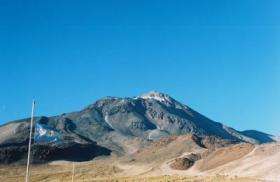
Gases rising from deep within the Earth are fueling the world's highest-known microbial ecosystems, which have been detected near the rim of the 19,850-foot-high Socompa volcano in the Andes by a University of Colorado at Boulder research team.
The new study shows the emission of water, carbon dioxide and methane from small volcanic vents near the summit of Socompa sustains complex microbial ecosystems new to science in the barren, sky-high landscape, said CU-Boulder Professor Steve Schmidt. He likened the physical environment of the Socompa volcano summit -- including the thin atmosphere, intense ultraviolet radiation and harsh climate -- to the physical characteristics of Mars, where the hunt for microbial life is under way by NASA.
The microbial communities atop Socompa -- which straddles Argentina and Chile high in the Atacama Desert -- are in a more extreme environment and not as well understood as microbes living in hydrothermal vents in deep oceans, he said. The Socompa microbial communities are located adjacent to several patches of green, carpet-like plant communities -- primarily mosses and liverworts -- discovered in the 1980s by Stephan Halloy of Conservation International in La Paz, Bolivia, a co-author on the new CU-Boulder study.
"These sites are unique little oases in the vast, barren landscape of the Atacama Desert and are supported by gases from deep within the Earth," said Schmidt, a professor in the ecology and evolutionary biology department. "Scientists just haven't been looking for microorganisms at these elevations, and when we did we discovered some strange types found nowhere else on Earth."
A paper on the subject by Schmidt and his colleagues was published in the February 2009 issue of the journal Applied and Environmental Microbiology. Co-authors on the study included CU-Boulder's Elizabeth Costello and Sasha Reed, Preston Sowell of Boulder's Stratus Consulting Inc., and Halloy.
The team used a sophisticated technique that involves extracting DNA from the soil to pinpoint new groups of microbes, using polymerase chain reaction, or PCR, to amplify and identify them, providing a snapshot of the microbial diversity on Socompa.
The new paper is based on an ongoing analysis of soil samples collected during an expedition to Socompa several years ago. The research team also reported a new variety of microscopic mite in the bacterial colonies near Socompa's rim, which appears to be the highest elevation that mites have ever been recorded on Earth, Schmidt said.
Costello, a research associate in CU-Boulder's chemistry and biochemistry department, said small amounts of sunlight, water, methane and CO2 work in concert in the barren soils to fuel microbial life near the small volcanic vents, or fumaroles. Such conditions "relieve the stress" on the high-elevation, arid soils enough to allow extreme life to get a toehold, Costello said. "It's as if these bacterial communities are living in tiny, volcanic greenhouses."
The CU-Boulder team also discovered unique colonies of bacteria living on the slopes of Socompa in extremely dry soils not associated with fumaroles. The bacteria detected in such dry soils may be transient life transported and deposited by wind in the extreme environment of Socompa, with some organisms surviving to bloom during periodic pulses of water and nutrients, said Schmidt.
"These sites are significantly less diverse," said Costello. "But the thing that really stands out is just how tough these microbes are and how little it takes for them to become established."
Schmidt, who likened the high Andes to the harsh Dry Valleys of Antarctica under study by researchers from NASA's Astrobiology Institute because of their hostile, arid conditions, said the new research also provides information on how the cold regions of Earth function and how they may respond to future climate change. Research in such extreme environments could lead to the discovery of new antibiotics and other products.
A return expedition to Socompa in February 2009 by Schmidt included a Chilean scientist, an Argentinean microbiologist, a Boulder spectral-imaging expert and an Argentinean archaeologist. There is archaeological evidence that ancient Incans once roamed over Socompa, and the remains of three, 500-year-old mummified Inca children were discovered in 1999 atop the nearby Llullaillaco volcano, apparent sacrifice victims.
Although reaching the summit of Socompa requires two days in a four-wheel drive vehicle and two more days of hiking, recent footpaths near the summit apparently made by adventurers may have damaged some of the mat-like plant communities, Costello said.
Source: University of Colorado at Boulder


