Researchers discover a potential on-off switch for nanoelectronics
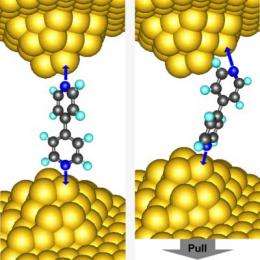
As electronic circuits shrink from finely etched lines in silicon wafers to nearly elusive proportions, researchers at the U.S. Department of Energy's Lawrence Berkeley National Laboratory and Columbia University are studying how electrons flow through a molecular junction—a nanometer scale circuit element that contacts gold atoms with a single molecule. Their findings reveal the electrical resistance through this junction can be turned 'on' and 'off' simply by pushing and pulling the junction—a feature that could be used as a switch in nanoscale electronic devices.
"To design circuit elements at the molecular scale, we need to understand how the intrinsic properties of a molecule or junction are actually connected to its measured resistance," said Jeff Neaton, Facility Director of the Theory of Nanostructured Materials Facility in the Molecular Foundry, a U.S. Department of Energy User Facility located at Berkeley Lab that provides support to nanoscience researchers around the world. "Knowing where each and every atom is in a single-molecule junction is simply beyond what's possible with experiments at this stage. For these sub-nanometer scale junctions—just a handful of atoms—theory can be valuable in helping interpret and understand resistance measurements."
In traditional electronic devices, charge-carrying electrons diffuse through circuits in a well-understood fashion, gaining or losing energy through transactions with impurities or other particles they encounter. Electrons at the nanoscale, however, can travel by a mechanism called quantum tunneling in which, due to the small length scales involved, it becomes possible for a particle to disappear through an energy barrier and suddenly appear on the other side, without expending energy. Tracking such 'tunneling' of electrons through individual molecules in nanoscale devices has proven difficult.
"For more than a decade, researchers have been 'wiring up' individual molecules and measuring their electrical conductance," said Neaton. "Forming reliable contacts between nanostructures and 'alligator clip' electrical leads is extremely challenging. This made experiments difficult to interpret, and as a result, reported conductance values—in experiment and theory—often varied by an order of magnitude or more. The time was ripe for a quantitative comparison between theory and an experiment with well-defined contacts."
Through the Molecular Foundry user program, Su Ying Quek, a postdoctoral researcher, worked with Neaton and Latha Venkataraman, an experimental researcher at Columbia University, using a scanning tunneling microscope (STM), which probes changes in current across a material's surface with a conductive gold tip. Previous work had shown a gold STM tip could be repeatedly be plunged into a gold surface containing a solution of molecules and retracted, until the contact area between the tip and gold surface reduces to a single strand, like a necklace. When this strand finally breaks, nearby molecules can hop into the gap between strands and contact the gold electrodes, resulting in a sudden change in conductance. Using this technique, Venkataraman and colleagues, including Mark Hybertsen at Brookhaven National Lab, had recently discovered that the conductance of molecules containing amines (a group of molecules related to ammonia) in contact with gold electrodes could be reliably measured.
"We now had a reproducible and consistent data set to benchmark our theory," said Quek. "Comparing with this data set, we discovered important electron correlation effects previously missing. When we added these, we found—for the first time—quantitative agreement with experimental results."
Using their new theoretical approach, Quek and Neaton, together with Hybertsen and collaborators Steven G. Louie of University of California Berkeley and Hyoung Joon Choi of Yonsei University in Korea, began to study the conductance of a junction between gold electrodes and bipyridine—a benzene-like ring molecule containing nitrogen. The experimental data showed two stable conductance states, unlike anything seen previously. Working closely with Venkataraman and collaborators, Quek hypothesized the peaks corresponded to two states with different structures within the junction. During the next year, Quek and Neaton meticulously constructed a theory that could describe the conductance of junctions arranged vertically between two gold molecules and sandwiched at angles.
The story that emerged was surprisingly detailed: if bipyridine bonded at an angle, more current could flow compared with when the bipyridine bonded vertically. This suggests the conductance of bipyridine was linked to the molecule's orientation in the junction, explained Quek. In the STM experiment, as you pull, just after the final strand of gold atoms breaks and snaps back, the vertical gap is not big enough for bipyridine, so it bonds at an angle. As the gap increases, the molecule jumps to a vertical configuration, causing the conductance to plummet abruptly. Eventually, the molecule straightens even more, and the contact breaks. "Once we determined this, we wondered, 'could you reverse this behavior?'" said Quek.
Teaming with Venkataraman and collaborators, Quek and Neaton demonstrated why pushing the junction to an angle and pulling it straight could repeatedly alter the conductance, creating a mechanical switch with well defined 'on' and 'off' states. "One of the fascinating things about this experiment is the degree to which it is possible to control the 'alligator clips'," said Neaton. "For this particular molecule, bipyridine, experiments can reproducibly and reliably alter these atomic-scale features back and forth to switch the conductance of the junction."
Quek and Neaton hope to refine and apply their theoretical framework to more complex molecular junctions for study of systems promising for solar energy conversion, such as organic photovoltaics.
"Understanding how electrons move through single-molecule junctions is the first step," said Neaton. "Organic-inorganic interfaces are everywhere in nanoscience, and developing a better picture of charge transport in hybrid materials systems will certainly lead to the discovery of new and improved electronic devices."
More information: "Mechanically-controlled binary conductance switching of a single-molecule junction," by Su Ying Quek, Maria Kamenetska, Michael L. Steigerwald, Hyoung Joon Choi, Steven G. Louie, Mark S. Hybertsen, J.B. Neaton and L. Venkataraman, appears in Nature Nanotechnology and is available in Nature Nanotechnology online.
Source: Lawrence Berkeley National Laboratory


