Misplaced metamorphosis: Researchers identify source of cells that spur aberrant bone growth
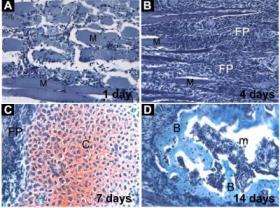
Researchers at the University of Pennsylvania School of Medicine and the University of Connecticut have pinpointed the source of immature cells that spur misplaced bone growth. Unexpectedly, the major repository of bone-forming cells originates in blood vessels deep within skeletal muscle and other connective tissues, not from muscle stem cells themselves. The work also shows that cells important in the inflammatory response to injury trigger skeleton-stimulating proteins to transform muscle tissue into bone.
Understanding this process has important implications for understanding the formation of bone not only in FOP, a rare disease in which patients' muscle cells literally metamorphose to bone, but also in many common disorders of misplaced bone growth such as that following head injury, athletic injury, and spinal cord injury. The findings were published this week in the Journal of Bone & Joint Surgery.
"We always knew that heterotopic, or misplaced, bone growth was supplied by a rich vasculature, but we never suspected that cells from the blood vessels, when triggered by cells from the immune system, could undergo a metamorphosis that becomes a second skeleton," says senior author Frederick S. Kaplan, M.D., Isaac & Rose Nassau Professor of Orthopaedic Molecular Medicine. "When these components interact pathologically, as in the rare disease FOP, devastating results occur. We want to fix that."
The researchers used genetically engineered mice with labeled immature, or progenitor, cells to trace specific cell lineages through the process of renegade bone formation, which is induced by skeleton-stimulating molecules called bone morphogenetic proteins (BMPs). The study has important implications for understanding the rare genetic disorder fibrodysplasia ossificans progressiva (FOP), a condition studied by the authors who care for most of the world's 700 patients with the condition.
In FOP, the body forms a second skeleton as a result of the transformation of normal muscle tissue into normal bone. That change is caused by a mutant gene that encodes a receptor, or switch, for BMPs and was discovered by the Penn scientists in April 2006. In 2007, the Penn group identified the seminal role of inflammation in the metamorphosis, indicting the immune system as a critical trigger in the aberrant bone-forming process.
The current study links the inflammatory response to injury with the responding blood-vessel cells that, in part, orchestrate the switch from muscle to bone. The interaction of blood-vessel cells with immune cells appears to trigger bone formation when the BMP switch is damaged or overactive. While the cells identified from blood-vessel linings in this study are a major contributor to the aberrant bone growth, the researchers say they account for only half of the cells important in the process, suggesting that other critical pools of cells are yet to be identified.
"BMPs regulate a great number of essential physiological processes," comments co-corresponding author David J. Goldhamer, Ph.D., Associate Professor, The Center for Regenerative Biology at the University of Connecticut. "For this reason, development of therapies for misplaced bone growth that specifically target offending progenitor cell populations is of primary importance in order to minimize collateral effects. Identification of progenitor cells directly involved in heterotopic bone formation is a critical first step toward this goal."
By identifying the interaction of key cellular and molecular elements in the transformation of muscle to bone, the study points the way to designing more effective treatments for undesirable heterotopic bone formation as well as for engineering new bone where it is desperately needed, such as in congenital malformations, fractures, spinal fusions, and bone loss from tumors.
Source: University of Pennsylvania School of Medicine


