Build your own space station
March 3, 2009 Build your own space station

Enlarge

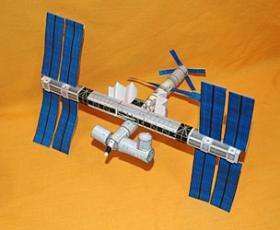
The paper model of the International Space Station (ISS) available in the latest editions of CSIRO's Scientriffic and The Helix magazines. Image credit - Jasmine Leong, CSIRO

(PhysOrg.com) -- CSIRO's Double Helix Science Club has produced a paper model of the International Space Station (ISS) - the first designed just for children.

The ISS model is part of the special space-themed issues of Scientriffic and The Helix magazines designed to celebrate the International Year of Astronomy. The issues also feature a poster of the solar system, great space images, researcher interviews, a board game, observable universe poster, star chart, hands-on activities and more.

The ISS, the largest and most complicated spacecraft ever built, is being constructed by about 100,000 people representing hundreds of companies, and 16 nations spread over four continents.

The space station’s major purpose is to provide a permanent orbiting facility where world-class research can be conducted in the microgravity environment of space.

CSIRO’s Dr Michael Fenech is leading a team of scientists to help NASA study the effects of high radiation exposure on human DNA. They are also looking at ways diet can help to minimise the effects of high radiation.

Space radiation is one of the main health hazards of spaceflight. It is dangerous because it has sufficient energy to change or break DNA molecules, which can damage or kill a cell.

This research is important to life on Earth because of the similarities between the effects of radiation exposure and the ageing process. Research onboard the ISS into the ‘accelerated ageing’ process is enabling scientists to study how people age over a compressed period of time.

CSIRO is also helping to develop better ways to identify people who are particularly vulnerable to the damaging effects of cosmic radiation.

This will be particularly important for future space missions which could be compromised if astronauts are prone to the genetic harm caused by cosmic radiation exposure.

The research could also lead to ways of identifying astronauts who are genetically resistant to radiation exposure.

To join CSIRO’s Double Helix Science Club and receive Scientriffic and The Helix visit; http://www.csiro.au/helix .

The model and instructions on how to build the ISS are available at: http://www.csiro.au/iss .

Provided by Cisco


print this article email this article download pdf blog this article bookmark this article     Stumble it Digg this share on Facebook retweet share on Reddit add to delicious
Rate this story - 3.7 /5 (3 votes)


March 3, 2009 all stories

Comments: 0

3.7 /5 (3 votes)
  • Stumble this up

  • Digg this

  • share this

  • hide
  • Related Stories

  • Into the eye of the helix
    created Feb 25, 2009 | popularity not rated yet | comments 0
  • New Method Offers Insight into Radiation Damage to DNA
    created Mar 21, 2008 | popularity not rated yet | comments 0
  • Where broken DNA is repaired
    created Aug 03, 2007 | popularity not rated yet | comments 0
  • Comets Clash at Heart of Helix Nebula
    created Feb 12, 2007 | popularity not rated yet | comments 0
  • New Look At DNA Hints At Origin Of Ultraviolet Damage
    created Aug 25, 2005 | popularity not rated yet | comments 0


  • hide
  • Relevant PhysicsForums posts

  • Some help with a X-Ray astronomy question please!
    created 13 hours ago
  • Help with Images and Optical Instrument Question..
    created Nov 26, 2009
  • Redshift as a distance indicator
    created Nov 26, 2009
  • Question about 2-body gravity
    created Nov 24, 2009
  • More from Physics Forums - General Astronomy

Other News

Fermi Telescope Peers Deep into Microquasar

Fermi Telescope Peers Deep into Microquasar (w/ Video)

Space & Earth / Astronomy

created 6 hours ago | popularity 4.3 / 5 (3) | comments 0

(PhysOrg.com) -- NASA's Fermi Gamma-ray Space Telescope has made the first unambiguous detection of high-energy gamma-rays from an enigmatic binary system known as Cygnus X-3. The system pairs a hot, massive ...


The Energy Sources of Ultraluminous Galaxies

The Energy Sources of Ultraluminous Galaxies

Space & Earth / Astronomy

created 7 hours ago | popularity 4.3 / 5 (7) | comments 0

(PhysOrg.com) -- Ultraluminous infrared galaxies ((ULIRGs) are galaxies whose luminosity exceeds that of a trillion suns; for comparison, the Milky Way galaxy has a typical (and much more modest) luminosity ...


Space shuttle Atlantis, 7 astronauts back on Earth (AP)

Space shuttle Atlantis, 7 astronauts back on Earth

Space & Earth / Space Exploration

created 8 hours ago | popularity not rated yet | comments 0

(AP) -- Space shuttle Atlantis and its seven astronauts returned to Earth with a smooth touchdown Friday to end an 11-day flight that resupplied the International Space Station.


Herschel takes a peek at the ingredients of the galaxies

Herschel takes a peek at the ingredients of the galaxies

Space & Earth / Astronomy

created 5 hours ago | popularity 5 / 5 (1) | comments 0

(PhysOrg.com) -- The European Space Agency has today released spectacular new observations from the Herschel Space Observatory, including the UK-led SPIRE instrument. Spectrometers on board all three Hershel ...


China is set to launch its second moon orbiter next October, state media have reported

China to launch second lunar probe: state media

Space & Earth / Space Exploration

created 12 hours ago | popularity 5 / 5 (3) | comments 0

China will launch its second moon orbiter next October, state media reported Friday, as it powers ahead with a space programme that has sparked concerns abroad.