New protein identified in bacterial arsenal
March 3, 2009 New protein identified in bacterial arsenal

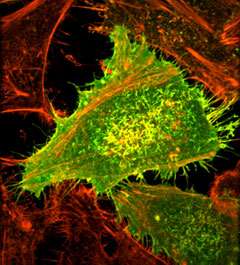
Top feeder. Ubiquitin ligase proteins (green), produced by Salmonella bacteria, are drawn to the surface of the host cells that they infect, near structures called microvilli (red) that help the cells absorb nutrients, among other things.

(PhysOrg.com) -- Nearly a billion years ago, bacteria evolved an insidious means of infecting their hosts — a syringe-like mechanism able to inject cells with stealthy hijacker molecules. These molecules, called virulence factors, play a sophisticated game of mimicry, imitating many of the cells’ normal activities but ultimately co-opting them to serve the bacteria’s needs. Now researchers at The Rockefeller University have identified a new class of these coup artists that appear to take over a key process that regulates a wide range of cellular duties, from cell-cycle progression to cell death, even communication between cells.

Scientists in C. Erec Stebbins’s Laboratory of Structural Microbiology have discovered the crystal structure of virulence factor SspH2, which is deployed by Salmonella, a mean strain of bacteria that can cause food poisoning, typhoid fever and septicemia. With colleagues at Yale University, they performed a series of biochemical experiments to show that SspH2 is an enzyme that links two molecules together, called a ligase. Specifically, it is involved in the targeting of a widespread regulatory molecule called ubiquitin to other proteins. Ubiquitin’s most common function is to label proteins for degradation in a process called ubiquitination.

“It’s a totally new ubiquitin ligase from a bacterial pathogen going in and messing around with human cell chemistry,” says Stebbins. “It’s a good example of the amazing ways bacteria have found to play around with our biochemistry for its own purposes.”

The structure, derived from the pattern of light bouncing off of a crystallized form of SspH2, reveals the identity and position of every atom in the virulence factor. It shows that it has two primary arms: One is a known structure that recruits other proteins, but the second had never been seen before. The Stebbins team named it NEL for Novel E3 Ligase. The two arms conceal a key amino acid — cysteine — required to bind to ubiquitin. In test-tube experiments, Stebbins and colleagues showed that in order to capture the ubiquitin, one arm must swing apart to expose the cysteine, and moreover, it must do so in a selective fashion. They generated a version of the molecule effectively locked in its open state and found that it was toxic to the cells it invaded.

The process of attaching ubiquitin to targeted proteins — ubiquitination — is very common in the cells of complex organisms and involves three different types of molecules such as SspH2. Molecules known as E1 capture the ubiquitin and hand it off to E2 molecules. E3 molecules then bring the E2 and its ubiquitin to attach to specific proteins. Stebbins and colleagues determined that SspH2 is a new member of this third family and that it targets proteins on top of cell membranes, but exactly which ones remain to be seen.

“When we find that out, we’ll know exactly what this ubiquitin ligase is doing,” Stebbins says. The findings are published this week in the Proceedings of the National Academy of Sciences.

More information: Proceedings of the National Academy of Sciences online, A family of Salmonella virulence factors functions as a distinct class of E3 ubiquitin ligases, Cindy M. Quezada, Stuart W. Hicks, Jorge E. Galán and C. Erec Stebbins

Provided by Rockefeller University


print this article email this article download pdf blog this article bookmark this article     Stumble it Digg this share on Facebook retweet share on Reddit add to delicious
Rate this story - 5 /5 (1 vote)


March 3, 2009 all stories

Comments: 0

5 /5 (1 vote)
  • Stumble this up

  • Digg this

  • share this

  • hide
  • Related Stories

  • Researchers discover key to vital DNA, protein interaction
    created Nov 09, 2009 | popularity not rated yet | comments 0
  • Researchers to develop novel drug detection technology using software that acts like a robotic scientist
    created Nov 09, 2009 | popularity not rated yet | comments 0
  • Nano bubble gum for enhancing drug delivery in gut
    created Nov 09, 2009 | popularity not rated yet | comments 0
  • Drought resistance explained
    created Nov 09, 2009 | popularity not rated yet | comments 0
  • 1930s drug slows tumor growth
    created Nov 06, 2009 | popularity not rated yet | comments 0


  • hide
  • Relevant PhysicsForums posts

  • DIY paraffin wax log for fire.
    created 9 hours ago
  • Electron Screening
    created 12 hours ago
  • Silver drove me crazy
    created 17 hours ago
  • Phosphate buffer calculation help
    created Nov 09, 2009
  • More from Physics Forums - Chemistry

Other News

Telling an old book by its smell: Aroma hints at ways of preserving treasured documents

Telling an old book by its smell: Aroma hints at ways of preserving treasured documents

Chemistry / Analytical Chemistry

created 19 hours ago | popularity not rated yet | comments 0

Scientists may not be able to tell a good book by its cover, but they now can tell the condition of an old book by its odor. In a report published in the American Chemical Society's Analytical Chemistry they d ...


H1N1 Virus Can Be Killed by Acidic Ozone Water

H1N1 Virus Can Be Killed by Acidic Ozone Water

Chemistry / Biochemistry

created Nov 09, 2009 | popularity 4.8 / 5 (22) | comments 10

(PhysOrg.com) -- Scientists have found that acidic ozone water can deactivate H1N1 viruses very effectively, offering a promising disinfectant for the millions of people trying to avoid the disease. Acidic ...


Toward home-brewed electricity with 'personalized solar energy'

Toward home-brewed electricity with 'personalized solar energy'

Chemistry / Materials Science

created Nov 04, 2009 | popularity 3.4 / 5 (9) | comments 5

New scientific discoveries are moving society toward the era of "personalized solar energy," in which the focus of electricity production shifts from huge central generating stations to individuals in their ...


New imagining technique could lead to better antibiotics and cancer drugs

Chemistry / Biochemistry

created Nov 09, 2009 | popularity 5 / 5 (4) | comments 0

A recently devised method of imaging the chemical communication and warfare between microorganisms could lead to new antibiotics, antifungal, antiviral and anti-cancer drugs, said a Texas AgriLife Research scientist.


Wet ethanol production process yields more ethanol and more co-products

Chemistry / Biochemistry

created Nov 09, 2009 | popularity 1 / 5 (1) | comments 1

Using a wet ethanol production method that begins by soaking corn kernels rather than grinding them, results in more gallons of ethanol and more usable co-products, giving ethanol producers a bigger bang for their buck - ...