Saturn has small moon hidden in ring
March 3, 2009
Tiny Moonlet Within G Ring Arc

Enlarge

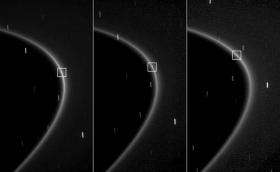
This sequence of three images, obtained by NASA's Cassini spacecraft over the course of about 10 minutes, shows the path of a newly found moonlet in a bright arc of Saturn's faint G ring. Image credit: NASA/JPL/Space Science Institute

(PhysOrg.com) -- NASA's Cassini spacecraft has found within Saturn's G ring an embedded moonlet that appears as a faint, moving pinprick of light. Scientists believe it is a main source of the G ring and its single ring arc.

Cassini imaging scientists analyzing images acquired over the course of about 600 days found the tiny moonlet, half a kilometer (about a third of a mile) across, embedded within a partial ring, or ring arc, previously found by Cassini in Saturn’s tenuous G ring.

The finding is being announced today in an International Astronomical Union circular.

“Before Cassini, the G ring was the only dusty ring that was not clearly associated with a known moon, which made it odd,” said Matthew Hedman, a Cassini imaging team associate at Cornell University in Ithaca, N.Y. “The discovery of this moonlet, together with other Cassini data, should help us make sense of this previously mysterious ring.”

Saturn’s rings were named in the order they were discovered. Working outward they are: D, C, B, A, F, G and E. The G ring is one of the outer diffuse rings. Within the faint G ring there is a relatively bright and narrow, 250-kilometer-wide (150-miles) arc of ring material, which extends 150,000 kilometers (90,000 miles), or one-sixth of the way around the ring’s circumference. The moonlet moves within this ring arc. Previous Cassini plasma and dust measurements indicated that this partial ring may be produced from relatively large, icy particles embedded within the arc, such as this moonlet.

Scientists imaged the moonlet on Aug. 15, 2008, and then they confirmed its presence by finding it in two earlier images. They have since seen the moonlet on multiple occasions, most recently on Feb. 20, 2009. The moonlet is too small to be resolved by Cassini’s cameras, so its size cannot be measured directly. However, Cassini scientists estimated the moonlet’s size by comparing its brightness to another small Saturnian moon, Pallene.

Hedman and his collaborators also have found that the moonlet’s orbit is being disturbed by the larger, nearby moon Mimas, which is responsible for keeping the ring arc together.

This brings the number of Saturnian ring arcs with embedded moonlets found by Cassini to three. The new moonlet may not be alone in the G ring arc. Previous measurements with other Cassini instruments implied the existence of a population of particles, possibly ranging in size from 1 to 100 meters (about three to several hundred feet) across. “Meteoroid impacts into, and collisions among, these bodies and the moonlet could liberate dust to form the arc,” said Hedman.

Carl Murray, a Cassini imaging team member and professor at Queen Mary, University of London, said, "The moon's discovery and the disturbance of its trajectory by the neighboring moon Mimas highlight the close association between moons and rings that we see throughout the Saturn system. Hopefully, we will learn in the future more about how such arcs form and interact with their parent bodies."

Early next year, Cassini’s camera will take a closer look at the arc and the moonlet. The Cassini Equinox mission, an extension of the original four-year mission, is expected to continue until fall of 2010.

Provided by NASA

4.8 /5 (5 votes)  

Rank 4.8 /5 (5 votes)
Relevant PhysicsForums posts
  • Titan's lack of impact craters
    createdFeb 09, 2012
  • Real pictures of black hole eating a star?
    createdFeb 08, 2012
  • Hypothetical way to travel faster than light, but not technically exceed lightspeed
    createdFeb 06, 2012
  • How do scientists monitor the Sun's activity?
    createdFeb 05, 2012
  • Search patterns in observational studies
    createdFeb 05, 2012
  • Derivation of Pogson's law
    createdFeb 03, 2012
  • More from Physics Forums - General Astronomy

More news stories

Humans may have helped the decline of African rainforests 3000 years ago

(PhysOrg.com) -- Large areas of rainforests in Central Africa mysteriously disappeared over three thousand years ago, to be replaced by savannas. The prevailing theory has been that the cause was a change ...

Space & Earth / Environment

created 10 hours ago | popularity 5 / 5 (3) | comments 9 | with audio podcast report

Could Venus be shifting gear?

(PhysOrg.com) -- ESA’s Venus Express spacecraft has discovered that our cloud-covered neighbour spins a little slower than previously measured. Peering through the dense atmosphere in the infrared, the ...

Space & Earth / Space Exploration

created 6 hours ago | popularity 5 / 5 (5) | comments 7 | with audio podcast

Mars Science Laboratory computer issue resolved

(PhysOrg.com) -- Engineers have found the root cause of a computer reset that occurred two months ago on NASA's Mars Science Laboratory and have determined how to correct it.

Space & Earth / Space Exploration

created 7 hours ago | popularity 5 / 5 (5) | comments 3 | with audio podcast

Clam fields found at deep, low-temperature Mariana vents

(PhysOrg.com) -- Scientists have marveled at the unusual life forms thriving at high temperature hydrothermal vents of the deep ocean.

Space & Earth / Earth Sciences

created 6 hours ago | popularity not rated yet | comments 0 | with audio podcast

Two new moons for Jupiter

Advances in technology have lead to the discovery of new planets outside of our Solar System, and now even new moons in our own backyard.

Space & Earth / Space Exploration

created 6 hours ago | popularity not rated yet | comments 3


Human cognitive performance suffers following natural disasters, researchers find

Not surprisingly, victims of a natural disaster can experience stress and anxiety, but a new study indicates that it might also cause them to make more errors - some serious - in their daily lives. In their upcoming Human Fa ...

The power of estrogen -- male snakes attract other males

A new study has shown that boosting the estrogen levels of male garter snakes causes them to secrete the same pheromones that females use to attract suitors, and turned the males into just about the sexiest ...

New error-correcting codes guarantee the fastest possible rate of data transmission

Error-correcting codes are one of the triumphs of the digital age. They’re a way of encoding information so that it can be transmitted across a communication channel — such as an optical fiber o ...

Putting the squeeze on planets outside our solar system

(PhysOrg.com) -- Using high-powered lasers, scientists at Lawrence Livermore National Laboratory and collaborators discovered that molten magnesium silicate undergoes a phase change in the liquid state, abruptly ...

Both maternal and paternal age linked to autism

Older maternal and paternal age are jointly associated with having a child with autism, according to a recently published study led by researchers at The University of Texas Health Science Center at Houston (UTHealth).

Curry spice component may help slow prostate tumor growth

Curcumin, an active component of the Indian curry spice turmeric, may help slow down tumor growth in castration-resistant prostate cancer patients on androgen deprivation therapy (ADT), a study from researchers ...