New Instrument Could Detect Hidden Aviation Hazards
(PhysOrg.com) -- While radar and other existing systems typically warn aircraft pilots of potential weather hazards during flight, they do not detect all possible atmospheric dangers.
“Some hazards can be the most dangerous because pilots’ eyes and radar cannot see them,” said Gary Gimmestad, a principal research scientist in the Georgia Tech Research Institute (GTRI). “For instance, if a plane encounters turbulence or low visibility that does not include rain droplets, radar will not sense them.”
GTRI is leading a team of researchers from five universities and research organizations to investigate the feasibility of using an instrument - called a forward looking interferometer - to detect several of these invisible hazards during takeoff, cruise and landing. Project team members include researchers at Hampton University, the National Aeronautics and Space Administration’s Langley Research Center, the University Center for Atmospheric Research, the Air Force Institute of Technology and the University of Wisconsin-Madison.
Forward looking interferometers - passive infrared radiometers based on high-resolution Fourier transform spectrometry technologies - were originally developed for satellite remote sensing. They can detect the presence of the environmental hazards by identifying each hazard’s distinct infrared spectral signature. The instruments have been used to detect aerosols and gases in the air, but not from aircraft during flight.
With funding from NASA, the researchers are conducting studies to determine the sensitivity of the system for detecting clear-air turbulence, wake vortices, volcanic ash, low visibility, dry wind shear and icing. They are also developing algorithms to estimate the severity of the hazards.
A major concern for air navigation is clear-air turbulence because it cannot be seen and is therefore difficult for pilots to avoid. It results from the collision of bodies of air that are moving at very different speeds. Airliner crews and passengers have been injured when tossed around inside an aircraft cabin during extreme clear-air turbulence.
At airliner cruising altitude, clear-air turbulence is frequently encountered around jet streams or near mountain ranges. For this reason, the researchers conducted their first ground-based field test in Boulder, Colo., because they expected turbulence to be generated over the Rocky Mountains.
During the Boulder ground test in January 2008, the research team evaluated the feasibility of the infrared interferometer to detect clear-air turbulence at a useful distance from the sensor by measuring temperature fluctuations. They also evaluated the turbulence detection and hazard prediction algorithms they developed.
“The measured results corresponded well to the model predictions, and this result was interpreted as a successful detection of mountain waves with interferometric radiometry, which has never before been accomplished,” said Leanne West, project director and GTRI senior research scientist.
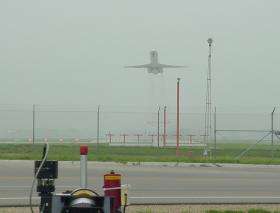
A second field test was conducted in Madison, Wis., in June 2008 to investigate the ability of the instrument to detect wake vortices. This tornado-like turbulence forms behind an aircraft as it passes through the air and can cause problems for any subsequent aircraft. Because of wake vortices, separation distances between aircraft takeoffs and landings are strictly regulated and can result in holding patterns and delays.
In Madison, the researchers wanted to verify that wake vortices had an observable signature in the high-resolution infrared radiance spectrum that would provide a means to detect, and perhaps image, wake vortices associated with takeoffs and landings.
The researchers were able to resolve what could potentially be a wake vortex about 80 seconds after a DC9 aircraft passed overhead. If this result can be verified, it would be the first detection of a wake vortex by spectral infrared radiometry, according to the researchers.
Another aviation hazard the research team is examining is volcanic ash, which caused a British Airways 747 to lose function in all four engines in 1982. More recently, volcanic ash caused Alaska Airlines to cancel 44 flights because it drifted into the flight paths.
“It’s catastrophic when you hit ash because it can lead to a loss of engine power,” explained West. “A cloud of volcanic ash moves quickly and alerts are intermittent so pilots sometimes do not have enough time to be alerted to the hazard in time to keep airplanes from flying into it.”
Dry wind shear is another weather hazard that cannot be detected by radar because it does not include rain drops. The researchers are examining whether temperature and humidity differences can point to dry wind shear.
The researchers are also investigating the ability of the forward-looking interferometer to detect ice on runways. Because asphalt, concrete, water, ice and snow have different spectral signatures, the researchers have been able to develop algorithms to determine the runway condition during an aircraft approach. This information would tell the pilot whether a safe landing was possible.
“The preliminary results from the field tests show that the imaging system is a promising technology to detect many, if not all, of the proposed external hazards,” noted West.
The combination of high spectral and temperature resolutions in the forward looking interferometer should enable sophisticated algorithms with high detection rates and low false alarm rates, according to West. The instrument will also function as an infrared imager, providing a real-time video display with night vision capability and enhanced vision in obscured conditions.
Further research will be completed to determine if the hazards can be detected with sufficient time-to-alarm for safe maneuvering to avoid the hazards.
“Once we get all of the ground-based field test data analyzed, our next step will be to collect data from the air to see if a forward looking interferometer will detect all of these hazards in-flight,” added West.
Provided by Georgia Institute of Technology


