Research examines how plants produce high-energy storage organs
(PhysOrg.com) -- Understanding how plants produce storage organs that humans use as food would be a valuable tool for science and for a hungry world.
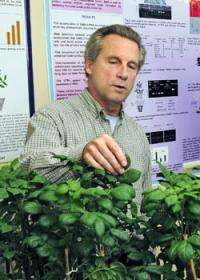
Iowa State University researcher David Hannapel, professor in horticulture, thinks he has found a key to figuring out the process.
Hannapel studies potatoes and the process that leads to tuber formation. Potatoes are the fourth most important food crop in the world.
Like other plants, potatoes collect sunlight in the leaves and turn that energy into sugars using carbon dioxide.
In potatoes, late in the growing season, the sugars in the leaves are delivered to underground stems during the process of making starch in the edible tubers.
"We've always known that there was a signal activated in the leaf that was sent down the plant to activate tuber formation," Hannapel said. "But the identity of that signal has never been confirmed."
Recent discoveries have demonstrated the role of a full-length mobile ribonucleic acid (RNA) molecule in a signaling system that activates tuber formation, Hannapel said. RNA is a molecule present in all living organisms that plays a part in protein production and transmission of genetic information.
Hannapel is part of Iowa State University's Plant Sciences Institute and is working with Guru Rao, professor and chair of the Department of Biochemistry, Biophysics and Molecular Biology.
Grants from the National Science Foundation (NSF) and the U.S. Department of Agriculture totaling $3.15 million are funding a study on how plants use RNAs as long-distance signalers. Other members of the research team include RNA biologist Jeff Coller of Case Western Reserve University, Cleveland, Ohio; and William J. Lucas of the University of California-Davis, who is an expert on RNA transport in plants.
According to Hannapel's theory, the signal molecule RNA moves from the leaves to the tubers and communicates to the plant when to activate the pathway that leads to tuber formation. This strand of RNA makes a protein called BEL5. BEL5 protein acts as a master switch that activates other genes that signal to the plant to manufacture its tubers underground.
The BEL5 gene is activated by sunlight in the leaf. The RNA (and other proteins that escort and protect BEL5 on its trip) recognizes when the days are getting shorter and this induces the RNA to start moving.
Hannapel has studied tuberization for more than 20 years and knows that understanding the process takes time.
"Right now, we have more questions than answers," he said. "But most likely RNA-binding proteins are involved that protect the RNA and deliver it to its site of function."
Hannapel's research has already verified that the BEL5 RNA is responsible for signaling the plant to make tubers.
"We've taken the RNA of BEL5 and over-expressed it in potato plants, and that causes the plant to produce more potatoes in a shorter period of time," said Hannapel.
Having figured out the function of BEL5, Hannapel now wants to understand how the signal RNA works.
And scientific knowledge is moving fast in this area. "It was just three years ago that we discovered these RNAs were moving," he said.
Since then, advances have been common and widespread. Scientists now know that there are hundreds of RNAs that traffic through many different plants.
"Full-length, mobile RNAs that travel long distances in plants and act as signals for development and defense are a novel idea in plant biology. The value of our work is that it provides a model for understanding how such signal RNAs are moving and what determines their final destination," Hannapel said.
Rao will work to identify and characterize the proteins that recognize mobile RNAs and facilitate their movement.
"We will use both targeted and random approaches to do this," says Rao.
The work also has the possibility of boosting potato production.
"We are fortunate in that the RNAs we study in this process activate tuber formation and in this way, regulate tuber yields," he said. "So this system can potentially be used to enhance crop productivity. When considering calories generated for human consumption per acre, potato is the most productive food crop on the planet and is a critical staple in many developing countries."
Provided by Iowa State University of Science and Technology


