Tropical lizards can't take the heat of climate warming
March 3, 2009
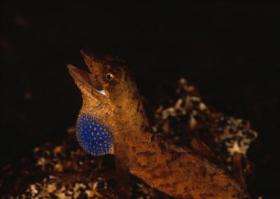
Anolis nitens tandai lives on the forest floor in leaf litter in rainforests of the southern Amazon and cannot withstand high temperatures. Credit: Laurie Vitt
From geckos and iguanas to Gila monsters and Komodo dragons, lizards are among the most common reptiles on Earth. They are found on every continent except Antarctica. One even pitches car insurance in TV ads. They seemingly can adapt to a variety of conditions, but are most abundant in the tropics.
However, new research that builds on data collected more than three decades ago demonstrates that lizards living in tropical forests in Central and South America and the Caribbean could be in serious peril from rising temperatures associated with climate change.
In fact, those forest lizards appear to tolerate a much narrower range of survivable temperatures than do their relatives at higher latitudes and are actually less tolerant of high temperatures, said Raymond Huey, a University of Washington biology professor.
"The least heat-tolerant lizards in the world are found at the lowest latitudes, in the tropical forests. I find that amazing," said Huey, lead author of a paper outlining climate warming's threat to lizards published in the March 4 Proceedings of the Royal Society B. The Royal Society is Great Britain's national academy of science.
It has often been assumed that tropical organisms are much better at dealing with high temperatures than those in colder climates because the lowland tropics are always warm. But that assumption is only true to a point, Huey said, because those in the tropical forest experience a much narrower range of temperatures during the year and are rarely, if ever, exposed to extreme high temperatures.
A lizard in Washington, for example, might experience a temperature range of 40 degrees or more between summer and winter, while one in Puerto Rican forests might only experience a range of 20 to 25 degrees.
Forest conditions tend to keep lizards living there at temperatures that allow them to function at or close to their physical peak. A temperature change of just a few degrees can reduce their physical performance greatly.
Lizards are ectotherms, regulating their body temperature by exchanging heat with their surroundings. Huey originally collected data on body temperatures of lizards in a Puerto Rican forest in 1973, and later measured how fast they can sprint at various body temperatures. Sprinting relates directly to survivability because it affects a lizard's ability to hunt or elude predators.
He found that even at the coolest and warmest parts of the day the forest lizards functioned at least at 90 percent of their maximum ability, because the temperatures varied so little and were optimal then for these lizards. Subsequent laboratory work by Huey and others tested the sprinting speeds for more than 70 species of lizards at varying body temperatures.
"In the 1970s a bunch of us were running around the Caribbean with thermometers taking lizard body temperatures for reasons totally unrelated to climate warming. But we can use our data from a third a century ago as a baseline to now predict how lizards at different latitudes would respond to climate change," Huey said.
His co-authors are Curtis Deutsch of the University of California, Los Angeles; Joshua Tewksbury of the UW; Laurie Vitt of the University of Oklahoma; Paul Hertz of Barnard College; Héctor Álvarez Pérez of the University of Puerto Rico; and Theodore Garland Jr. of the University of California, Riverside. The work was funded by the National Science Foundation and the UW Program on Climate Change.
Huey's lizard studies in the early 1970s included a species called Anolis gundlachi that lived in a forest at about 1,000 feet elevation near El Verde, Puerto Rico. The shaded forest was an ideal environment for Anolis gundlachi, but was too cool for another species, A. cristatellus, that favored the warmer conditions found in unforested habitats nearby.
But since the early 1970s, Huey said, the average temperature in the forest has risen from just less than 80 degrees Fahrenheit to nearly 83.5 F, which should be stressfully warm for A. gundlachi and almost warm enough for A. cristatellus. Scientists believe the tropics could warm by another 5 degrees F by the end of this century.
"That may not sound like much, but we think gundlachi is going to get hammered because it will suffer heat stress from the warmer temperatures," Huey said.
To make matters worse, if temperatures become warm enough A. cristatellus could well move into the forest, forcing A. gundlachi to deal with a formidable competitor that it doesn't have now.
The assessment does not look at potential effects of climate change on the forest canopy, Huey said, and that could make matters worse. If warming stresses the trees so that the leafy canopy at the top of the forest becomes more open, then the amount of solar radiation reachng the forest floor will further increase the ambient temperature. This will add to the stress of species such as A. gundlachi.
It also is possible the lizards could adapt evolutionarily to the warmer conditions, Huey said, "but we don't think it's likely because of their long generation times." The scientists also believe the same concerns apply to other ectotherms, such as snakes, insects and spiders, that live on land in tropical forests.
"Because tropical forest lizards aren't very heat tolerant and they live in environments that are already warm, any further warming could push them over the edge," Huey said.
Source: University of Washington
-
Hotter homes produce smarter babies
Jan 12, 2012 |
4.6 / 5 (5) |
1
-
Climate change downsizing fauna, flora: study
Oct 16, 2011 |
3.9 / 5 (18) |
21
-
Stable temperatures boost biodiversity in tropical mountains
Jun 08, 2011 |
4 / 5 (2) |
9
-
Size matters in lizard research
Mar 08, 2011 |
4 / 5 (2) |
0
-
Study documents widespread extinction of lizard populations due to climate change
May 13, 2010 |
2.8 / 5 (10) |
5
-
Engineers build first sub-10-nm carbon nanotube transistor
Feb 01, 2012 |
4.9 / 5 (33) |
30
-
Something old, something new: Evolution and the structural divergence of duplicate genes
Jan 31, 2012 |
4.6 / 5 (7) |
1
-
The hidden nanoworld of ice crystals: Revealing the dynamic behavior of quasi-liquid layers
Jan 30, 2012 |
5 / 5 (4) |
1
-
Stock market network reveals investor clustering
Jan 27, 2012 |
3.9 / 5 (23) |
8
-
Of microchemistry and molecules: Electronic microfluidic device synthesizes biocompatible probes
Jan 26, 2012 |
5 / 5 (2) |
0
-
Factors affecting beet root cell membrane
11 hours ago
-
Stem cell question.
Feb 10, 2012
-
Protease cleavage
Feb 10, 2012
-
Pertubance in a model
Feb 10, 2012
-
Cancer drugs and Alzheimer's, Oh my!
Feb 09, 2012
-
Squishing cells
Feb 09, 2012
- More from Physics Forums - Biology
More news stories
A mitosis mystery solved: How chromosomes align perfectly in a dividing cell
Although the process of mitotic cell division has been studied intensely for more than 50 years, Whitehead Institute researchers have only now solved the mystery of how cells correctly align their chromosomes during symmetric ...
6 hours ago |
4.5 / 5 (11) |
0
|
Researchers find extensive RNA editing in human transcriptome
In a new study published online in Nature Biotechnology, researchers from BGI, the world's largest genomics organization, reported the evidence of extensive RNA editing in a human cell line by analysis of RNA-seq data, demons ...
6 hours ago |
5 / 5 (4) |
0
|
The proteins ensuring genome protection
Researchers from the University of Geneva (UNIGE), Switzerland, have discovered the crucial role of two proteins in developing a cell 'anti-enzyme shield'. This protection system, which operates at the level of molecular ...
6 hours ago |
5 / 5 (3) |
0
|
Entire genome of extinct human decoded from fossil
(PhysOrg.com) -- In 2010, Svante Pääbo and his colleagues presented a draft version of the genome from a small fragment of a human finger bone discovered in Denisova Cave in southern Siberia. The ...
Feb 07, 2012 |
4.7 / 5 (59) |
50
|
Why are there so few fish in the Earth's oceans?
(PhysOrg.com) -- A Stony Brook University researcher has found that, contrary to popular belief, there are not plenty of fish in the sea.
Feb 08, 2012 |
4.2 / 5 (18) |
27
|
Scientists discover molecular secrets of 2,000-year-old Chinese herbal remedy
For roughly two thousand years, Chinese herbalists have treated Malaria using a root extract, commonly known as Chang Shan, from a type of hydrangea that grows in Tibet and Nepal. More recent studies suggest that halofuginone, ...
New method to examine batteries -- MRI from the inside
There is an ever-increasing need for advanced batteries for portable electronics, such as phones, cameras, and music players, but also to power electric vehicles and to facilitate the distribution and storage of energy derived ...
Overeating may double risk of memory loss
New research suggests that consuming between 2,100 and 6,000 calories per day may double the risk of memory loss, or mild cognitive impairment (MCI), among people age 70 and older. The study was released today and will be ...
Lab study raises questions over nano-particle impact
Tests involving chickens have raised questions about the impact on health from engineered nano-particles, the ultra-fine grains commonly used in drugs and processed foods, scientists said on Sunday.
Google might launch Drive for cloud storage soon
(PhysOrg.com) -- Google's next big move, according to the Wall Street Journal, is a cloud storage service called Drive. Hardly first to the plate, Google is simply catching up to introducing its cloud reposi ...
Starve a virus, feed a cure? Findings show how some cells protect themselves against HIV
A protein that protects some of our immune cells from the most common and virulent form of HIV works by starving the virus of the molecular building blocks that it needs to replicate, according to research published online ...
Mar 03, 2009
Rank: 3.7 / 5 (6)
I remember when i was in college in 1984, i was a stupid vapid liberal who believed that Imperialist Capitalist American logging companies would have the entire South American rain forest clear cut and burned down within 5 years. I also believed that all of the tigers on the indian subcontinent were on the verge of extinction... I believed that acid rain would soon completely wipe out the forests of Germany and from there it was a foregone conclusion that all of the forests in North America were going to die from run-away unstoppable ozone-sulphur cosmic ray induced acidity... Then guess what was going to happen... as massive tracts of plant life and forests died off, more and more carbon dioxide (CO2) was going to be released into the atmosphere due to the lack of carbon absorption by the now dead plants and trees and the crowning glory of my liberal terrorized and reason fogged mind was... wait for it... Earth would freeze like Mars is freezing due to so much CO2 in the atmosphere.
So if you are under the age of 25, rest assured that the little lizards will continue to thrive and procreate and move hither and thither as needs be by the NATURAL COOLING AND WARMING PROCESSES ongoing on our planet for the last several BILLION years.
Mar 04, 2009
Rank: 5 / 5 (2)
2) Even if the tropics were warming as well, nearly all warming is in the minimum (overnight) temperature, so this should also not be an issue.
Mar 04, 2009
Rank: 5 / 5 (2)
The prejudice of doomsayers is that the current narrow range of conditions is ideal and necessary. It is neither.
Mar 04, 2009
Rank: 3 / 5 (2)
Nature is a cruel hard so and so....
Mar 04, 2009
Rank: 5 / 5 (1)
hmmm...it cant be all bad with no good....
The world is not static and never has been. And with that said, having a warmer world is much easier to cope with than one that would be moving toward a ice age. Just the media tends to allow for a one sided viewpoint.
Mar 04, 2009
Rank: not rated yet
Mar 05, 2009
Rank: 5 / 5 (1)