Mountain on Mars may answer big question
March 4, 2009
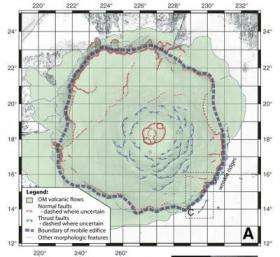
Olympus Mons Volcanic Flows

Enlarge

The Martian volcano Olympus Mons is about three times the height of Mount Everest, but it's the small details that Rice University professors Patrick McGovern and Julia Morgan are looking at in thinking about whether the Red Planet ever had -- or still supports -- life. Credit: Rice University

The Martian volcano Olympus Mons is about three times the height of Mount Everest, but it's the small details that Rice University professors Patrick McGovern and Julia Morgan are looking at in thinking about whether the Red Planet ever had - or still supports - life.

Using a computer modeling system to figure out how Olympus Mons came to be, McGovern and Morgan reached the surprising conclusion that pockets of ancient water may still be trapped under the mountain. Their research is published in February's issue of the journal Geology.

The scientists explained that their finding is more implication than revelation. "What we were analyzing was the structure of Olympus Mons, why it's shaped the way it is," said McGovern, an adjunct assistant professor of Earth science and staff scientist at the NASA-affiliated Lunar and Planetary Institute. "What we found has implications for life - but implications are what go at the end of a paper."
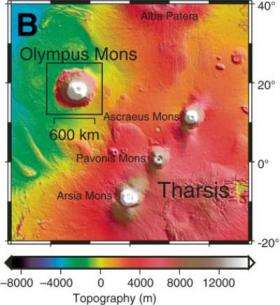
Olympus Mons
Enlarge

The Martian volcano Olympus Mons is about three times the height of Mount Everest, but it's the small details that Rice University professors Patrick McGovern and Julia Morgan are looking at in thinking about whether the Red Planet ever had -- or still supports -- life. Credit: Rice University

Co-author Morgan is an associate professor of Earth science.

In modeling the formation of Olympus Mons with an algorithm known as particle dynamics simulation, McGovern and Morgan determined that only the presence of ancient clay sediments could account for the volcano's asymmetric shape. The presence of sediment indicates water was or is involved.

Olympus Mons is tall, standing almost 15 miles high, and slopes gently from the foothills to the caldera, a distance of more than 150 miles. That shallow slope is a clue to what lies beneath, said the researchers. They suspect if they were able to stand on the northwest side of Olympus Mons and start digging, they'd eventually find clay sediment deposited there billions of years ago, before the mountain was even a molehill.

The European Space Agency's Mars Express spacecraft has in recent years found abundant evidence of clay on Mars. This supports a previous theory that where Olympus Mons now stands, a layer of sediment once rested that may have been hundreds of meters thick.

Morgan and McGovern show in their computer models that volcanic material was able to spread to Olympus-sized proportions because of the clay's friction-reducing effect, a phenomenon also seen at volcanoes in Hawaii.

What may be trapped underneath is of great interest, said the researchers. Fluids embedded in an impermeable, pressurized layer of clay sediment would allow the kind of slipping motion that would account for Olympus Mons' spread-out northeast flank - and they may still be there.

Thanks to NASA's Phoenix lander, which scratched through the surface to find ice underneath the red dust last year, scientists now know there's water on Mars. So Morgan and McGovern feel it's reasonable to suspect water may be trapped in pores in the sediment underneath the mountain.

"This deep reservoir, warmed by geothermal gradients and magmatic heat and protected from adverse surface conditions, would be a favored environment for the development and maintenance of thermophilic organisms," they wrote. This brings to mind the primal life forms found deep in Earth's oceans, thriving near geothermal vents.

Finding a source of heat will be a challenge, they admitted. "We'd love to have the answer to that question," said McGovern, noting evidence of methane on Mars is considered by some to be another marker for life. "Spacecraft up there have the capability to detect a thermal anomaly, like a magma flow or a volcano, and they haven't.

"What we need is 'ground truth' - something reporting from the surface saying, 'Hey, there's a Marsquake,' or 'Hey, there's unusual emissions of gas.' Ultimately, we'd like to see a series of seismic stations so we can see what's moving around the planet."

More information: The paper appears online in Geology at: http://geology.gsa … act/37/2/139 .

Source: Rice University

4.2 /5 (17 votes)  

Filter


Move the slider to adjust rank threshold, so that you can hide some of the comments.


Display comments: newest first

deatopmg
Mar 05, 2009

Rank: not rated yet
"What we need is 'ground truth' - something reporting from the surface saying, 'Hey, there's a Marsquake,' or 'Hey, there's unusual emissions of gas.'

NO, NO, NO, we don't need more "suggestive" experiments. What we do need is an instrument like a GC or LC/mass spec to detect the building blocks of life on the surface of Mars in an obviously wet area near the equator.
Another "Phoenix" in a permanently frozen, dead polar region using some crude, pre-1950's oven technique to heat soil samples to see if something de-gases is not what we the people need. Phoenix was a clever half billion dollar obfuscation.

Since, the detection of life by the Viking mission in the 70's, (that NASA insufficiently explained away as a chemical reaction - read the experiment online and look at the daily rise and fall of CO2), the agency has carefully avoided sending ANY device that can detect life directly or indirectly.

Can anyone explain why this is so? (I expect to immediately get 1's for this post from the NASA/JPL lurkers.)
Rank 4.2 /5 (17 votes)
Relevant PhysicsForums posts
  • Titan's lack of impact craters
    created23 hours ago
  • Real pictures of black hole eating a star?
    createdFeb 08, 2012
  • Hypothetical way to travel faster than light, but not technically exceed lightspeed
    createdFeb 06, 2012
  • How do scientists monitor the Sun's activity?
    createdFeb 05, 2012
  • Search patterns in observational studies
    createdFeb 05, 2012
  • Derivation of Pogson's law
    createdFeb 03, 2012
  • More from Physics Forums - General Astronomy

More news stories

Sandy streets over the Atlantic

Thick dust from the Sahara blowing over the ocean off the western coast of Africa encounters the islands of Cape Verde, forming a wake of swirling “vortex streets” visible by satellite.

Space & Earth / Earth Sciences

created 48 minutes ago | popularity not rated yet | comments 0

Domestic consumption main contributor to Africa's growing e-waste

West Africa faces a rising tide of e-waste generated by domestic consumption of new and used electrical and electronic equipment, according to a new United Nations report. Domestic consumption makes up the majority (up to ...

Space & Earth / Environment

created 20 minutes ago | popularity not rated yet | comments 0

Could Venus be shifting gear?

(PhysOrg.com) -- ESA’s Venus Express spacecraft has discovered that our cloud-covered neighbour spins a little slower than previously measured. Peering through the dense atmosphere in the infrared, the ...

Space & Earth / Space Exploration

created 1 hour ago | popularity 5 / 5 (3) | comments 2 | with audio podcast

Humans may have helped the decline of African rainforests 3000 years ago

(PhysOrg.com) -- Large areas of rainforests in Central Africa mysteriously disappeared over three thousand years ago, to be replaced by savannas. The prevailing theory has been that the cause was a change ...

Space & Earth / Environment

created 5 hours ago | popularity 5 / 5 (2) | comments 1 | with audio podcast report

Clam fields found at deep, low-temperature Mariana vents

(PhysOrg.com) -- Scientists have marveled at the unusual life forms thriving at high temperature hydrothermal vents of the deep ocean.

Space & Earth / Earth Sciences

created 1 hour ago | popularity not rated yet | comments 0 | with audio podcast


The power of estrogen -- male snakes attract other males

A new study has shown that boosting the estrogen levels of male garter snakes causes them to secrete the same pheromones that females use to attract suitors, and turned the males into just about the sexiest ...

Experts reveal how plants don't get sunburn

(PhysOrg.com) -- Experts at the University of Glasgow have discovered how plants survive the harmful rays of the sun.

Team isolates nerve cells involved in storing long term memory and gene proteins associated with them

(Medical Xpress) -- A research team in Taiwan has succeeded in isolating two nerve cells in fruit fly brains that are believed to be the major players in allowing for the formation of long term memories. Furthermore, ...

Fool's gold may prove an unlikely alternative to overexploited catalytic materials

Catalytic materials, which lower the energy barriers for chemical reactions, are used in everything from the commercial production of chemicals to catalytic converters in car engines. However, with current catalytic materials ...

SLAC, Stanford team focuses on high-energy electrons to treat cancer

Accelerator physicists at SLAC and cancer specialists from Stanford are working on a new technology that could dramatically reduce the time needed for cancer radiation treatments. The team ran an initial experiment ...

News of plaque-clearing drug tops week of major advances against Alzheimer's disease

In the last eight days, scientists have delivered a powerful one-two punch in the fight to defeat Alzheimer's disease. At the same time, the White House and members of Congress are proposing increases in Alzheimer's research ...