Mediterranean Sea level could rise by 61 cm
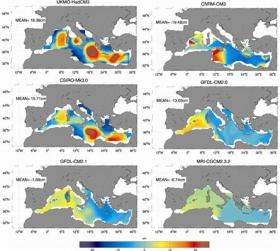
A Spanish-British research project has come up with three future scenarios for the effects of climate change on the Mediterranean over the next 90 years, using global models from the Intergovernmental Panel on Climate Change (IPCC). The conclusions show that ocean temperatures in this area will increase, along with sea levels.
In order to understand and correctly predict risks for the Mediterranean coast, researchers from the Mediterranean Institute for Advanced Studies (IMEDEA, a joint centre run by the University of the Balearic Islands (UIB) and the Spanish National Research Council, CSIC) and the National Oceanography Centre of Southampton in the United Kingdom have analysed simulations based on three scenarios related to climate change and the rise in greenhouse gases. Their goal was to predict the temperature, sea level and salinity of the Mediterranean in the 21st Century.
"The most positive scenario assumes that greenhouse gas concentrations remain constant at their levels in the year 2000, and even in this case climate change still has an impact. The most negative scenario is based on diverse levels of economic development all over the world, with an ongoing increase in greenhouse gas production throughout the 21st Century," Marta Marcos, the study's lead author and a researcher at the UIB, tells SINC.
The study, which has been published recently in the Journal of Geophysical Research-Oceans, shows what could happen in the Mediterranean. The models predict that higher concentrations of gases will lead to an increase in temperatures throughout the entire sea.
In the most positive scenario, the changes are least, with temperature increases of less than 1ºC expected to be recorded in the Mediterranean by the end of the 21st Century. The other two scenarios envision an increase in greenhouse gases over coming decades, and foresee an increase in the temperature of the sea of up to 2.5º C. In addition, the results show that the temperature increase will accelerate during the 21st Century.
In the long term, sea levels could alter due to changes in temperature (warming leads to an increase in volume) as well as additional mass. "The level of the whole Mediterranean will rise by between 3cm and 61cm on average as a result of the effects of warming," says Marcos.
There is "greater uncertainty" in terms of the mass likely to be added as a result of melting ice at the poles and from continental glaciers, and this aspect is not incorporated in the study. The most important area in terms of understanding sea level rise is the coasts, "but it is here that we know least because of the low spatial resolution of the models" the expert adds.
In search of greater clarity
The conclusions of this study are not based on observations, but rather on global climate models that include a whole range of possible future socio-economic scenarios in order to predict what is likely to happen in the Mediterranean. According to the scientists, climatic conditions are going to change greatly, and for this reason it is impossible to make a completely precise prediction of what the future really holds.
In these circumstances, Marta Marcos and Michael Tsimplis say that, aside from temperature changes, the models show that the Mediterranean will also become saltier over the coming century. However, this prediction is also very uncertain because "the variations in salinity in the Mediterranean are controlled by the exchange of water through the Straits of Gibraltar, and this has not been incorporated as an indicator, meaning the related results are not very reliable".
This is due to the fact that IPCC models have very low spatial resolution, which means they can show global processes "reasonably well", but not always regional ones. In particular, the 14km-wide Straits of Gibraltar, which are of key importance in the processes of water exchange between the Mediterranean and Atlantic, are not well reproduced in the models.
The global models are of no use in estimating the impact of sea level rise in coastal areas, because of the high level of regional variability for this factor. The solution would be to use high-resolution, regional climate models to show the Mediterranean straits with greater clarity, as well as the oceanic processes that take place within the ocean's basin and coastal areas.
This is a strategy currently being pursued by European research groups working to predict the effects of climate change at a regional level, and it is expected that the level of uncertainty in predictions will be reduced over the short term. In Spain, IMEDEA is working to produce data on ocean levels in collaboration with the Spanish Port System. Without such resolution in the models "we cannot be sure of the scale of the changes", the researcher concludes.
More information: Marcos, Marta; y Tsimplis, Michael “Comparison of results of AOGCMs in the Mediterranean Sea during the 21st century” Journal of Geophysical Research-Oceans 113(C12) Número del artículo: C12028 31 de diciembre de 2008.
Provided by Plataforma SINC, Spain


