Buckyballs could keep water systems flowing
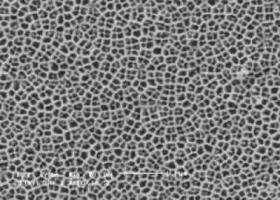
March 5, 2009 Buckyball-Treated Membrane

Enlarge

This is a buckyball-treated membrane. Credit: Duke University

Microscopic particles of carbon known as buckyballs may be able to keep the nation's water pipes clear in the same way clot-busting drugs prevent arteries from clogging up.

Engineers at Duke University have found that buckyballs hinder the ability of bacteria and other microorganisms to accumulate on the membranes used to filter water in treatment plants. This attribute leads the researchers to believe that coating pipes and membranes with these nanoparticles may prove to be an effective strategy for addressing one of the major problems and costs of treating water.

"Just as plaque can build up inside arteries and reduce the flow of blood, bacteria and other microorganisms can over time attach and accumulate on water treatment membranes and along water pipes," said So-Ryong Chae, post-doctoral fellow in Duke's environmental and civil engineering department. The results of his experiments were published March 5, 2009 in the Journal of Membrane Sciences.
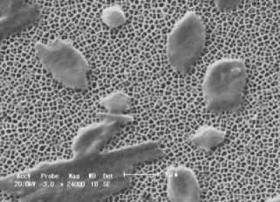
Membrane Without Buckyball Treatment
Enlarge

This is a membrane without buckyball treatment. Credit: Duke University

"As the bacteria build up on these surfaces, they attract other organic matter, creating a biofilm that slowly builds up over time," Chae continued, "The results of our experiments in the laboratory indicate that buckyballs may be able to prevent this clogging, known as biofouling. The only other options to address biofouling are digging up the pipes and replacing the membranes, which can be expensive and inconvenient."

A buckyball, or C60, is one shape within the family of tiny carbon shapes known as fullerenes. They are named after Richard Buckminster Fuller, the inventor of the geodesic dome, since their shape resembles his famous structure.

"Biofouling is viewed as one of the biggest costs associated with membrane-based water treatment systems," said Claudia Gunsch, assistant professor of civil engineering at Duke's Pratt School of Engineering and senior member of the research team. "These membranes have very small pores, so they can get stopped up quickly. If we could increase the time between membrane replacements by 50 percent, for example, that would be a huge cost savings."

According to Chae, the addition of buckyballs to treatment membranes had a two-fold effect. First, treated membranes showed less bacterial attachment than non-treated membranes. After three days, the membranes treated with buckyballs had on average 20 colony forming units, the method by which bacterial colonies are counted.

"In contrast, the number of bacterial colonies on the untreated membrane was too numerous to count," Chae said.

Chae also found that the presence of the buckyballs inhibited respiration, or the ability of the bacteria to use oxygen to fuel its activities.

"As the concentration of buckyballs increased, so did the inhibition of respiration," Chae said. "This respiratory inhibition and anti-attachment suggests that this nanoparticle may be useful as an anti-fouling agent to prevent the biofouling of membranes or other surfaces."

Gunsch said the mechanisms involved are not well-understood.

Both Gunsch and Chae believe that since buckyballs are one of the most widely used nanoparticles, additional research is needed to determine if they have any detrimental effects on the environment or to humans. This is one of many issues being studied at Duke's Center for Environmental Implications of Nanotechnology.

"We need to figure out how resistant these coatings will be to long-term use," Gunsch said. "If they can indeed prevent fouling, they will last longer. If they slough off over time, we need to know what the effects will be."

The current experiments in the laboratory were conducted with Escherichia coli K12, a strain of the bacteria that is widely used in laboratory experiments.

"We focused on a quite specific microorganism, so the next stage of our research will to see if these nanoparticles will have the same effects on bacteria commonly found in the environment or those in mixed microbial communities," Chae said. "We also plan to build a small-scale version of a treatment plant in the lab to conduct these tests."

Source: Duke University


print this article email this article download pdf blog this article bookmark this article     Stumble it Digg this share on Facebook retweet share on Reddit add to delicious
Rate this story - 3.6 /5 (7 votes)

Rank Filter

Move the slider to adjust rank threshold, so that you can hide some of the comments.


Display comments: newest first

  • tkjtkj - Mar 05, 2009
    • Rank: 1 / 5 (2)
    More 'garbage science'?? I speak of the inclusion of only the 'control' experimental result: the photo of what happens without the buckyballs. Where is the corresponding 'experimental group's photo????
    Is half a story better than none? For myself, i'll opt for the 'none' and save myself a lot of time.

    Just who at physorg is choosing these articles???

    shame.
  • Crossrip - Mar 05, 2009
    • Rank: 1 / 5 (1)
    It was an article about a "possible application" in the first round of testing. I found the article informative and well within the scope of Physorg's style of reporting.
  • barakn - Mar 05, 2009
    • Rank: 1 / 5 (2)
    What planet did tkjkj come from? I see two photos in the story, one with and one without buckyballs.
  • Graeme - Mar 05, 2009
    • Rank: 1 / 5 (1)
    And is the bucky ball treated membrane 500 times as expensive as the untreated membrane? Are Bucky balls safe to drink? some are sure to leak through.
  • nkalanaga - Mar 05, 2009
    • Rank: 1 / 5 (1)
    Nanotubes may be dangerous, as they resemble asbestos fibers, and could poke holes in cell membranes. So far, I haven't seen any evidence that buckyballs are dangerous, and I doubt that they are physically. It's hard to do much damage with an almost inert object without sharp edges. Since they seem to be insoluble, and chemically inert in most environments, I doubt that they would pose a health hazard in small quantities.

    If any research in their effects has been done, I haven't seen it. If it has, and there were possible problems, someone would have demanded that they be banned, so there must not be any evidence of harm.
  • MattJ - Mar 08, 2009
    • Rank: not rated yet
    In response to nkalanaga - Mar 05, 2009:

    Obviously the buckyballs can't be completely inert, since they are interfering with bacterial respiration. But if they can harm bacterial cells, then they might harm other cells too, such as OUR cells!

    So it must be studied carefully before people put these in our drinking water.
  • Damon_Hastings - Mar 09, 2009
    • Rank: not rated yet
    So it must be studied carefully before people put these in our drinking water.


    Hear, hear! There are enough insufficiently tested additives and groundwater contaminants in our drinking supply already.

March 5, 2009 all stories

Comments: 7

3.6 /5 (7 votes)
  • Stumble this up

  • Digg this

  • share this

  • hide
  • Related Stories

  • Fusion of Nanocircuits, Bio-membranes Creates New Hybrid Technology
    created Aug 27, 2009 | popularity not rated yet | comments 0
  • Discovery to aid study of biological structures, molecules
    created Aug 11, 2009 | popularity not rated yet | comments 0
  • Wastewater produces electricity and desalinates water
    created Aug 06, 2009 | popularity not rated yet | comments 0
  • Trapped! Scientists Immobilize Bacteria in Fibrous Hydrogel
    created Aug 04, 2009 | popularity not rated yet | comments 0
  • Scientists work to plug microorganisms into the energy grid
    created May 18, 2009 | popularity not rated yet | comments 0


  • hide
  • Relevant PhysicsForums posts

Other News

Findings show nanomedicine promising for treating spinal cord injuries

Findings show nanomedicine promising for treating spinal cord injuries

Nanotechnology / Bio & Medicine

created 15 hours ago | popularity 4.5 / 5 (4) | comments 0

(PhysOrg.com) -- Researchers at Purdue University have discovered a new approach for repairing damaged nerve fibers in spinal cord injuries using nano-spheres that could be injected into the blood shortly ...


New Digital 'Electronics' Concept May Continue Moore's Law

New Digital 'Electronics' Concept May Continue Moore's Law

Nanotechnology / Nanophysics

created Nov 05, 2009 | popularity 4.6 / 5 (54) | comments 9

(PhysOrg.com) -- Computers of the future could be operating not on electrons, but on tiny waves traveling through an electron "fluid," if a new proposal is successful. The new circuit design, recently introduced ...


Nanoparticles for gene therapy improve

Nanoparticles for gene therapy improve

Nanotechnology / Bio & Medicine

created Nov 06, 2009 | popularity 5 / 5 (4) | comments 3

(PhysOrg.com) -- About five years ago, Professor Janet Sawicki at the Lankenau Institute in Pennsylvania read an article about nanoparticles developed by MIT's Robert Langer for gene therapy, the insertion ...


Breakthrough in industrial-scale nanotube processing

Breakthrough in industrial-scale nanotube processing

Nanotechnology / Nanomaterials

created Nov 02, 2009 | popularity 4.9 / 5 (20) | comments 3

(PhysOrg.com) -- Rice University scientists today unveiled a method for the industrial-scale processing of pure carbon-nanotube fibers that could lead to revolutionary advances in materials science, power ...


Scientists witness nature's complexity unfold in self-assembling quasicrystals

Scientists witness nature's complexity unfold in self-assembling quasicrystals

Nanotechnology / Nanomaterials

created Oct 31, 2009 | popularity 4.9 / 5 (17) | comments 3

(PhysOrg.com) -- Just a few decades ago, scientists believed that all ordered matter consists of self-repeating building blocks -- atoms, ions or molecules. In this view, the ordinary solids of everyday life ...