New deep-sea coral discovered
March 5, 2009 New deep-sea coral discovered

Enlarge

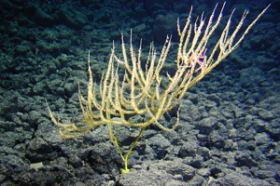
This five-foot tall yellow bamboo coral, standing in 4,787 feet of water, represents a new species and establishes a new genus of bamboo corals. (Credit: Hawaii Deep-Sea Coral Expedition 2007/NOAA)

(PhysOrg.com) -- Scientists identified seven new species of bamboo coral discovered on a NOAA-funded mission in the deep waters of the Papahānaumokuākea Marine National Monument. Six of these species may represent entirely new genera, a remarkable feat given the broad classification a genus represents. A genus is a major category in the classification of organisms, ranking above a species and below a family. Scientists expect to identify more new species as analysis of samples continues.

"These discoveries are important, because deep-sea corals support diverse seafloor ecosystems and also because these corals may be among the first marine organisms to be affected by ocean acidification," said Richard Spinrad, Ph.D., NOAA's assistant administrator for Oceanic and Atmospheric Research. Ocean acidification is a change in ocean chemistry due to excess carbon dioxide. Researchers have seen adverse changes in marine life with calcium-carbonate shells, such as corals, because of acidified ocean water.

"Deep-sea bamboo corals also produce growth rings much as trees do, and can provide a much-needed view of how deep ocean conditions change through time," said Spinrad.
New deep-sea coral discovered
Enlarge

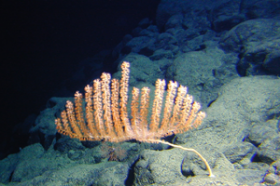
This orange bamboo coral is another new species and new genus found in the Papahanaumokuakea Marine National Monument. It is between four and five feet tall, and was found 5,745 feet below the surface. (Credit: Hawaii Deep-Sea Coral Expedition 2007/NOAA)

Rob Dunbar, a Stanford University scientist, was studying long-term climate data by examining long-lived corals. "We found live, 4,000-year-old corals in the Monument - meaning 4,000 years worth of information about what has been going on in the deep ocean interior."

"Studying these corals can help us understand how they survive for such long periods of time as well as how they may respond to climate change in the future," said Dunbar.

Among the other findings were a five-foot tall yellow bamboo coral tree that had never been described before, new beds of living deepwater coral and sponges, and a giant sponge scientists dubbed the "cauldron sponge," approximately three feet tall and three feet across. Scientists collected two other sponges which have not yet been analyzed but may represent new species or genera as well.

The mission also discovered a "coral graveyard" covering about 10,000 square feet on a seamount's summit, more than 2,000 feet deep. Scientists estimated the death of the community occurred several thousand to potentially more than a million years ago, but did not know why the community died. The species of coral had never been recorded in Hawaii before, according a Smithsonian Institution coral expert they consulted.

Finding new species was not an express purpose of the research mission, but Dunbar and Christopher Kelley, a scientist with the University of Hawaii, both collected specimens that looked unusual. Kelley's objective was to locate and predict locations of high density deep-sea coral beds in the Monument. NOAA scientist Frank Parrish also led a portion of the mission, focusing on growth rates of deep-sea corals.

The three-week research mission ended in November 2007, but analysis of specimens is ongoing. "The potential for more discoveries is high, but these deep-sea corals are not protected everywhere as they are here, and can easily be destroyed," said Kelley.

The Papahānaumokuākea Marine National Monument has more deep water than any other U.S. protected area, with more than 98 percent below SCUBA-diving depths and only accessible to submersibles. The Hawaii Undersea Research Laboratory, sponsored by NOAA and the University of Hawaii, piloted the Pisces V submersible from a research vessel to the discovery sites, between 3300 and 4200 feet deep.

Provided by NOAA


print this article email this article download pdf blog this article bookmark this article     Stumble it Digg this share on Facebook retweet share on Reddit add to delicious
Rate this story - 5 /5 (2 votes)

Rank Filter

Move the slider to adjust rank threshold, so that you can hide some of the comments.


Display comments: newest first

  • Necrophage - Mar 05, 2009
    • Rank: not rated yet
    If any of you check out Peter Watts' "Starfish" saga, you will gain an even greater appreciation for the awesome potential and diversity of deepsea life. Not for the faint of heart, though.

March 5, 2009 all stories

Comments: 1

5 /5 (2 votes)
  • Stumble this up

  • Digg this

  • share this

  • hide
  • Related Stories


  • hide
  • Relevant PhysicsForums posts

  • Selenocysteine in pH=7
    created 6 hours ago
  • What is the formula for calculating the speed of thought?
    created 11 hours ago
  • What does word "absorption" mean in the intestine?
    created 11 hours ago
  • What is transpulmonary pressure?
    created Nov 24, 2009
  • Is there a gay gene?
    created Nov 23, 2009
  • Super quick question about Starling forces?
    created Nov 22, 2009
  • More from Physics Forums - Biology

Other News

The six elephants in Sierra Leone were shot and "crudely butchered"

S.Leone elephants 'wiped out' by poachers: official

Biology / Ecology

created 5 hours ago | popularity 5 / 5 (2) | comments 3

Poachers "wiped out" the entire elephant herd in Sierra Leone's only wildlife park, wildlife managers said Thursday after police said they had arrested a gang of 10 poachers.


Knockouts in human cells point to pathogenic targets

Knockouts in human cells point to pathogenic targets

Biology / Cell & Microbiology

created 6 hours ago | popularity not rated yet | comments 0

(PhysOrg.com) -- Whitehead researchers have developed a new approach for genetics in human cells and used this technique to identify specific genes and proteins required for pathogens.


Whiteflies sabotage alarm system of plant in distress

Whiteflies sabotage alarm system of plant in distress

Biology / Plants & Animals

created 7 hours ago | popularity 5 / 5 (1) | comments 0

(PhysOrg.com) -- When spider mites attack a bean plant, the plant responds by producing odours which attract predatory mites. These predatory mites then exterminate the spider mite population, thus acting ...


First-ever blueprint of a minimal cell is more complex than expected

First-ever blueprint of a minimal cell is more complex than expected

Biology / Cell & Microbiology

created 3 hours ago | popularity 5 / 5 (6) | comments 0

What are the bare essentials of life, the indispensable ingredients required to produce a cell that can survive on its own? Can we describe the molecular anatomy of a cell, and understand how an entire organism ...


Ecological speciation by sexual selection on good genes: Is speciation adaptive?

Biology / Ecology

created 3 hours ago | popularity not rated yet | comments 0

Darwin suggested that the action of natural selection can produce new species, but 150 years after the publication of his famous book, 'On the Origin of Species', debate still continues on the mechanisms of speciation. New ...