Geologists map rocks to soak CO2 from air
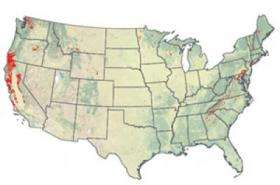
A new report by scientists at Columbia University's Earth Institute and the US Geological Survey points to an abundant supply of carbon-trapping rock in the US that could be used to help stabilize global warming.
To slow global warming, scientists are exploring ways to pull carbon dioxide from the air and safely lock it away. Trees already do this naturally through photosynthesis; now, in a new report, geologists have mapped large rock formations in the United States that can also absorb CO2, which they say might be artificially harnessed to do the task at a vastly increased pace.
The report, by scientists at Columbia University's Earth Institute and the U.S. Geological Survey, shows 6,000 square miles of ultramafic rocks at or near the surface. Originating deep in the earth, these rocks contain minerals that react naturally with carbon dioxide to form solid minerals. Earth Institute scientists are experimenting with ways to speed this natural process, called mineral carbonation. If the technology takes off, geologic formations around the world could provide a vast sink for heat-trapping carbon dioxide released by humans.
Lead author Sam Krevor, a graduate student working through the Earth Institute's Lenfest Center for Sustainable Energy, says the United States' ultramafic rocks could be enough to stash more than 500 years of U.S. CO2 production. Conveniently, most of them are clustered in strips along the east and west coasts--some near major cities including New York, Baltimore and San Francisco. "We're trying to show that anyone within a reasonable distance of these rock formations could use this process to sequester as much carbon dioxide as possible," said Krevor.
So-called carbon sequestration has become a hot area of research, but so far, most work has focused on storing liquid or gaseous CO2 underground where there is room: in saline aquifers, depleted oil wells and porous coal seams that are not commercially viable. However, concern about leaks has scientists pursuing natural chemical reactions within the earth to turn the carbon back into a solid.
Ultramafic rocks generally form in earth's mantle, starting some 12 miles under the surface and extending down hundreds of miles. Bits of these rocks—peridotite, dunite, lherzholite and others-- may be squeezed to the surface when continental plates collide with oceanic plates, or, less often, when the interiors of continents thin and develop rifts. Because of their chemical makeup, when the rocks are exposed to carbon dioxide, they react to form common limestone and chalk. A map accompanying the report shows that most such rocks are found in and around coastal mountain ranges, with the greatest concentrations in California, Oregon and Washington, and along the Appalachians from New England to Alabama. Some also occur in the interior, including Montana. Worldwide, other formations are scattered across Eurasia and Australia.
Klaus Lackner, who directs the Lenfest Center, helped originate the idea of mineral sequestration in the 1990s. The U.S. survey is the first of what Lackner hopes will become a global mapping effort. "It's a really big step forward," he said. Krevor produced the map as part of his PhD. dissertation, with help from another Columbia student, Christopher Graves, and two USGS researchers, Bradley Van Gosen and Anne McCafferty. By combining more than a hundred existing maps, the researchers were able to pinpoint the areas nationally where ultramafic rocks are most abundant.
Another rock, common volcanic basalt, also reacts with CO2, and efforts are underway to map this in detail as well. The U.S. Department of Energy has been working on a basalt atlas for the northwestern United States as part of its Big Sky Carbon Sequestration Partnership; extensive mapping in Washington, Oregon and Idaho has already been done through Idaho State University.
The major drawback to natural mineral carbonation is its slow pace: normally, it takes thousands of years for rocks to react with sizable quantities of CO2. But scientists are experimenting with ways to speed the reaction up by dissolving carbon dioxide in water and injecting it into the rock, as well as capturing heat generated by the reaction to accelerate the process. "It offers a way to permanently get rid of CO2 emissions," said Juerg Matter, a scientist at Columbia's Lamont-Doherty Earth Observatory, where a range of projects is underway.
Matter and his colleague Peter Kelemen are currently researching peridotite formations in Oman, which they say could be used to mineralize as much as 4 billion tons of CO2 a year, or about 12 percent of the world's annual output. And in Iceland, Matter is about to participate in the first major pilot study on CO2 sequestration in a basalt formation. In May, he and three other Lamont-Doherty scientists will join Reykjavik Energy and others to inject CO2-saturated water into basalt formations there. Over nine months, the rock is expected to absorb 1,600 tons of CO2 generated by a nearby geothermal power plant. Matter and another Lamont-Doherty scientist, David Goldberg, are also involved in a study by Pacific Northwest National Laboratory, which will eventually inject 1,000 tons of C02 into formations beneath land owned by a paper mill near Wallula, Wash.
One model is to capture CO2 directly from power-plant smokestacks or other industrial facilities, combine it with water and pipe it into the ground, as in the upcoming Iceland project. Lackner and his colleagues are also working on a process using "artificial trees" that would remove CO2 already emitted into the atmosphere.
Combining rocks and carbon dioxide could provide an added benefit, as Krevor points out. For decades, some large U.S. peridotite formations were mined for asbestos, used for insulation and other purposes. After a link between asbestos and cancer was proven, the substance was banned for most uses, and the mines were closed. Mine tailings left behind, at Belvidere Mountain in Vermont and various sites in California, provide a ready supply of crushed rocks. These potentially hazardous tailings would be rendered harmless during the mineralization process.
More information: The report, Mapping the Mineral Resource Base for Mineral Carbon-Dioxide Sequestration in the Conterminous United States, is at: pubs.usgs.gov/ds/414/
Source: The Earth Institute at Columbia University


