How mosquitoes could teach us a trick in the fight against malaria
March 5, 2009
How mosquitoes could teach us a trick in the fight against malaria

Enlarge

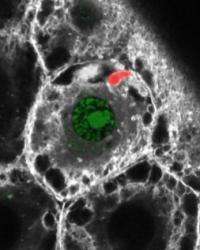
A malaria parasite (red) has invaded a mosquito cell, which is dying as a result.

(PhysOrg.com) -- The means by which most deadly malaria parasites are detected and killed by the mosquitoes that carry them is revealed for the first time in research published today in Science Express. The discovery could help researchers find a way to block transmission of the disease from mosquitoes to humans.

Mosquitoes become infected with malaria when they feed on the blood of an infected person. Young malaria parasites then grow and develop inside the mosquito for two weeks. New human infections occur when these parasites are 'injected' with the insect's saliva during the mosquito's next blood meal.

However, most of the malaria parasites are killed by the mosquito's immune system as soon as they enter the insect's bloodstream, with only one or two slipping through the net and going on to divide, multiply, and infect people.

The new study shows exactly how the mosquito's immune system kicks in to kill 80 - 90 percent of the parasites. The researchers discovered that the parasites are detected by a pair of proteins called LRIM1 and APL1C which belong to the mosquito's infection surveillance system. These two 'intruder detection' proteins then activate a third protein in the mosquito's blood called TEP1, which seeks out the parasitic invader, binds to its surface and orchestrates its destruction by punching holes in its cell membrane.

The Imperial College London team behind the new discovery say this knowledge could be used to develop new genetic or chemical techniques to improve on the mosquito's natural detection success rate, so that 100 percent of the parasites can be killed inside the mosquito, preventing transmission of the disease from insects to people.

Dr George Christophides from Imperial's Department of Life Sciences comments: "Mosquitoes are known as the 'bad guys' that spread malaria, but these insects are unwilling carriers of the disease, whose immune systems try to fight it, just like ours do. Now that we know exactly how their immune system attacks malaria parasites, we need to work out how a small number of parasites manage to evade detection by this system. Only a few manage to get past the mosquito's defences, but that's all that's needed for the disease to be transmitted to humans.

"If we can figure out how some parasites manage to sneak through undetected, hopefully we can find a way to bolster the mosquito's defences to catch them all."

The research, which was funded by the Wellcome Trust, the Biotechnology and Biological Sciences Research Council (BBSRC), and the National Institute of Allergy and Infectious Diseases of the U.S. National Institutes of Health, was carried out in the laboratory using a model parasite which causes malaria in rodents.

Half the global population are at risk of contracting malaria and up to half a billion new infections are recorded every year. Between one and three million people die from malaria every year - the majority of fatalities are children living in sub-Saharan Africa.

Apart from malaria, mosquitoes also spread other serious infectious diseases such as dengue and yellow fever, filariasis and various encephalitides. Dr Christophides and his colleagues at Imperial also discovered that LRIM1 and APL1C belong to a family of infection detection proteins that appear to be specific to mosquitoes. The researchers believe that proteins in this family may play a role in defence against these other infections too, and are currently investigating how these proteins function during mosquito infection with dangerous human pathogens.

Source: Imperial College London

Filter


Move the slider to adjust rank threshold, so that you can hide some of the comments.


Display comments: newest first

E_L_Earnhardt
Mar 05, 2009

Rank: 2 / 5 (1)
I just want to know how to kill the little pests!
I doubt they serve any good purpose at all!
mhenriday
Mar 07, 2009

Rank: not rated yet
My guess is that mosquitoes serve as much or as little purpose as humans do. In any event, Dr Christophides and his colleagues are to be congratulated on a fascinating piece of research - I wish them good luck in their further investigations !...

Henri
Rank 5 /5 (3 votes)
Relevant PhysicsForums posts
  • Factors affecting beet root cell membrane
    createdFeb 12, 2012
  • Stem cell question.
    createdFeb 10, 2012
  • Protease cleavage
    createdFeb 10, 2012
  • Pertubance in a model
    createdFeb 10, 2012
  • Cancer drugs and Alzheimer's, Oh my!
    createdFeb 09, 2012
  • Squishing cells
    createdFeb 09, 2012
  • More from Physics Forums - Biology

More news stories

Plants use circadian rhythms to prepare for battle with insects

In a study of the molecular underpinnings of plants' pest resistance, Rice University biologists have shown that plants both anticipate daytime raids by hungry insects and make sophisticated preparations to ...

Biology / Cell & Microbiology

created 1 hour ago | popularity 5 / 5 (2) | comments 0 | with audio podcast

Study finds fish of Antarctica threatened by climate change

A Yale-led study of the evolutionary history of Antarctic fish and their "anti-freeze" proteins illustrates how tens of millions of years ago a lineage of fish adapted to newly formed polar conditions – ...

Biology / Ecology

created 4 hours ago | popularity 5 / 5 (2) | comments 0 | with audio podcast

Explosive evolution need not follow mass extinctions, says study of ancient zooplankton

Following one of Earth's five greatest mass extinctions, tiny marine organisms called graptoloids did not begin to rapidly develop new physical traits until about 2 million years after competing species became ...

Biology / Evolution

created 4 hours ago | popularity 5 / 5 (1) | comments 1 | with audio podcast

Writing a new code for life?

On "Star Trek, the aliens often look so human that crew members fall in love with them. But in real life, scientists in the field known as astrobiology can't be sure alien life would even be carbon-based like us, or use DNA ...

Biology / Biotechnology

created 6 hours ago | popularity 5 / 5 (5) | comments 1

Lens produces hours of scientific work in seconds

A new form of microscope which can produce results in seconds rather than hours – dramatically speeding up the process of drug development - is being developed by researchers at the University of Strathclyde ...

Biology / Other

created 8 hours ago | popularity 4.4 / 5 (7) | comments 1 | with audio podcast


First-of-its-kind stem cell study re-grows healthy heart muscle in heart attack patients

Results from a Cedars-Sinai Heart Institute clinical trial show that treating heart attack patients with an infusion of their own heart-derived cells helps damaged hearts re-grow healthy muscle.

Scientists discover reason for Mt. Hood's non-explosive nature

(PhysOrg.com) -- For a half-million years, Mount Hood has towered over the landscape, but unlike some of its cousins in Oregon’s Cascade Mountains and many other volcanoes around the Pacific “Rim ...

Discovery paves way for salmonella vaccine

(Medical Xpress) -- An international research team led by a University of California, Davis, immunologist has taken an important step toward an effective vaccine against salmonella, a group of increasingly antibiotic-resistant ...

Time of year important in projections of climate change effects on ecosystems

(PhysOrg.com) -- Does it matter whether long periods of hot weather, such as last year's heat wave that gripped the U.S. Midwest, happen in June or July, August or September?

Smoking bans lead to less, not more, smoking at home: study

Smoking bans in public/workplaces don't drive smokers to light up more at home, suggests a study of four European countries with smoke free legislation, published online in Tobacco Control.

Ovarian cancer arises in fallopian tube of knockout mice

(Medical Xpress) -- The most deadly form of "ovarian" cancer arises in the fallopian tubes – not the ovaries – of knockout mice that lack two genes associated with the disease, said researchers led by Baylor College ...