Engineering tissues and organs
March 5, 2009 by Anne Trafton
Engineering tissues and organs

Enlarge

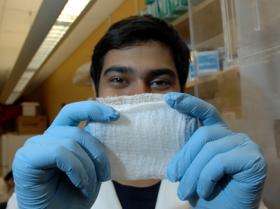
Sophomore Asad Moten holds up a fibrous scaffold he developed that can help regenerate cartilage and other tissues. Photo / Donna Coveney

(PhysOrg.com) -- As a high school sophomore, Asad Moten read a news story about engineering new organs for patients waiting for a transplant, and decided to start his own tissue-engineering project.

His efforts led to the invention of a scaffold that can help regenerate tissue and that may one day be able to help patients with spinal cord injuries, serious burns, nerve defects and other chronic wounds. The invention, known as a protein printboard, may also lead to methods to engineer transplantable organs, which could help some of the 80,000 people in the United States waiting for donated organs.

"Twenty of these patients die every day due to a lack of replacement organs and tissues for them," says Moten, who is forming a startup, ECMatrix Inc., to develop tissue replacement scaffolds.

Moten's invention has won him numerous awards and accolades, the most recent being an induction into the Young Inventor's International Hall of Fame. He was also a regional finalist in the 2006-2007 Siemens Westinghouse Competition.

Now a sophomore at MIT majoring in brain and cognitive sciences and biological engineering, Moten, who is originally from Pakistan, says he became passionate about science and medicine in elementary school. As a high school student in Houston, he completed several projects in nanotechnology, computational neuroscience, gene therapy and biomedical engineering.

He is now working with several other students to launch ECMatrix: Salvatore Mascia, an MIT postdoctoral associate in chemical engineering; Benjamin Geisler, an MD and a student at Harvard School of Public Health; Nate Huebsch, a PhD student in the Harvard-MIT Division of Health Sciences and Technology; and Francesco Renzo, an MBA student at MIT Sloan.

The team is filing for a patent on the tissue scaffold, writing grant applications and entering venture capital and business plan competitions, including the $100K MIT Entrepreneurship Competition. For the $100K competition, the students are focusing on one application of the scaffold: regeneration of spinal discs.

Moten envisions that the scaffold could be implanted to replace a deteriorated disc, and the patient's own cells would then migrate to the scaffold and start forming new cartilage. "The body does most of the regeneration after implantation," he says.

Currently there are no implantable devices that can regenerate tissue the way this scaffold would, he says.

"This is a highly important area, and Asad's approach is novel and a significant step forward," says Ali Khademhosseini, a faculty member at the Harvard-MIT Division of Health Sciences and Technology and Harvard Medical School who has advised Moten on his research.

Moten developed the protein scaffold at Rice University, University of Texas Medical Branch and NASA Johnson Space Center, later at Stony Brook University in New York, and now at Harvard-MIT Division of Health Science and Technology.

Moten is driven by his desire to develop innovative technology that can improve patient care -- a goal he pursues on top of his regular workload as a double major.

"It doesn't seem like work when you are truly passionate and dedicated," he says.

Provided by MIT

Filter


Move the slider to adjust rank threshold, so that you can hide some of the comments.


Display comments: newest first

robbscholl
Mar 05, 2009

Rank: not rated yet
Three Cheers for Asad Moten
Rank 4 /5 (4 votes)
Relevant PhysicsForums posts
  • Stoichiometry
    created22 hours ago
  • Boiling and melting point of impure substances
    created23 hours ago
  • Safe nitrogen compound to decompose a 500 deg C in a furnace?
    createdFeb 09, 2012
  • [ask]electron inside drinking water
    createdFeb 08, 2012
  • How to avoid formation of Lithium Chromate ???
    createdFeb 08, 2012
  • how to choose a reduced or oxidated form in a redox
    createdFeb 08, 2012
  • More from Physics Forums - Chemistry

More news stories

Fool's gold may prove an unlikely alternative to overexploited catalytic materials

Catalytic materials, which lower the energy barriers for chemical reactions, are used in everything from the commercial production of chemicals to catalytic converters in car engines. However, with current catalytic materials ...

Chemistry / Materials Science

created 13 hours ago | popularity 4.3 / 5 (7) | comments 5 | with audio podcast

Unpicking HIV’s invisibility cloak

Drug researchers hunting for alternative ways to treat human immunodeficiency virus (HIV) infections may soon have a novel target—its camouflage coat. HIV hides inside a cloak unusually rich in a sugar ...

Chemistry / Biochemistry

created 13 hours ago | popularity 5 / 5 (4) | comments 0

No entry without protein recycling: Researchers discover new coherence in enzyme transport

The group of Prof. Dr. Ralf Erdmann at the Ruhr-Universität Bochum, Germany, discovered a connection of peroxisomal protein import and receptor export. In the Journal of Biological Chemistry, they disclo ...

Chemistry / Biochemistry

created 13 hours ago | popularity not rated yet | comments 0

Hydrogen from acidic water: Researchers develop potential low cost alternative to platinum for splitting water

A technique for creating a new molecule that structurally and chemically replicates the active part of the widely used industrial catalyst molybdenite has been developed by researchers with the Lawrence Berkeley ...

Chemistry / Materials Science

created Feb 09, 2012 | popularity 5 / 5 (12) | comments 13 | with audio podcast

Under the microscope #7

In this video Dr Ingrid Graz shows us a thin layer of gold on top of rubber. Cracks in the gold allow it to stretch and we can use this for stretchable electronics.

Chemistry / Other

created 15 hours ago | popularity not rated yet | comments 0


Anonymous knocks CIA website offline (Update)

The website of the Central Intelligence Agency was inaccessible on Friday after the hacker group Anonymous claimed to have knocked it offline.

Google users warned of threat to smartphone wallets

Users of Google smartphone wallets were being warned on Friday that there is a way to crack pass codes intended to thwart thieves from going on illicit shopping sprees.

New error-correcting codes guarantee the fastest possible rate of data transmission

Error-correcting codes are one of the triumphs of the digital age. They’re a way of encoding information so that it can be transmitted across a communication channel — such as an optical fiber o ...

Humans may have helped the decline of African rainforests 3000 years ago

(PhysOrg.com) -- Large areas of rainforests in Central Africa mysteriously disappeared over three thousand years ago, to be replaced by savannas. The prevailing theory has been that the cause was a change ...

Complex wiring of the nervous system may rely on a just a handful of genes and proteins

Researchers at the Salk Institute have discovered a startling feature of early brain development that helps to explain how complex neuron wiring patterns are programmed using just a handful of critical genes. ...

The power of estrogen -- male snakes attract other males

A new study has shown that boosting the estrogen levels of male garter snakes causes them to secrete the same pheromones that females use to attract suitors, and turned the males into just about the sexiest ...