Scientists Expose 'Buried' Fault that Caused Deadly 2003 Quake in Iran
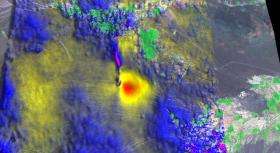
(PhysOrg.com) -- Using satellite radar data, NASA-funded scientists, including UC Riverside’s Gareth Funning, have observed for the first time the healing of subtle, natural surface scars from an earthquake in Iran that occurred on a “buried” fault extending several miles below the surface—a fault whose fractures are not easily observed at Earth’s surface.
Reporting March 5 in Nature, the scientists, led by geophysicist Eric Fielding of NASA’s Jet Propulsion Laboratory (JPL) in Pasadena, Calif., describe how so-called “buried” faults are not so hidden after all.
Using as a case study the magnitude 6.6 earthquake that killed more than 30,000 people and devastated Bam, Iran, in 2003, the scientists analyzed radar images from the European Space Agency’s Envisat satellite to study the land surface above a fault buried about half a mile under Earth’s surface. They discovered a shallow, narrow surface depression that formed and evolved after the quake.
“Using data that cover the first three and a half years after the earthquake, we observed subsidence and lateral contraction of the Earth’s crust surrounding the fault on which the earthquake occurred,” said Funning, an assistant professor in the Department of Earth Sciences. “After testing many models, we concluded that this can only be a result of volume reduction in the crust - the closing of cracks that were opened up during the earthquake. In other words, we observed the crust healing after the earthquake. This has been inferred before using seismological methods, but never before seen from surface movements.”
The researchers’ results have implications for assessing the risk of future earthquakes associated with known buried faults. Such faults can be found around the world but are often missed by geologists or assumed not to be active. A buried fault is thought to be responsible for the major 1994 Northridge earthquake in Southern California.
“The study of so-called ‘damage zones’ surrounding faults is an important topic in Earth Sciences,” said Funning, who joined UCR in 2007. “Such damage, which is observed on many faults in California, particularly the San Andreas, can influence the behavior of earthquakes on those faults - where they initiate, the direction in which they break, and the strength of the shaking near the fault.”
In the case of the Bam earthquake, previous seismic and satellite studies showed that the fault under Bam had slipped by about 2 to 3 meters at the time of the earthquake. But when scientists from Iran went out in the field after the earthquake, the cracks they found at the surface only showed 25 centimeters of slip or less. If indeed there had been 2 to 3 meters of slip at depth, the surface must have somehow absorbed that slip.
The researchers suspected the fault zone below could reveal itself in a slight deformation of Earth’s surface because the pressure and stress during an earthquake causes rocks in the fault zone to expand and become more porous. After the quake, the ground will “heal” over a period of years, settling and forming a depression.
To investigate the extent and rate of surface deformation after the 2003 earthquake, the researchers turned to the Advanced Synthetic Aperture Radar (ASAR) instrument on Envisat. (ASAR images are used to precisely measure elevation by bouncing a beam of microwave radiation off Earth’s surface and observing the reflection back to the satellite.) The researchers compared images from the 3.5 years following the Bam quake to see how the surface elevation changed, using a technique known as interferometric synthetic aperture radar (InSAR).
InSAR revealed a shallow, ditch-like depression on the surface - measuring between 200 to 400 meters wide and about 3 centimeters deep - directly above the ruptured fault, indicating that the deformation was associated with the earthquake.
The team also modeled the sinking throughout the fault zone, using a model that is normally used to study crustal compaction and expansion around volcanoes. By analyzing an array of points along the fault to estimate how compaction produced the features at the surface, the researchers concluded that the 2 to 3 meters of slip at depth was absorbed by a “damage zone,” close to Earth’s surface. This means that the earthquake slip was spread over a wide volume of rock in the surface layers instead of a single fault.
The study is helping the researchers anticipate the future behavior of the fault. Initially, they were concerned that if stress at depth was not relieved at the surface, then a subsequent earthquake could result. Because the rupture’s stress was absorbed in the damage zone, the researchers believe the fault that shook Bam in 2003 is no longer a risk.
“There’s always the chance that a nearby, related fault could rupture, as eastern Iran is full of faults that are active at some scale,” JPL’s Fielding said. “But this one beneath Bam is the type that ruptures every 2,000 years or longer, and the stress on it seems to have been relieved.”
Provided by University of California, Riverside


