Lustful beetles desire water, not sex
March 5, 2009 By Megan Easton
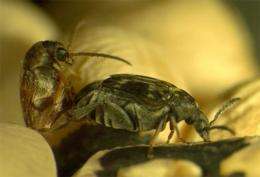
Seed beetles mating.
(PhysOrg.com) -- Female seed beetles are known for their promiscuity, a surprising fact given that the males of the species have dangerously sharp spikes on their sex organs. Now a U of T Mississauga team led by an undergraduate student has discovered that this perplexing hunger for sex may in fact be driven by a thirst for water.
The female's desire to mate multiple times appears to be linked to her need for hydration, which she receives from males during copulation, says lead researcher Claudia Ursprung. The beetles live in arid environments where the benefits of being hydrated likely offset the potential damage to the female reproductive tract from the male's sharp edges.
"The male seed beetle's ejaculate is very large for its body size - close to 10 per cent of its body weight - and we wanted to know whether there was something that he was giving to the female to make her want to come back for multiple matings," said Ursprung, who conducted the study in 2007 for her fourth-year thesis in the lab of biology professor Darryl Gwynne. The research was published in a recent issue of the journal Behavioral Ecology and Sociobiology.
"Males of many insects transfer substances in the ejaculate to females," said Gwynne, a co-author on the paper. "With this beetle, 'drinks and food' were the two likely material benefits from male ejaculate."
To test their hypothesis, the researchers contained 79 female seed beetles for eight days in one of four groups receiving either water, sugar-water, food or nothing. When virgin male seed beetles arrived on the scene, only the females receiving water and sugar-water showed less than their usual interest in coupling. Female beetles who received water in the experiment also had a longer lifespan.
"We were surprised that water and not food was the important factor in the female's mating behaviour, because in other species it's often a matter of receiving nutrition from the male," said Ursprung, now a second-year student in veterinary medicine at the University of Guelph.
Provided by University of Toronto
-
Mountain pine beetle activity may impact snow accumulation and melt
Jun 08, 2011 |
5 / 5 (6) |
0
-
Where birds fly offers clues to man
May 11, 2011 |
5 / 5 (1) |
0
-
Hidden water holds the key to a changing desert
Apr 27, 2011 |
3.3 / 5 (7) |
0
-
Less radiation damage in Chernobyl lakes than feared
Apr 21, 2011 |
4.8 / 5 (4) |
10
-
With A-List help, Glory aims to unravel uncertainties about aerosols
Feb 10, 2011 |
4.7 / 5 (3) |
0
-
Engineers build first sub-10-nm carbon nanotube transistor
Feb 01, 2012 |
4.9 / 5 (33) |
30
-
Something old, something new: Evolution and the structural divergence of duplicate genes
Jan 31, 2012 |
4.6 / 5 (7) |
1
-
The hidden nanoworld of ice crystals: Revealing the dynamic behavior of quasi-liquid layers
Jan 30, 2012 |
5 / 5 (4) |
1
-
Stock market network reveals investor clustering
Jan 27, 2012 |
3.9 / 5 (23) |
8
-
Of microchemistry and molecules: Electronic microfluidic device synthesizes biocompatible probes
Jan 26, 2012 |
5 / 5 (2) |
0
-
Factors affecting beet root cell membrane
12 hours ago
-
Stem cell question.
Feb 10, 2012
-
Protease cleavage
Feb 10, 2012
-
Pertubance in a model
Feb 10, 2012
-
Cancer drugs and Alzheimer's, Oh my!
Feb 09, 2012
-
Squishing cells
Feb 09, 2012
- More from Physics Forums - Biology
More news stories
A mitosis mystery solved: How chromosomes align perfectly in a dividing cell
Although the process of mitotic cell division has been studied intensely for more than 50 years, Whitehead Institute researchers have only now solved the mystery of how cells correctly align their chromosomes during symmetric ...
7 hours ago |
4.5 / 5 (12) |
0
|
Researchers find extensive RNA editing in human transcriptome
In a new study published online in Nature Biotechnology, researchers from BGI, the world's largest genomics organization, reported the evidence of extensive RNA editing in a human cell line by analysis of RNA-seq data, demons ...
7 hours ago |
5 / 5 (4) |
0
|
The proteins ensuring genome protection
Researchers from the University of Geneva (UNIGE), Switzerland, have discovered the crucial role of two proteins in developing a cell 'anti-enzyme shield'. This protection system, which operates at the level of molecular ...
7 hours ago |
5 / 5 (3) |
0
|
Entire genome of extinct human decoded from fossil
(PhysOrg.com) -- In 2010, Svante Pääbo and his colleagues presented a draft version of the genome from a small fragment of a human finger bone discovered in Denisova Cave in southern Siberia. The ...
Feb 07, 2012 |
4.7 / 5 (60) |
51
|
Why are there so few fish in the Earth's oceans?
(PhysOrg.com) -- A Stony Brook University researcher has found that, contrary to popular belief, there are not plenty of fish in the sea.
Feb 08, 2012 |
4.2 / 5 (18) |
27
|
Scientists discover molecular secrets of 2,000-year-old Chinese herbal remedy
For roughly two thousand years, Chinese herbalists have treated Malaria using a root extract, commonly known as Chang Shan, from a type of hydrangea that grows in Tibet and Nepal. More recent studies suggest that halofuginone, ...
New method to examine batteries -- MRI from the inside
There is an ever-increasing need for advanced batteries for portable electronics, such as phones, cameras, and music players, but also to power electric vehicles and to facilitate the distribution and storage of energy derived ...
Google might launch Drive for cloud storage soon
(PhysOrg.com) -- Google's next big move, according to the Wall Street Journal, is a cloud storage service called Drive. Hardly first to the plate, Google is simply catching up to introducing its cloud reposi ...
Lab study raises questions over nano-particle impact
Tests involving chickens have raised questions about the impact on health from engineered nano-particles, the ultra-fine grains commonly used in drugs and processed foods, scientists said on Sunday.
Overeating may double risk of memory loss
New research suggests that consuming between 2,100 and 6,000 calories per day may double the risk of memory loss, or mild cognitive impairment (MCI), among people age 70 and older. The study was released today and will be ...
Starve a virus, feed a cure? Findings show how some cells protect themselves against HIV
A protein that protects some of our immune cells from the most common and virulent form of HIV works by starving the virus of the molecular building blocks that it needs to replicate, according to research published online ...