Bristly Spheres as Capsules
March 6, 2009 Bristly Spheres as Capsules

Enlarge

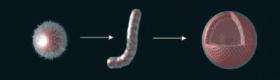
Nanoparticle brushes: Complex nanostructures can be formed by self assembly of amphiphilic CdSe/CdS core-shell nanoparticles that bear a brushlike layer of poly(ethylene oxide) chains. This route is based on controlling the volume fractions of hydrophilic and hydrophobic moieties within the particles and allows the formation of micellar, cylindrical, or vesicular nanoobjects. (c) Wiley-VCH 2009

(PhysOrg.com) -- Amphiphilic molecules, which have one water-friendly (hydrophilic) end and one water-repellant (hydrophobic) end, spontaneously aggregate in aqueous solutions to make superstructures like capsules or bilayers. This phenomenon is responsible for the effects of detergents and soaps. Dirt is enclosed in little capsules of surfactant, which makes it water-soluble.

Cell membranes are also based on this principle: they are simply lipid bilayers, an aggregation of lipid molecules that line up with their hydrophobic tails all together and their hydrophilic heads protruding into the aqueous environment. As reported in the journal Angewandte Chemie, researchers at the Universities of Hamburg and Freiburg (Germany) led by Horst Weller and Stephan Förster have now produced amphiphilic hybrid particles made of a water-insoluble inorganic nanoparticle at the core surrounded by a bristle-like layer of hydrophilic polymer chains.

The inorganic nanoparticles are made of cadmium selenide and cadmium sulfide. Polyethylene oxide chains are attached to the nanoparticles through amino groups. The nature of the superstructures formed in aqueous solution depends on how densely the surfaces of the little spheres are covered with the polymer "bristles". If they are densely packed, the hybrid particles remain in solution as individuals, because the bristles repel each other.

If the bristles are less dense, dimers and trimers are formed; still sparser bristles result in long wormlike aggregates of many particles that grow into a network through occasional Y-shaped branches. For the particles to aggregate in this way, the bristles on the surfaces of the inorganic cores have to reorganize significantly: they move aside a little to free up points of contact so the cores can attach to each other. Aggregation then continues until the resulting ensemble of cores is, as a whole, surrounded by a sufficiently dense layer of bristles, which acts as a shield toward additional particles.

Cores with an even smaller number of polymer bristles aggregate into extended curved layers that close themselves off into capsule-shaped vesicles. The walls of the vesicles consist of a monolayer of the bristly particles.

The polymer-coated spheres offer a new, simple method for the controlled production of superstructures. The vesicles could be used to encapsulate drugs, for example, as contrast agents, or as ordered liquid crystalline phases for the production of nanostructured hybrid materials.

More information: Stephan Förster, Micelle and Vesicle Formation of Amphiphilic Nanoparticles, Angewandte Chemie International Edition, doi: 10.1002/anie.200805158

Source: Wiley


print this article email this article download pdf blog this article bookmark this article     Stumble it Digg this share on Facebook retweet share on Reddit add to delicious
Rate this story - 3 /5 (1 vote)


March 6, 2009 all stories

Comments: 0

3 /5 (1 vote)
  • Stumble this up

  • Digg this

  • share this

  • hide
  • Related Stories


  • hide
  • Relevant PhysicsForums posts

  • More from

Other News

Blocking biofilms: Alzheimer's research sheds light on potential treatments for urinary tract infections

Chemistry / Biochemistry

created 9 hours ago | popularity 5 / 5 (1) | comments 0

(PhysOrg.com) -- Research into Alzheimer's disease seems an unlikely approach to yield a better way to fight urinary tract infections (UTIs), but that's what scientists at Washington University School of Medicine in St. Louis ...


Chemists get custom-designed microscopic particles to self-assemble in liquid crystal

Chemists get custom-designed microscopic particles to self-assemble in liquid crystal

Chemistry / Materials Science

created 10 hours ago | popularity 5 / 5 (5) | comments 0

(PhysOrg.com) -- The scientists anticipate their "LithoParticles" will have significant applications in photonics, optical communications and other areas.


Study shows flavanol antioxidant content of US chocolate and cocoa-containing products

Chemistry / Other

created 12 hours ago | popularity 1 / 5 (2) | comments 0

A recent study confirms that the antioxidants and other plant-based nutrients in chocolate and cocoa products are highly associated with the amount of non-fat cocoa-derived ingredients in the product. The study expands on ...


Sandia CR5

Machine Converts CO2 into Gasoline, Diesel, and Jet Fuel

Chemistry / Biochemistry

created Nov 23, 2009 | popularity 4.6 / 5 (30) | comments 19

(PhysOrg.com) -- Researchers at Sandia National Laboratories have built a machine that uses the sun's energy to convert carbon dioxide waste from power plants into transportation fuels such as gasoline, diesel, ...


New hydrogen-storage method discovered

New hydrogen-storage method discovered

Chemistry / Materials Science

created Nov 22, 2009 | popularity 4.3 / 5 (41) | comments 15

Scientists at the Carnegie Institution have found for the first time that high pressure can be used to make a unique hydrogen-storage material. The discovery paves the way for an entirely new way to approach ...