A dead gene comes back to life in humans
March 6, 2009 A dead gene comes back to life in humans

Enlarge

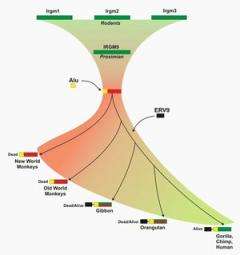
The figure summarizes the death and resurrection of Human IRGM gene. The functional gene (green) and the non-functional dead copy (red) are shown within the context of the generally accepted primate phylogeny. Genetic analyses suggest that that gene died approximately 50 million years ago as a result of genetic changes that disrupted its expression and function. In all Old World and New World monkeys, the gene is non-functional. However, in the ancestor of the apes and humans, mutations occurred to restore its function. This restoration of the protein's reading frame was gradual and some species such as gibbon and orangutan carry a living and dead copy.

(PhysOrg.com) -- Researchers have discovered that a long-defunct gene was resurrected during the course of human evolution. This is believed to be the first evidence of a doomed gene - infection-fighting human IRGM - making a comeback in the human/great ape lineage.

The study, led by Evan Eichler's genome sciences laboratory at the University of Washington and the Howard Hughes Institute, is published March 6 in the open access journal PLoS Genetics, in the article, "Death and Resurrection of the Human IRGM Gene." The first author of the study is Cemalettin Bekpen, a UW senior fellow in genome sciences.

The truncated IRGM gene is one of only two genes of its type remaining in humans. The genes are Immune-Related GTPases, a kind of gene that helps mammals resist germs like tuberculosis and salmonella that try to invade cells. Unlike humans, most other mammals have several genes of this type. Mice, for example, have 21 Immune-Related GTPases. Medical interest in this gene ignited recently, when scientists associated specific IRGM mutations with the risk of Crohn's disease, an inflammatory digestive disorder.

In this latest study, the researchers reconstructed the evolutionary history of the IRGM locus within primates. They found that most of the gene cluster was eliminated by going from multiple copies to a sole copy early in primate evolution, approximately 50 million years ago. Comparisons of Old World and New World monkey species suggest that the remaining copy died in their common ancestor.

The gene remnant continued to be inherited through millions of years of evolution. Then, in the common ancestor of humans and great apes, something unexpected happened. Once again the gene could be read to produce proteins. Evidence suggests that this change coincided with a retrovirus insertion in the ancestral genome.

"The IRGM gene was dead and later resurrected through a complex series of structural events," Eichler said. "These findings tell us that we shouldn't count a gene out until it is completely deleted."

The structural analysis, he added, also suggests a remarkable functional plasticity in genes that experience a variety of evolutionary pressures over time. Such malleability may be especially useful for genes that help in the fight against new or newly resistant infectious agents.

More information: Bekpen C, Marques-Bonet T, Alkan C, Antonacci F, Leogrande MB, et al. (2009) Death and Resurrection of the Human IRGM Gene. PLoS Genet 5(3): e1000403. doi:10.1371/journal.pgen.1000403, http://www.plosgenetics.org/article/info:doi/10.1371/journal.pgen.1000403

Provided by University of Washington


print this article email this article download pdf blog this article bookmark this article     Stumble it Digg this share on Facebook retweet share on Reddit add to delicious
Rate this story - 4.9 /5 (10 votes)

Rank Filter

Move the slider to adjust rank threshold, so that you can hide some of the comments.


Display comments: newest first

  • Sepp - Mar 07, 2009
    • Rank: 4 / 5 (1)
    Any chance of bringing back to life the gene that lets humans manufacture vitamin C as part of normal metabolism, as is the case with most animals?

March 6, 2009 all stories

Comments: 1

4.9 /5 (10 votes)
  • Stumble this up

  • Digg this

  • share this

  • hide
  • Related Stories

  • Nanoparticles for gene therapy improve
    created Nov 06, 2009 | popularity not rated yet | comments 0
  • Genome sequence for the domestic horse unveiled
    created Nov 05, 2009 | popularity not rated yet | comments 0
  • Study shows neural stem cells in mice affected by gene associated with longevity
    created Nov 05, 2009 | popularity not rated yet | comments 0
  • Scientists reveal a new mechanism that increases atherosclerosis in mice
    created Nov 05, 2009 | popularity not rated yet | comments 0
  • New discoveries in the yeast Saccharomyces cerevisiae
    created Nov 04, 2009 | popularity not rated yet | comments 0


  • hide
  • Relevant PhysicsForums posts

Other News

Breast density associated with increased risk of cancer recurrence

Medicine & Health / Cancer

created 1hour ago | popularity not rated yet | comments 0

A new study finds that women treated for breast cancer are at higher risk of cancer recurrence if they have dense breasts. Published in the December 15, 2009 issue of Cancer, a peer-reviewed journal of the American Cancer ...


Scientists uncover new key to the puzzle of hormone therapy and breast cancer

Scientists uncover new key to the puzzle of hormone therapy and breast cancer

Medicine & Health / Cancer

created 2 hours ago | popularity 5 / 5 (1) | comments 0

The use of postmenopausal hormone therapy has decreased over time in the United States, which researchers suggest may play a key role in the declining rate of atypical ductal hyperplasia, a known risk factor ...


Young tennis players who play only 1 sport are more prone to injuries

Young tennis players who play only one sport are more prone to injuries

Medicine & Health / Health

created 2 hours ago | popularity not rated yet | comments 0

Gifted young athletes are under increasing pressure to play only one sport year round.


Lawmaker wants probe of E. coli and school lunches

Medicine & Health / Diseases

created 2 hours ago | popularity not rated yet | comments 0

(AP) -- The chairman of the House Education and Labor Committee wants an investigation into the risk of deadly E. coli getting into school lunches.


Developmental delay could stem from nicotinic receptor deletion

Medicine & Health / Genetics

created 17 hours ago | popularity 4.7 / 5 (3) | comments 0

The loss of a gene through deletion of genetic material on chromosome 15 is associated with significant abnormalities in learning and behavior, said a consortium of researchers led by Baylor College of Medicine in a report ...