Unexpected source of gamma rays discovered
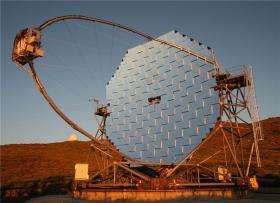
An international team of astrophysicists, involving several research groups in Spain, has discovered a source of very high energy gamma rays in the region of the distant galaxies 3C 66A and 3C 66B. This new gamma emission, observed from the MAGIC telescope in La Palma (Canary Islands) is not consistent with what scientists expected to find, and has resulted in them suggesting three hypotheses to explain their origin.
In 2007, the MAGIC telescope, located in the Roque de los Muchachos observatory on the Canary island of La Palma, spent more than 50 hours examining the 3C 66A galaxy region, which is about 3 billion light years from Earth. The results of those observations led to the discovery of a source of very high energy gamma rays (over 150 billion electron volts), as published in The Astrophysical Journal Letters journal.
The researcher, Errando Manel, from the Institut de Física d'Altes Energies (IFAE), one of the institutions involved in the study, explained to SINC that very high energy gamma rays "are a type of extremely high energy light which rarely occurs in nature". They are generally associated with violent phenomena such as supernova explosions or jets of high energy particles that form around black holes.
With regard to the data collected by MAGIC, Errando indicates that neither the position nor the properties of gamma emission exactly match what was expected from a galaxy like 3C 66A, which is considered a quasar (celestial body that emits large amounts of radiation) emitting a jet of particles that points directly towards Earth.
Scientists suggest three hypotheses for explaining this unexpected source of very high energy gamma rays, which they have called "MAGIC J0223+430", due to the celestial coordinates where they found it.
The first option is that the emission is actually from the quasar 3C 66A, assuming that its active nucleus had different properties to those attributed to it to date, or that this galaxy is not as distant as previously thought.
Another possibility, supported by data from the energy spectrum taken by MAGIC, is that the source of gamma rays comes from another far closer galaxy, 3C 66B, about three million light years from Earth. "This galaxy is similar to 3C 66A, but its jet of particles does not point directly towards us," commented Errando.
"If confirmed that the 3C 66B galaxy is the source, it would only be the second radio galaxy observed to date (the first was M87) that emits VHE gamma rays, and these types of galaxies would be established as a new source of emission of very high energy gamma rays", SINC was told by Maria Victoria Fonseca, another of the study participants from the High Energy Group at the Complutense University of Madrid (UCM).
The third hypothesis is that the astrophysical gamma rays do not originate from 3C 66A or 3C 66B, but rather from an unknown source not yet detected, not even by the observatories that analyse the sky at lower energies.
Over the next few years scientists will continue to study that region of space, also observed by many telescopes apart from MAGIC, to find the correct explanation.
Apart from the UCM and IFAE, also taking part in the study were the Autonomous University of Barcelona (UAB), the Astrophysical Institute of the Canary Islands (IAC), the University of Barcelona (UB), University of La Laguna (ULL), the Institut de Ciencičs de l'Espai (IEEC-CSIC) and the Astrophysical Institute of Andalusia (CSIC), together with other research centres in Finland, Germany, Italy, Switzerland, Poland, Armenia, Bulgaria and the United States.
More information: E. Aliu et al. (MAGIC Collaboration). “Discovery of a very high energy gamma-ray signal from the 3C 66A/B region”. The Astrophysical Journal Letters 692:L29-L33, febrero de 2009.
Provided by SINC


