NASA Gives 'Go' for Space Shuttle Launch on March 11
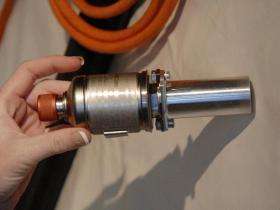
March 6, 2009 Flow Control Valve

Enlarge

On Launch Pad 39A at NASA's Kennedy Space Center in Florida, a technician holds one of space shuttle Discovery's gaseous hydrogen flow control valves after its removal. Two of the three valves being removed will undergo detailed inspection. Photo Credit: NASA/Kim Shiflett

(PhysOrg.com) -- NASA managers completed a review Friday of space shuttle Discovery's readiness for flight and selected the official launch date for the STS-119 mission. Commander Lee Archambault and his six crewmates are now scheduled to lift off to the International Space Station at 9:20 p.m. EDT on March 11.

Discovery's launch date was announced following Friday's Flight Readiness Review. During the meeting, top NASA and contractor managers assessed the risks associated with the mission and determined the shuttle's equipment, support systems and procedures are ready for flight.

The review included a formal presentation of the shuttle's flow control valve work, initiated after NASA identified damage to a valve on shuttle Endeavour during its November 2008 flight. Using a detailed inspections, there are three valves that have been cleared of crack indications now installed in Discovery to support the STS-119 mission.

The three flow control valves, one for each space shuttle main engine, channel gaseous hydrogen from the engines through the main propulsion system and back to the external fuel tank. This flow regulation maintains the tank's structural integrity and delivers liquid hydrogen to the engines at the correct pressure.

Discovery's STS-119 flight will deliver the space station's fourth and final set of solar array wings, completing the station’s truss, or backbone. The arrays will provide the electricity to fully power science experiments and support the station's expanded crew of six in May. The 14-day mission will feature four spacewalks to help install the S6 truss segment to the starboard, or right, side of the station and the deployment of its solar arrays. The flight also will replace a failed unit for a system that converts urine to potable water.

Archambault will be joined on STS-119 by Pilot Tony Antonelli and Mission Specialists Joseph Acaba, Steve Swanson, Richard Arnold, John Phillips and Japan Aerospace Exploration Agency astronaut Koichi Wakata. Wakata will replace space station crew member Sandra Magnus, who has been aboard the station for more than four months. He will return to Earth during the next station shuttle mission, STS-127, targeted to launch in June 2009.

Former science teachers Acaba and Arnold are now fully-trained NASA astronauts. They will make their first journey to orbit on the mission and step outside the station to conduct critical spacewalking tasks.

Provided by NASA


print this article email this article download pdf blog this article bookmark this article     Stumble it Digg this share on Facebook retweet share on Reddit add to delicious
Rate this story - 5 /5 (2 votes)


March 6, 2009 all stories

Comments: 0

5 /5 (2 votes)
  • Stumble this up

  • Digg this

  • share this

  • hide
  • Related Stories

  • Shuttle, station crews seal hatches for departure
    created 23 hours ago | popularity not rated yet | comments 0
  • Astronauts take spacewalk No. 3 after suit snag
    created Nov 23, 2009 | popularity not rated yet | comments 0
  • Astronaut's baby daughter born as he circles Earth
    created Nov 22, 2009 | popularity not rated yet | comments 0
  • Baby can wait as expectant dad finishes spacewalk
    created Nov 21, 2009 | popularity not rated yet | comments 0
  • Astronauts await word of baby girl on Earth
    created Nov 20, 2009 | popularity not rated yet | comments 0


  • hide
  • Relevant PhysicsForums posts

  • Question about 2-body gravity
    created Nov 24, 2009
  • life on Mars
    created Nov 24, 2009
  • Semi-major axis from cartesian co-ordinates
    created Nov 23, 2009
  • Primary Mirror grinding
    created Nov 23, 2009
  • More from Physics Forums - General Astronomy

Other News

Oceanic crust formation is dynamic after all

Oceanic crust formation is dynamic after all

Space & Earth / Earth Sciences

created 3 minutes ago | popularity not rated yet | comments 0

Imagine the Earth's crust as the planet's skin: Some areas are old and wrinkled while others have a fresher, more youthful sheen, as if they had been regularly lathered with lotion.


Cosmic 'dig' reveals vestiges of the Milky Way's building blocks

Cosmic 'Dig' Reveals Vestiges of the Milky Way's Building Blocks

Space & Earth / Astronomy

created 1hour ago | popularity 5 / 5 (2) | comments 0

(PhysOrg.com) -- Peering through the thick dust clouds of our galaxy's "bulge" (the myriads of stars surrounding its center), a team of astronomers has unveiled an unusual mix of stars in the stellar grouping ...


Cutting greenhouse pollutants could directly save millions of lives worldwide

Space & Earth / Environment

created 3 hours ago | popularity 1 / 5 (2) | comments 1

Tackling climate change by reducing carbon dioxide and other greenhouse emissions will have major direct health benefits in addition to reducing the risk of climate change, especially in low-income countries, according to ...


Mars Reconnaissance Orbite

Mars Reconnaissance Orbite Team Plans Uplink of Protective Files

Space & Earth / Space Exploration

created 6 hours ago | popularity 5 / 5 (1) | comments 0

(PhysOrg.com) -- The team operating NASA's Mars Reconnaissance Orbiter plans to uplink protective files to the spacecraft next week as one step toward resuming the orbiter's research and relay activities.


Small faults in Southeast Spain reduce earthquake risk of larger ones

Small faults in Southeast Spain reduce earthquake risk of larger ones

Space & Earth / Earth Sciences

created 3 hours ago | popularity not rated yet | comments 0

A team of Spanish scientists, studying recent, active deformations in the Baetic mountain range, have shown that the activity of smaller tectonic structures close to larger faults in the south east of the ...