Singapore-made biofuel to run cars in Europe, North America
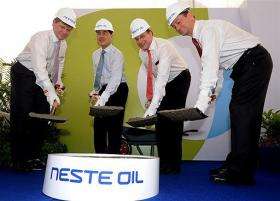
March 6, 2009 Singapore and Neste Oil officials break ground on the world's biggest renewable diesel plant

Enlarge

L-R: Neste Oil's Jarmo Honkamaa, Singapore Minister for Trade and Industry, Lim Hng Kiang, Neste Oil President and CEO Matti Lievonen, and Neste Oil Managing Director Olli Virta attend a ceremony to kick off the world's biggest renewable diesel plant. Diesel made from palm oil, vegetable oil and animal fat in Singapore may soon be powering cars in Europe and North America, Neste Oil said.

Diesel made from palm oil, vegetable oil and animal fat in Singapore may soon be powering cars in Europe and North America, Finland's Neste Oil said Friday.

Neste Oil, which is building the world's biggest biodiesel plant in the city-state at a cost of 1.2 billion Singapore dollars (776 million US), said it was also looking to market the fuel in Japan and South Korea.

The plant will have an annual capacity of 800,000 tonnes when it becomes operational next year.

It will produce Neste Oil's patented NExBTL renewable diesel which the company said is the cleanest diesel fuel in the world.

NExBTL can be used in all diesel engines and significantly reduces exhaust emissions compared with regular diesel, the company said.

The plant was originally planned to target the European market, Neste Oil deputy chief executive Jarmo Honkamaa told reporters during a media visit to the plant site, which is 30 percent complete.

"We know now already that part of the volume will go to North America... the west coast of Canada."

Company executives said the move towards cleaner fuel worldwide in a bid to reduce global warming was likely to drive demand.

Neste Oil was also talking with companies in Japan and South Korea to buy the renewable diesel, Honkamaa said, adding that Singapore would also be a potential market.

"I don't see that the marketing of this product is very challenging. The main challenges will be on the raw material side," Honkamaa said.

He said the Singapore facility could be beefed up to produce jet fuel from the same feedstocks if there was a need.

Renewable diesel would have a 200-300 US dollar premium per tonne over regular diesel but Neste Oil said there was demand because of the benefits of using cleaner fuel.

While crude oil prices have plunged from their peak at 147 dollars in July 2008 to current levels around 44 dollars, palm oil prices have also plummeted from 1,245 dollars per tonne a year ago to about 526 dollars a tonne.

Neste Oil chief executive Matti Lievonen said Singapore was chosen partly because its proximity to raw materials.

Singapore is close to Indonesia and Malaysia, the world's two leading crude palm oil producers.

Despite a global economic crisis, Neste Oil is in a healthy financial state, with a 1.6 billion euro (2.0 billion US) credit facility with European banks, Lievonen said.

Neste Oil is also building a renewable diesel plant with similar capacity in Rotterdam, the Netherlands which is expected to come on stream after the Singapore facility.

(c) 2009 AFP


print this article email this article download pdf blog this article bookmark this article     Stumble it Digg this share on Facebook retweet share on Reddit add to delicious
Rate this story - 1.3 /5 (3 votes)

Rank Filter

Move the slider to adjust rank threshold, so that you can hide some of the comments.


Display comments: newest first

  • AnnieG - Mar 07, 2009
    • Rank: not rated yet
    This fuel is being hailed as being green and a way to provide cleaner fuels worldwide but at what cost to the environment. Many forsests have been decimated to make way for the palm oil plants with loss of whole ecosystems. How many animals will be bred and slaughtered just to provide the animal fat and how many large tracts of land will be clreared to produce the vegetable oil instead of growing food? It seems to me to be robbing Peter to pay Paul!

March 6, 2009 all stories

Comments: 1

1.3 /5 (3 votes)
  • Stumble this up

  • Digg this

  • share this

  • hide
  • Related Stories


  • hide
  • Relevant PhysicsForums posts

  • Control System
    created 23 hours ago
  • Base Isolation Systems in Skyscrapers?
    created Nov 23, 2009
  • Need to interview a Computer Hardware Engineer for school project
    created Nov 23, 2009
  • transient heat transfer
    created Nov 23, 2009
  • More from Physics Forums - General Engineering

Other News

Magic box for mission impossible

Technology / Telecom

created 27 minutes ago | popularity not rated yet | comments 0

On September 11, firefighters, police officers and ambulance workers faced a terrifying rescue effort in the World Trade Center complex. They battled to save people from the collapsing Twin Towers, searched for survivors, ...


Design chosen for British 1,000 mph car

Design chosen for British 1,000 mph car (w/ Video)

Technology / Engineering

created 2 hours ago | popularity 5 / 5 (1) | comments 1

(PhysOrg.com) -- A British team hoping to be the first to get a car to 1,000 mph (1,610 km/h) has made its final design selection. The six-tonne car, known as the Bloodhound, will be powered by a Eurofighter ...


Selling chip makers on optical computing

Selling chip makers on optical computing

Technology / Semiconductors

created 20 hours ago | popularity 4.7 / 5 (9) | comments 1

(PhysOrg.com) -- Computer chips that transmit data with light instead of electricity consume much less power than conventional chips, but so far, they've remained laboratory curiosities. Professors Vladimir ...


Taking the drudgery out of software development

Taking the drudgery out of software development

Technology / Software

created 17 hours ago | popularity 3.9 / 5 (9) | comments 3

(PhysOrg.com) -- Software developers will no longer have to reinvent the wheel when writing new programs and applications thanks to a clever new set of tools and a central repository of 'building blocks'.


The number of text messages that a mobile user in S.Korea can send out a day has been restricted to 500, down from 1,000

S.Korea halves ceiling on text messages to fight spam

Technology / Telecom

created 6 hours ago | popularity not rated yet | comments 0

South Korean authorities on Wednesday halved the daily limit on text messages sent out by mobile phones as part of a campaign against spam, officials said.