Obama to reverse Bush limits on stem-cell research
March 6, 2009
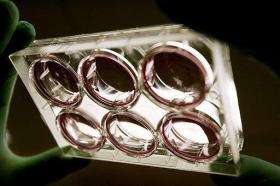
Stem cell cultures are held up in a US lab. US President Barack Obama will on Monday sign an executive order reversing Bush administration restrictions on federal funding for stem cell research, a senior administration official said.
US President Barack Obama will on Monday sign an executive order reversing Bush administration restrictions on federal funding for stem-cell research, a senior administration official said.
The official would not divulge the exact wording of the order, but confirmed, on condition of anonymity, that it would be in line with Obama's campaign vow to restore funding to embryonic stem-cell research.
The president will sign the document in a White House ceremony Monday morning, the official said, in the latest of a long line of actions reversing the policies of his predecessor, former president George W. Bush.
The move will spark delight among scientists who have long campaigned for the Bush policy to be overturned, but will likely be condemned by conservative right-to-life groups.
Obama spelled out his campaign policy on stem-cell research last August in a list of answers to the Science Debate 2008 scientific lobby group.
"I strongly support expanding research on stem cells," Obama wrote.
"I believe that the restrictions that President Bush has placed on funding of human embryonic stem-cell research have handcuffed our scientists and hindered our ability to compete with other nations.
"As president, I will lift the current administration's ban on federal funding of research on embryonic stem cell lines created after Aug. 9, 2001 through executive order, and I will ensure that all research on stem cells is conducted ethically and with rigorous oversight."
Reports about Obama's plans for Monday were immediately condemned by Tony Perkins, president of the Family Research Council.
"Today's news that President Obama will open the door to direct taxpayer funds for embryonic stem-cell research that encourages the destruction of human embryos is a slap in the face to Americans who believe in the dignity of all human life," Perkins said.
Bush barred federal funding from supporting work on new lines of stem cells derived from human embryos in 2001, allowing research only on a small number of embryonic stem-cell lines which existed at that time.
He also several times vetoed legislation passed by Congress backing the research, which advocates say could help find a cure to diseases like Alzheimer's, diabetes and Parkinson's.
Obama reportedly told Democratic lawmakers shortly after his inauguration in January that he would guarantee lifting Bush-era restrictions on federal funding of stem-cell research.
He also co-sponsored legislation while a senator that would have permitted using federal funding for stem-cell research.
"Barack Obama and Joe Biden believe that we owe it to the American public to explore the potential of stem cells to treat the millions of people suffering from debilitating and life-threatening diseases," his campaign said in a statement last year.
Bush argued that using human embryos for scientific research -- which often involves their destruction -- crossed a moral barrier and urged scientists to consider other alternatives.
Embryonic stem cells are primitive cells from early-stage embryos capable of developing into almost every tissue of the body.
Science's quest to harness stem cell power
The controversial quest to harness the power of embryonic stem cells may be about to enter a new phase in the United States with the Obama administration set to lift a seven-year research ban Monday.
Stem cells are the primitive cells that grow into the roughly 200 types of cell that comprise the body's tissues.
Scientists aim is to coax these cells into becoming lab-dish replacements for heart, liver, skin, eye, brain, nerve and other cells destroyed by disease, accident, war or normal wear-and-tear.
Parkinson's disease, Alzheimer's, Type 1 diabetes, cancer and cardiac degeneration are among the many disorders that, in theory, could be healed by this wonder cure.
Of the two categories of stem cells, the biggest interest by far has focused on embryonic stem cells.
These are so-called totipotent cells, meaning that they have ability to differentiate, or diversify, into any type of cell.
But embryonic stem cell research has been controversial.
These master cells are extracted from fertilized eggs that typically are allowed to grow for three to three to five days.
The harvested stem cells are kept in self-replicating "lines" for study, but the embryos themselves -- usually surplus embryos from in-vitro fertilization (IVF) -- are destroyed by the process.
American evangelical conservatives have long opposed this research, saying that a human embryo equates to a human life.
In August 2001, former president George W. Bush banned all US federal funding for research that entailed new lines of human embryonic stem cells.
That move caused an outcry among US researchers, who warned investment and talent in their field would shift to other countries.
In July 2006, an attempt in the US Senate to lift some restrictions was barred by Bush, wielding his presidential veto for the first time.
President Barack Obama has vowed to scrap the ban, and a White House official said the president would sign executive order Monday reversing Bush administration restrictions on federal funding for stem cell research.
The official would not divulge the exact wording of the order, but confirmed, on condition of anonymity, that it would be in line with Obama's campaign vow to restore funding to embryonic stem cell research.
Access to embryonic stem cells in other countries has also been restricted by laws or regulations governing the source of the embryos or by difficulties in finding women willing to donate their eggs.
In contrast to embryonic stem cells are so-called adult stem cells, which while still immature are genetically programmed to differentiate into specific cell types.
Adult stem cells were initially thought to be very small in number, but the tally has been found in many more tissues in recent years. They have now been discovered in brain, bone marrow, peripheral blood, blood vessels, skeletal muscle, skin and liver.
There are already several types of therapy involving adult stem cells, the best known of which, dating from the 1960s, is the bone marrow transplant. Most, though, are at still at experimental or laboratory level.
Compared with embryonic stem cells, adult stem cells are less versatile and are harder to culture in the lab, but in the past two years new work has shown they are more capable, or "plastic," than thought.
In 2007, researchers said they had found a way to make pluripotent stem cells by "reprogramming" adult stem cells taken from skin.
And in January 2008, a team led by Robert Lanza at Advanced Cell Technology (ACT), a Massachusetts biotech company, announced they had created the first human embryonic stem cells without destroying the embryo.
Biomedical researchers caution that several big questions remain to be answered before stem cell research fully delivers on its great promise.
One of the big challenges is understanding exactly how a stem cell "differentiates" into a specialized cells.
Another is how to ensure that transplanted stem cells are not attacked as alien by the immune system. One area of work is to clone stem cells so that they carry the DNA signature of the patient and thus are not treated as foreign.
(c) 2009 AFP


If you say yes, then what was wrong with the Natzis who did medical experiments on Jews, (though some breakthroughs were made I believe) Just as the Natzis used the term Jew to denigrate a living person, (Thats not a person, its a Jew)today we use the term embryo, (its not a person, its an embryo.)
Those that kill, alway dehuminize their victims. An embryo is a person, just like a jew, just like you, just like me.
Can it be rightly argued that higher forms of consciousness (such as that of an intellectually inclined, well developed person) are worth preserving more than potential forms (such as that of an embryo)?
How can anyone know?
As I see it, a rat's response mechanism to harmful stimuli is largely same as ours. It wouldn't make much sense to me to then come to the conclusion that it does not experience it as pain in a manner that is at least somewhat similar to myself (and I am not so ridiculous to forget what pain is to me -- and that it is generally a _bad_ thing). This isn't to say that I don't care about anything that doesn't have nerve cells.. but it is true that I am wary of causing beings similar to myself to experience things that I feel undesirable. In fact, I am most wary of those things. It has nothing in particular to do with intelligence/complexity directly -- only with sympathy as the primary means at my disposal for moral direction. People tend to draw a line somewhere anyway, even if it means that they are holding an opinion that makes no logical sense to themselves. So many terrible things happen in the world regardless of your decisions.. that it can easily be overwhelming (and even counterproductive to others) if you don't ignore something.
As for people being able to 'know' what matters.. I was never raised to believe in any sort of external omnipotent being that could veto our perspective.. so I tend to just try and figure out what others are experiencing, while again, projecting my sympathies upon others because I cannot find a better alternative.
Many of them were already engaged in this research. They were just going out of their way to prove that they weren't spending government money on it.
Sure. Having already decided unilaterally that creating human embryos for experimental purposes is ethical and safe, where is the ethical oversight? Where is any kind of oversight?
The fact is that the liberals have no respect for human life.
The fact is that people on physorg should be sharp enough to avoid absolute, all-encompassing generalizations that expose political biases.
Alas, I have attempted to make a stereotype, and you have proven me wrong.
These "babies"(spheres of undifferentiated cells with no decernible features) are left overs from in vitro fertilizations and will be "slaughtered" whether you use them for research that has the potential to save millions of lives or not.
Embryos are not persons. As much as it is still somewhat an unknown at what point consciousness actually develops in humans, it is quite obvious to anyone that there is no consciousness to be discussed in a group of cells, which is basically what an embryo is, and until cells specialize into different functions and form different organs, there is no "person" or "human being" to speak of, there are only human stem cells.
Comparing what Nazis (not Natzis) did with this is failed logic and comparison. We are not talking about real living human beings by far, and people keep insisting on it because it shocks people and has a convincing effect. And it's bullshit.
More over, pro-life fundamentalists, which are just as bad as any other fundamentalists, want to turn stem cell research into being solely about killing embryos. It isn't. There is a lot of research focused on finding other sources for stem cells and the results are promising.
Also, it's very narrow-minded to reduce everything in medical science to curing diseases. One very promising outlook of stem cell research is being able to create new organs for patients, new hearts, livers, pancreases, hell someday we could be able to even grow new limbs. Even if we're not there yet, the possibilities are amazing.
Granted stem cell research can go a lot of ways, just like any other research field may be used for good or bad, that is up to us, as a civilization and species whether we will ultimately use our smarts to evolve further or blow ourselves into oblivion.
And abortion? How modern society can still consider abortions tabu, with the frightening numbers of orphans out there is beyond me. Bring more kids into the world! Who cares how they came about. Why, because we're all doing so well and everyone's so well fed an educated?
There's one thing I'd like to say to pro-life activists and zealots. Live up to your title! Go to africa, go to south america, go to asia, there's plenty of life that needs saving there. Build them wells, build them schools, help them produce a healthy crop. Be about the right to a decent life not just about borking out another baby when the world's backbone's already cracking.
Use your brain more and your gut less.
Blastulas(pluripotent) and morulas(totipotent) are left overs from in vitro fertilization and is the primary source of embryonic stem cells for research.
So? They're not a very good source of stem cells and even if you don't use them they will still die.
So what? The damage is done, idiocy delayed our understanding of stem cells and the role they play by years with a potential death toll in the millions(depending on how useful stem cells turn out to be).
These adult stem cells are only multipotent.
Bollocks. There is no moral dimension to this discussion. These blastocysts and morulas are dead no matter what you do. They have no organs, no brains, no hearts, no muscle; it's more objectionable to squash a common fruit fly.
That said, the children are already dead. At least this way, good can still come from it in that they are used to hopefully find cures for other people. Adults volunteer their organs after death for the good of others all the time. The babies didn't choose, but they are dead and they will never object. Abortion was the crime, but stem cell research has potential benefits that should be explored.
Is a 30 year old Jew a person? Yes! Is a 10 year old Jew a person? Yes! Is a 1 day old Jew a person? Yes! Is a Jew who is just born a person? Yes! Is a Jew who is half born a person? For me and people of logic and science, YES! To abortionist, no. This person can have a knife shoved up its brain, then its brain sucked out killing them. Is a 6 month pre-born Jew a person? For me and people of logic and science, YES! To an abortionists, no. This person can have their skin burned off using a saline abortion. Is a 3 month pre-born Jew a person? For me and people of logic and science, YES! To an abortionist, no. This person can have their limbs ripped off, head crushed, and each part has to be looked at to ensure nothing is left in the womb. Is a Jew that is just conceived a human? Yes, on its own it may live and grow, or die. Sperm and egg not united are they a person? No!
So what is the difference between burning a Jew (or others) in a gas chamber or in the womb? What is the difference between stabbing an adult in the brain, and a halfway born baby? What is wrong with using a just born baby for scientific experiments that will lead to its death, and using a per-born person the same way?
Could everyone please shut up about souls and killing babies? Souls don't exist and killing babies isn't going to happen. This is a scientific website. Accept the scientific method! Accepting a hypothesis without proof is nuts. This is the 21st for Pete's sake! Grow up!!
No religious belief was involved in coming to that conclusion.
This is a good thing.
I may be for embryonic stem cell research, but at least this guy is stating the facts...
And you this how?
Because he said he didn't have a religious reason?
He sure didn't have a rational reason. He made a LOT of dubious assumptions. For one thing abortion has nothing to do with stem cell research. All stem cells have come either come from adults or in-vitro fertilization, or from umbilical cords. Not one abortion.
Ethelred
[edit]
To be perfectly honest, nobody 'really' knows the limitations on what is and what isn't life. All that we have is either scientific data or faith. Neither is 100% conclusive.
Please go and seek a mental health professional.
To compare Faith to scientific data is idiotic. Faith is you're imagination running amok science is not.
You would think a person viewing a science based website would know the difference.
This is in refutation of the argument being put forth by parties of a certain faith in saying that an embryo (aborted) is a human life.
My point is that if the embryo has already been aborted, that it shouldn't be an issue that their tissues are used for scientific research.
What the religious are arguing against is the abortion which they might find reprehensible, but that is an entirely different discussion and these views have no place in this arena.
You are seriously delusional,friend. And very uninformed about what you are talking about. There is no logic in what you said, there is only pure emotion, gut and lack of reason.
Wasting time to comment your ranting would be utterly pointless, more so as there is no actual argument in there.
Though I think I see what you're getting at (and probably largely agree with you in the main issue here), I think what you have said here is nonsense. When you say 'life', I take it as the word. Like any other word, its definition is assigned and understood by convention. Its meaning is subject to fluctuation and revision. You seem to be assuming a sort of natural/internal notion of 'life' (which may or may not be a good assumption) that we attempt to adequately approximate with the word. That is a different matter.. and I believe that the path to better resolution of the matter would be investigation into our own brains (I most want to emphasize that I would see this notion of life as a construct of our minds, rather than one of the universe which might be divine).
It's pedantic what I'm saying.. but it's my opinion that failure to clarify these distinctions and agree upon a common terminology is what leads to a certain cloudiness which perpetuates disagreements for centuries. (I apologize if I'm threadjacking somewhat here.. I've always been fascinated that people seem to incorrectly assume that words have universal meaning.. while in reality, words are flawed tools, and each person has their own)
it's sad that the president has that much power.
I don't think there ever will be a consensual definition for life, simply because the value and meaning of the word shifts a lot with social and religious context, sadly because humanity is still largely dominated by religion from an ethical and philosophical pov.
Considering "life" also boils down (in a lot of ways in a stupid and immature manner) to the degree of sentience, likeability and familiarity of and with one form of "life" or another. People protest against killing whales but not against killing mosquitoes. From an objective point of view, the life of a whale counts just as much as "life" as the life of a mosquito. You will see a lot more people revolted at the sight of a dog being killed than at that of a hyena. And you won't see a lot of people crying over an octopus being cooked in a pan, but tell them that it's dolphin and you have the entire world planning to burn you at the stake. And that's more interesting since octopuses have been found to be amazingly intelligent, but then again not a lot of people know that. Crows are also very intelligent birds, but pidgeons are cuter, so you can always pump a few crows full of lead, but god forbid you shoot pigeons.
It's that sort of double standard that goes around a lot of what we call modern society, mostly because we're complete and utter failures (as an average, there are exceptions) at being even close to objective.
I think it is, despite all that, safe to say that a general consensus is that life pretty much equates to some sort of sentience, which is why plants and micro-organisms are usually not considered "life".
Will the President list the "demonstrated" cures derived from these animal experiments to justify now moving into human testing?
I doubt it... Most researchers have discovered that it is easier to take a skin or bone marrow cell and "trick" them into retrogressing into the equivalent of the patient's own embryonic stem cell rather than to fight the autoimmune response that results from injecting a stem cell derived from a "fresh" (and necessarily DNA unique) embryo.
For this reason, I believe the hype around the very limited embryonic stem cell FUNDING ban was primarily from two communities:
a) businesses trying to create new businesses (harvesting embryos, freezing cord blood, etc.... you see their ads everywhere embryonic stem cell research is reported), and
b) people who seem to dread the thought that fertilization (unique DNA sequence generation) could possibly define the beginning of a unique life.
It is very unfortunate that religious prejudices and excessive hype (and fear driven by greed) has become the focus of so much energy and time. I am happy to report that the REAL researchers in this field have moved on, discovering techniques that do not require the "harvesting" of embryos, reducing the whole debate to yet another piece of crass political theater.
That may be true, but this is still a win for a legitimate research field that was censored and shut down because of religious prejudice and sheer stupidity and lack of knowledge.
The fact science has moved on isn't good because we won't need to "kill babies", it's good because it found or is finding better more efficient ways to reach a goal, which is ultimately the goal of medicine and applied science in general.