Turn back, wayward axon
March 9, 2009
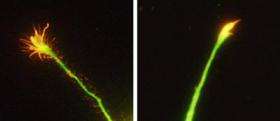
An elongating axon tip (left) crumples when it encounters RGMa (right). Credit: Hata, K., et al. 2009. J. Cell Biol. doi:10.1083/jcb.200807029.
To a growing axon, the protein RGMa is a "Wrong Way" sign, alerting it to head in another direction. As Hata et al. demonstrate in the March 9, 2009 issue of the Journal of Cell Biology, translating that signal into cellular action requires teamwork from two receptors.
During development, new synapses form when the growing axon of one neuron reaches another neuron. As an axon searches out the path to its destination, it bends toward so-called attractive guidance molecules and veers away from repulsive guidance molecules such as RGMa. For example, if the tip of an axon touches a glial cell instead of a neuron, the extension pulls back. On its membrane the glial cell sports RGMa, which latches onto the receptor neogenin on the axon. Researchers knew that the interaction between RGMa and neogenin halted the axon by activating the GTPase RhoA. However, they didn't know how neogenin switches on RhoA.
Hata et al. discovered that it gets help from another axon membrane receptor called Unc5B. The researchers found that after a dose of RGMa, the tip of a growing axon halted and often retreated. Eliminating Unc5B prevented this collapse.
Neogenin and Unc5B stick together and serve as coreceptors, performing slightly different tasks, Hata et al. conclude. Neogenin's job is to hook up with RGMa. Unc5B, by contrast, never contacts RGMa. Instead, it serves as a docking point for the RhoA activator LARG. Unc5B indirectly switches on RhoA by interacting with LARG.
But that left one further mystery to explain. LARG clings to Unc5B all the time, so why does it fire up RhoA only in response to RGMa? The researchers found that binding of RGMa prodded another protein, the focal adhesion kinase (FAK), to switch on LARG, allowing activation of RhoA. How RGMa binding triggers FAK is the next question the researchers want to answer.
More information: www.jcb.org" targe … >www.jcb.org, Hata, K., et al. 2009. J. Cell Biol. doi:10.1083/jcb.200807029.
Source: Rockefeller University
-
Complex wiring of the nervous system may rely on a just a handful of genes and proteins
Feb 10, 2012 |
4.9 / 5 (11) |
1
-
Imaging live mouse spinal cord will aid trauma therapy
Jan 25, 2012 |
5 / 5 (1) |
0
-
Scientists succeed in making the spinal cord transparent
Dec 26, 2011 |
4.8 / 5 (14) |
6
-
Physicists 'turn signals' for neuron growth
Dec 15, 2011 |
4.5 / 5 (6) |
0
-
Neuroscientists visualize neural circuitry at once-unattainable depths
Dec 12, 2011 |
4 / 5 (1) |
1
-
Fast photon control brings quantum photonic technologies closer
31 minutes ago |
5 / 5 (2) |
0
-
Engineers build first sub-10-nm carbon nanotube transistor
Feb 01, 2012 |
4.9 / 5 (33) |
30
-
Something old, something new: Evolution and the structural divergence of duplicate genes
Jan 31, 2012 |
4.6 / 5 (7) |
1
-
The hidden nanoworld of ice crystals: Revealing the dynamic behavior of quasi-liquid layers
Jan 30, 2012 |
5 / 5 (5) |
1
-
Stock market network reveals investor clustering
Jan 27, 2012 |
3.9 / 5 (23) |
8
-
Factors affecting beet root cell membrane
Feb 12, 2012
-
Stem cell question.
Feb 10, 2012
-
Protease cleavage
Feb 10, 2012
-
Pertubance in a model
Feb 10, 2012
-
Cancer drugs and Alzheimer's, Oh my!
Feb 09, 2012
-
Squishing cells
Feb 09, 2012
- More from Physics Forums - Biology
More news stories
Big Society could threaten biodiversity conservation
A study of the Moray Firth Seal Management Plan (MFSMP), in north-east Scotland, identified four key conditions for long-term success, three of which pointed to the importance of direct government involvement.
40 minutes ago |
not rated yet |
0
Biobased approaches examined in fight against zebra chip
Thanks to investigations by scientists-turned-detectives with the U.S. Department of Agriculture (USDA) and other agencies, potato growers in the western United States and abroad now know the identities of ...
1 hour ago |
not rated yet |
0
New molecule has potential to help treat genetic diseases and HIV
(PhysOrg.com) -- Chemists at The University of Texas at Austin have created a molecule that's so good at tangling itself inside the double helix of a DNA sequence that it can stay there for up to 16 days before ...
3 hours ago |
5 / 5 (2) |
0
|
Integrated pest management recommendations for the southern pine beetle
The southern pine beetle, Dendroctonus frontalis Zimmermann, is a chronic insect pest within pine forests in the southeastern United States. Under favorable environmental and host conditions, it is an agg ...
6 hours ago |
not rated yet |
0
A mitosis mystery solved: How chromosomes align perfectly in a dividing cell
Although the process of mitotic cell division has been studied intensely for more than 50 years, Whitehead Institute researchers have only now solved the mystery of how cells correctly align their chromosomes during symmetric ...
20 hours ago |
4.5 / 5 (24) |
0
|
Fast photon control brings quantum photonic technologies closer
(PhysOrg.com) -- Using photons instead of electrons to transmit information could lead to faster and more secure ways to communicate, among other advantages. Now a team of physicists has taken another step toward realizing ...
Planck mission steps closer to the cosmic blueprint
(PhysOrg.com) -- ESA's Planck mission has revealed that our Galaxy contains previously undiscovered islands of cold gas and a mysterious haze of microwaves. These results give scientists new treasure to mine ...
New ability to regrow blood vessels holds promise for treatment of heart disease
(Medical Xpress) -- University of Texas at Austin researchers have demonstrated a new and more effective method for regrowing blood vessels in the heart and limbs a research advancement that could have ...
Nanostructured electrodes for rechargeable sodium-Ion batteries
Highly efficient 3V cathodes for rechargeable sodium-ion batteries have been developed by users from Argonne National Laboratory's Materials Science, Chemical Sciences & Engineering, and X-ray Sciences Divisions, ...
A lost world? How zooarchaeology can inform biodiversity conservation
A new study of tropical forests will provide a 50,000-year perspective on how animal biodiversity has changed, explored through an archaeological investigation of animal bones.
Myths and shame keep many from seeking bankruptcy protection
(PhysOrg.com) -- Two interesting facts that may counter modern ideas about bankruptcy: The overwhelming majority of U.S. filings belong to individuals rather than corporations or entities, and most of these ...