Inserting Catheters Without X-rays
March 9, 2009 Inserting Catheters Without X-rays

Enlarge

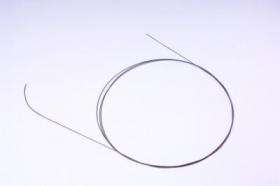
This is a rolled-up guide wire. Credit: Fraunhofer IPT

X-rays penetrate the patient's body, helping the doctor guide the catheter through the artery. In future, it will be possible to monitor the position of the catheter without exposing the patient to X-ray radiation, and without the need for a contrast medium.

Have the patient's , heart valves or myocardial muscle changed abnormally? Doctors can verify this and administer the necessary therapy with the help of a , which is inserted into the body through a small incision in the groin area and pushed to the heart through the .

A metal guide wire inside the catheter serves as a navigational aid. It is pulled and turned by the physician to steer and guide the catheter. At the same time the catheter's position in the vascular system has to be monitored. This task is performed by X-rays, which penetrate the patient and show exactly where the catheter is. The problem with this method is that it exposes the patient to quite a high dose of radiation. In addition, a has to be injected into the patient's body in order to make the vascular system and the soft tissue visible on the X-ray images.

Researchers at the Fraunhofer Institute for Production Technology IPT in Aachen have now found a way of avoiding both the radiation and the contrast medium. In collaboration with colleagues at Philips and University Hospital Aachen, they have developed a guide wire made of glass-fiber-reinforced plastic. "Because the guide wire is made of plastic the imaging can be performed by magnetic resonance tomography instead of computer tomography," says IPT scientist Adrian Schütte. "This is not possible with metal as the metal wire acts as an antenna and heats up too much - this would damage the vessels, and could cause proteins to clot." Magnetic resonance tomography has many advantages for doctors and patients. It does not produce like computer tomography, and soft tissue is clearly visible, so there is no need for a contrast medium.

For the manufacture of the two-meter guide wires the researchers use the pultrusion method, which is the standard procedure for making continuous profiles from glass-fiber-reinforced plastic. "Diameters of half a millimeter or less are required for the guide wires - that's the absolute minimum," explains Schütte. The new guide wires will be presented at the JEC trade fair in Paris from March 24 to 26 and will be used in hospitals for the first time in the next few months.

Source: Fraunhofer-Gesellschaft


print this article email this article download pdf blog this article bookmark this article     Stumble it Digg this share on Facebook retweet share on Reddit add to delicious
Rate this story - not rated yet


March 9, 2009 all stories

Comments: 0

not rated yet
  • Stumble this up

  • Digg this

  • share this

  • hide
  • Related Stories


  • hide
  • Relevant PhysicsForums posts

  • Achromat lens - magnifying LCD
    created 7 hours ago
  • Control System
    created Nov 24, 2009
  • Base Isolation Systems in Skyscrapers?
    created Nov 23, 2009
  • Need to interview a Computer Hardware Engineer for school project
    created Nov 23, 2009
  • More from Physics Forums - General Engineering

Other News

Design chosen for British 1,000 mph car

Design chosen for British 1,000 mph car (w/ Video)

Technology / Engineering

created 18 hours ago | popularity 3.7 / 5 (6) | comments 4

(PhysOrg.com) -- A British team hoping to be the first to get a car to 1,000 mph (1,610 km/h) has made its final design selection. The six-tonne car, known as the Bloodhound, will be powered by a Eurofighter ...


Time Inc., Conde Nast and Hearst are preparing to launch an online newsstand described as an "iTunes for magazines"

Magazine publishers creating 'iTunes for magazines': reports

Technology / Internet

created 9 hours ago | popularity not rated yet | comments 0

US magazine publishers Time Inc., Conde Nast and Hearst are preparing to launch an online newsstand described as an "iTunes for magazines," according to published reports.


Should I buy a PC or Mac?

Technology / Software

created 7 hours ago | popularity 4 / 5 (2) | comments 2

Q. Our 6-year-old PC computer is dying a slow death and we are considering moving to a new iMac but have a few concerns. First, of all, we have several Word documents on our disk drive now that we want to keep and add to ...


ORNL 'deep retrofits' can cut home energy bills in half

ORNL 'deep retrofits' can cut home energy bills in half

Technology / Energy

created 10 hours ago | popularity 3 / 5 (2) | comments 0

(PhysOrg.com) -- Oak Ridge National Laboratory has announced plans to conduct a series of deep energy retrofit research projects with the potential to improve the energy efficiency in selected homes by as ...


The logo of NBC studios in Burbank, California

Comcast bid for NBC Universal could be sealed next week: source

Technology / Business

created 8 hours ago | popularity not rated yet | comments 0

Comcast's bid to buy a controlling stake in NBC Universal from General Electric could be sealed next week if GE reaches an agreement with Vivendi, a source close to the matter said Wednesday.