Fermilab collider experiments discover rare single top quark
March 9, 2009 Fermilab collider experiments discover rare single top quark

Enlarge

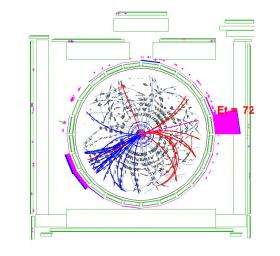
This collision event display, created by the CDF collaboration, shows a single top quark candidate event. The red arrow indicates the direction of a neutrino and the purple line the direction of an electron escaping from the decay of the top quark. Credit: CDF collaboration.

(PhysOrg.com) -- Scientists of the CDF and DZero collaborations at the Department of Energy's Fermi National Accelerator Laboratory have observed particle collisions that produce single top quarks. The discovery of the single top confirms important parameters of particle physics, including the total number of quarks, and has significance for the ongoing search for the Higgs particle at Fermilab's Tevatron, currently the world's most powerful operating particle accelerator.

Previously, had only been observed when produced by the strong nuclear force. That interaction leads to the production of pairs of top quarks. The production of single top quarks, which involves the weak nuclear force and is harder to identify experimentally, has now been observed, almost 14 years to the day of the top quark discovery in 1995.

Searching for single-top production makes finding a needle in a haystack look easy. Only one in every 20 billion proton-antiproton collisions produces a single top quark. Even worse, the signal of these rare occurrences is easily mimicked by other "background" processes that occur at much higher rates.
Fermilab collider experiments discover rare single top quark
Enlarge

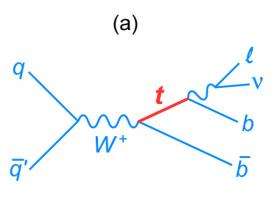
Protons and antiprotons comprise quarks, antiquarks and gluons. A proton-antiproton collision can produce a single top quark in two different ways: a quark and an antiquark can create a W boson, which then decays into a top quark and an anti-bottom quark. Or a gluon and a quark interact, with the quark emitting a W boson and the gluon creating a bottom quark and anti-bottom quark. The W boson then interacts with the bottom quark and produces a single top quark. In both cases, the top quark is short-lived and decays, for example, into a bottom quark, a lepton (such as a muon) and a neutrino. Credit: DZero collaboration.

"Observation of the single top is an important milestone for the Tevatron program," said Dr. Dennis Kovar, Associate Director of the Office of Science for High Energy Physics at the U.S. Department of Energy. "Furthermore, the highly sensitive and successful analysis is an important step in the search for the Higgs."

Discovering the single top quark production presents challenges similar to the search in the need to extract an extremely small signal from a very large background. Advanced analysis techniques pioneered for the single top discovery are now in use for the Higgs boson search. In addition, the single top and the Higgs signals have backgrounds in common, and the single top is itself a background for the .

To make the single-top discovery, physicists of the CDF and DZero collaborations spent years combing independently through the results of proton-antiproton collisions recorded by their experiments, respectively. Each team identified several thousand collision events that looked the way experimenters expect single top events to appear. Sophisticated statistical analysis and detailed background modeling showed that a few hundred collision events produced the real thing. On March 4, the two teams submitted their independent results to Physical Review Letters.
Fermilab collider experiments discover rare single top quark
Enlarge

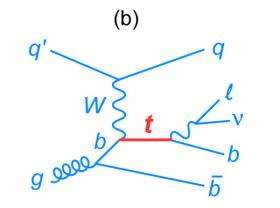
Protons and antiprotons comprise quarks, antiquarks and gluons. A proton-antiproton collision can produce a single top quark in two different ways: a quark and an antiquark can create a W boson, which then decays into a top quark and an anti-bottom quark. Or a gluon and a quark interact, with the quark emitting a W boson and the gluon creating a bottom quark and anti-bottom quark. The W boson then interacts with the bottom quark and produces a single top quark. In both cases, the top quark is short-lived and decays, for example, into a bottom quark, a lepton (such as a muon) and a neutrino. Credit: DZero collaboration.

The two collaborations earlier had reported preliminary results on the search for the single top. Since then, experimenters have more than doubled the amount of data analyzed and sharpened selection and analysis techniques, making the discovery possible. For each experiment, the probability that background events have faked the signal is now only one in nearly four million, allowing both collaborations to claim a bona fide discovery that paves the way to more discoveries.

"I am thrilled that CDF and DZero achieved this goal," said Fermilab Director Pier Oddone. "The two collaborations have been searching for this rare process for the last fifteen years, starting before the discovery of the top quark in 1995. Investigating these subatomic processes in more detail may open a window onto physics phenomena beyond the Standard Model."

Provided by Fermilab


print this article email this article download pdf blog this article bookmark this article     Stumble it Digg this share on Facebook retweet share on Reddit add to delicious
Rate this story - 4.9 /5 (22 votes)

Rank Filter

Move the slider to adjust rank threshold, so that you can hide some of the comments.


Display comments: newest first

  • deatopmg - Mar 09, 2009
    • Rank: 2.3 / 5 (3)
    if one beats the crap out of a proton and/or anti-proton, both made up of the 4 flavors of electron, with enough energy one is bound to eventually find chunks that fit the quark parameters
  • magpies - Mar 09, 2009
    • Rank: not rated yet
    Heres a thought... What if the quarks and electrons are actualy huge when compaired to the real things that make up the universes atoms and such things... Like lets say beyound atoms and quarks there is something so significantly smaller we cant even make a compairison that would make sense in terms of like the universe to a ping-pong ball? What would science need to do to find thouse things if they existed?
  • mmstick - Mar 10, 2009
    • Rank: 1 / 5 (1)
    Heres a thought... What if the quarks and electrons are actualy huge when compaired to the real things that make up the universes atoms and such things... Like lets say beyound atoms and quarks there is something so significantly smaller we cant even make a compairison that would make sense in terms of like the universe to a ping-pong ball? What would science need to do to find thouse things if they existed?


    Subatomic Universe Theory? Give science time... they'll figure it out eventually.
  • Hyperion1110 - Mar 10, 2009
    • Rank: not rated yet
    Umm...protons and anti-protons aren't made of electrons. If memory serves, a proton is 2 up quarks and one down quark (2/3 plus 2/3 - 1/3 = 1). And, while I've never really worked it out, my guess is that an anti-proton is three down quarks (-1/3 - 1/3 - 1/3 = -1).
  • Ant - Mar 10, 2009
    • Rank: not rated yet
    is there an explanation why this particle appears to be traveling in a straight line rather than curved as most of the others?
  • Alexa - Mar 11, 2009
    • Rank: not rated yet
    ..why this particle appears to be traveling in a straight line rather than curved as most of the others?
    Indeed, electron is lightweight particle with compare to qaurk-antiquarks jets and it transfers most of top-quark extreme energy. So it travels by nearly luminal speed so that the curvature of its path in magnetic field is very low.
  • Noumenon - Mar 12, 2009
    • Rank: not rated yet
    So was the top-quark isolated for a time?
  • Bot - Jun 30, 2009
    • Rank: not rated yet


    Umm...protons and anti-protons aren't made of electrons. If memory serves, a proton is 2 up quarks and one down quark (2/3 plus 2/3 - 1/3 = 1). And, while I've never really worked it out, my guess is that an anti-proton is three down quarks (-1/3 - 1/3 - 1/3 = -1).


    Actually, an anti-proton is made up of 2 anti-up and 1 anti-down quarks.

    So was the top-quark isolated for a time?


    The life of a top quark is only about 1 x 10^-25 seconds...it's just too heavy to hang together, decaying almost immediately into a W boson and a bottom quark.

March 9, 2009 all stories

Comments: 8

4.9 /5 (22 votes)
  • Stumble this up

  • Digg this

  • share this

  • hide
  • Related Stories

  • Precision measurement of W-boson mass suggests a lighter Higgs particle
    created Jan 08, 2007 | popularity not rated yet | comments 0
  • Physicists 'See' Single Top Quarks at the Tevatron
    created Aug 22, 2008 | popularity not rated yet | comments 0
  • Tevatron collider yields new results on subatomic matter, forces
    created Apr 17, 2007 | popularity not rated yet | comments 0
  • Prelude to the Higgs: A work for 2 bosons in the key of Z
    created Jul 30, 2008 | popularity not rated yet | comments 0
  • Team Detects 'Top Quark,' a Basic Constituent of Matter
    created Dec 13, 2006 | popularity not rated yet | comments 0


  • hide
  • Relevant PhysicsForums posts

  • avoidance of admitting that we dont know somethin
    created 5 hours ago
  • Speed of light : missing energy
    created 9 hours ago
  • Can light produce darkness and can noise procude quiteness 4
    created 11 hours ago
  • Magnetic Oscillation Equations
    created 17 hours ago
  • US Physics Test Eligibility
    created 19 hours ago
  • Are Active Noise Control Stereo Possible?
    created 23 hours ago
  • More from Physics Forums - General Physics

Other News

Restored machine to explore mysteries of Big Bang (AP)

Restored machine to explore mysteries of Big Bang

Physics / General Physics

created 9 hours ago | popularity 4.4 / 5 (12) | comments 6

(AP) -- Scientists are preparing the world's largest atom smasher to explore the depths of matter after successfully restarting the $10 billion machine following more than a year of repairs.


nuclear power plant

Doubts raised on nuclear industry viability

Physics / General Physics

created Nov 19, 2009 | popularity 3.2 / 5 (19) | comments 18

(PhysOrg.com) -- The investment in nuclear power has been growing around the world over the last few years, being viewed as a means for countries to control their energy security, avoid the price fluctuations ...


Researchers Find Innate Correlations Among Different Power Law Phenomena

Researchers Find Innate Correlations Among Different Power Law Phenomena

Physics / General Physics

created Nov 17, 2009 | popularity 4.3 / 5 (15) | comments 12

(PhysOrg.com) -- Studying the patterns that emerge in natural and social phenomena is a popular area of research, although usually individual phenomena are studied separately from each other. In a recent study, ...


Scientists demonstrate 'universal' programmable quantum processor

Scientists demonstrate 'universal' programmable quantum processor

Physics / Quantum Physics

created Nov 15, 2009 | popularity 4.6 / 5 (21) | comments 11

Physicists at the National Institute of Standards and Technology have demonstrated the first "universal" programmable quantum information processor able to run any program allowed by quantum mechanics -- th ...


Proton's party pals may alter its internal structure

Proton's party pals may alter its internal structure

Physics / General Physics

created Nov 18, 2009 | popularity 4.6 / 5 (18) | comments 9

A recent experiment at the DOE's Thomas Jefferson National Accelerator Facility has found that a proton's nearest neighbors in the nucleus of the atom may modify the proton's internal structure.