Spinning carbon nanotubes spawns new wireless applications
March 9, 2009 Cell Phone Antenna

Enlarge

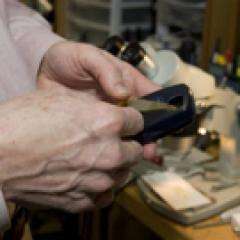
University of Cincinnati physicist David Mast replaced the antenna in his cell phone with a "nano antenna" made from spun carbon nanotubes, made in the UC labs of Mark Schulz and Vesselin Shanov. Credit: Lisa Britton/UC Photographic Services

The University of Cincinnati has long been known for its world-record-breaking carbon nanotubes. Now researchers at the University of Cincinnati have discovered new uses by spinning carbon nanotubes (CNTs) into longer fibers with additional useful properties.

Breakthroughs Without Broken Threads

Taking technology that has already been proven to grow carbon nanotubes of world-record breaking lengths, researchers Vesselin Shanov and Mark Schulz in the UC College of Engineering NanoWorld Lab have now found new applications by spinning these fibers into strong threads.

David Mast, from UC's McMicken College of Arts and Sciences, saw possibilities in the threads. Mast, an associate professor of physics, took a 25-micron thread and created a using double-sided transparent tape and silver paste. He was immediately successful in transmitting radio signals.

"It transmitted almost as well as the copper did, but at about one ten-thousandth of the weight," says Mast.

"Then I decided to dismantle my ," says Mast. He created a cell phone antenna, using CNT thread and tape. Ripping the back off his own cell phone, he tore out the phone's original antenna and replaced it with his home-made one. With the "nano-antenna" or "nantenna," he was able to get four to five "bars" of service, compared to none when he removed it.

"That was a very pleasant surprise, how easy it was to do," Mast says. "The hardest thing is to manipulate them. They float on ambient air."

From there it was an easy leap to video, in which he was again successful. "I want to now set up a wireless webcam for the lab using these thread antennas so

Mast says that the key to the new applications is the quality of the material that Schulz and Shanov came up with using multi-wall carbon nanotubes.

"They spin thread that is of such high quality, it opens the door to incredible possibilities," says Mast. "This is just one of many potential applications."

Schulz explains that the carbon nanotube threads work well as an antenna because of something called the "skin effect."

"The electrons transfer well because they want to go to the surface," he says. "Instead of traveling through a bulk mass, they are traveling across a skin."

"Copper wire is a bulk material," Shanov points out. "With carbon nanotubes, all the atoms are on the surface of these carbon structures and the tubes themselves are hollow, so the CNT thread is small and light."

"Carbon thread that is a fraction of the weight of current copper conductors and antennas could directly apply and would be significant to aerospace activities — commercial, military and space," he adds. "On any aircraft, there are about several hundred pounds of copper as cables and wiring."

Mast points out that the threads have what he calls an "immensely high tensile strength — perhaps five times that of steel and yet they are less dense than steel."

Now that the team has shown the feasibility of such applications, the next steps will be to work on improvements (such as making yarn out of several threads) and to find industries that will commercialize CNT thread.

Mast's next step was going to be to buy a new cell phone. However, he says, "it works so well now that I decided to just upgrade to a new antenna made of carbon nanotube yarn."

Source: University of Cincinnati


print this article email this article download pdf blog this article bookmark this article     Stumble it Digg this share on Facebook retweet share on Reddit add to delicious
Rate this story - 4.6 /5 (10 votes)

Rank Filter

Move the slider to adjust rank threshold, so that you can hide some of the comments.


Display comments: newest first

  • earls - Mar 09, 2009
    • Rank: not rated yet
    'With the "nano-antenna" or "nantenna," he was able to get four to five "bars" of service, compared to none when he removed it.'

    ...ok... How about compared to the stock antenna?!
  • el_gramador - Mar 23, 2009
    • Rank: not rated yet
    I would agree. Also n-antenna probably would have been better.

March 9, 2009 all stories

Comments: 2

4.6 /5 (10 votes)
  • Stumble this up

  • Digg this

  • share this

  • hide
  • Related Stories

  • Researchers Grow 7 mm Carbon Nanotube Array
    created Nov 29, 2006 | popularity not rated yet | comments 0
  • The longest carbon nanotubes you've ever seen
    created May 10, 2007 | popularity not rated yet | comments 0
  • Researchers Shatter World Records with Length of Latest Carbon Nanotube Arrays
    created Apr 25, 2007 | popularity not rated yet | comments 0
  • Nanotube's 'tapestry' controls its growth
    created Feb 05, 2009 | popularity not rated yet | comments 0
  • Penn Physicists Develop a Carbon Nanotube Aeroegel Optimizing Strength, Shape and Conductivity
    created May 16, 2007 | popularity not rated yet | comments 0


  • hide
  • Relevant PhysicsForums posts

  • Heat pipe for high temperature
    created 8 hours ago
  • Robot built out of acrylic
    created 17 hours ago
  • Thickness or Ga. of Stainless steel water tank?
    created 18 hours ago
  • dynamic hardness measurements
    created Nov 21, 2009
  • More from Physics Forums - Materials & Chemical Engineering

Other News

Fast, easy, and highly sensitive arsenic detection with gold nanoparticles

Nanotechnology / Nanomaterials

created 2 hours ago | popularity not rated yet | comments 0

(PhysOrg.com) -- Mention of arsenic poisoning usually brings to mind underhanded murder. However, the danger of arsenic poisoning from contaminated drinking water is far greater. Low concentrations of arsenic are found in ...


Nanotech in Space: Experiment To Weather the Trials of Orbit

Nanotech in Space: Experiment To Weather the Trials of Orbit

Nanotechnology / Nanomaterials

created 14 hours ago | popularity 4 / 5 (2) | comments 0

Novel nanomaterials developed at Rensselaer were sent into orbit on Nov. 16 aboard Space Shuttle Atlantis.


Water droplets direct self-assembly process in thin-film materials

Nanotechnology / Nanomaterials

created Nov 23, 2009 | popularity 5 / 5 (4) | comments 2

You can think of it as origami - very high-tech origami. Researchers at the University of Illinois have developed a technique for fabricating three-dimensional, single-crystalline silicon structures from thin films by coupling ...


Nanotube defects equal better energy and storage systems

Nanotube defects equal better energy and storage systems

Nanotechnology / Nanomaterials

created Nov 19, 2009 | popularity 4.4 / 5 (10) | comments 2

(PhysOrg.com) -- Most people would like to be able to charge their cell phones and other personal electronics quickly and not too often. A recent discovery made by UC San Diego engineers could lead to carbon ...


Peptides control crystal growth with 'switches, throttles and brakes'

Peptides control crystal growth with 'switches, throttles and brakes'

Nanotechnology / Bio & Medicine

created Nov 23, 2009 | popularity 5 / 5 (3) | comments 0

(PhysOrg.com) -- By producing some of the highest resolution images of peptides attaching to mineral surfaces, scientists have a deeper understanding how biomolecules manipulate the growth crystals. This research ...