Single-Molecule Magnets Open New Door for Information Technology
March 9, 2009 By Laura Mgrdichian
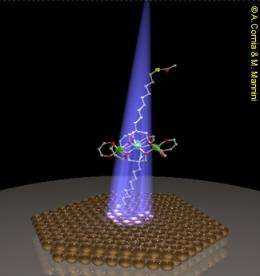
The magnetic memory molecule, Fe4, tethered to a gold surface. Image copyright A. Cornia and M. Mannini.
(PhysOrg.com) -- Recent research by scientists in Italy and France shows that that single molecules have the ability to store information via their magnetic state. Their work is a first step toward a new generation of ultra-compact data storage technologies based on individual molecules.
Using x-ray analysis methods, the group learned that iron-containing molecules can display a magnetic "memory" when tethered to a gold surface. This type of finding is a necessary precursor to the ability to store data, bit by bit, on individual molecules rather than capacitors or transistors, which are much larger.
The research is reported in the March 2009 edition of Nature Materials.
"Our work has opened a door to the study of individually magnetized molecules 'wired' to conducting surfaces, which will now allow scientists to investigate the elementary interactions between electron transport and magnetism at the molecular scale," said the paper's corresponding researcher, Roberta Sessoli of the University of Florence, to PhysOrg.com.
Scientists have successfully organized molecules on conducting surfaces, but prior to this work had been unable to determine whether the molecules could retain a specific magnetic property: its ability to "remember" its magnetization history on the molecular level when demagnetized; this is known as magnetic hysteresis. Not only do small molecule clusters tend to be chemically unstable on surfaces, but scientists also lacked the tools to study them.
As they report in their paper, Sessoli and her colleagues proved that synchrotron radiation, the light emitted when charged particles are accelerated to nearly the speed of light around a large conducting ring, is the ideal tool for investigating these materials. Synchrotrons can produce all types of light, from radio waves to gamma-rays.
Using a "self-assembly" method starting with molecules in solution, they deposited a single layer of iron (Fe) molecules—specifically, Fe4, a propeller-shaped molecule—onto a surface of gold.
At two synchrotron facilities, BESSY in Germany and SLS in Switzerland, the group chilled the monolayer of molecules to extremely low temperatures, only a few degrees Kelvin (around -270 degrees Celsius), and placed it in the path of a very concentrated beam of x-ray light produced by the synchrotron. By analyzing how the x-rays interacted with the sample, the group gained specific information about the molecules' magnetic properties despite the tiny amount of molecules present on the surface.
They used x-ray absorption spectroscopy (XAS), in which the x-ray photon energies are tuned to a range in which they can excite core electrons of the selected atomic species, in this case iron. While XAS can probe the electronic state of the deposited molecules, their magnetic properties can be investigated by magnetic circular dichroism (XMCD). It measures how a sample's response to x-ray light that is left circularly polarized (the rays rotate to the left as they propagate forward) is different from light that is right circularly polarized, when the sample is placed in a magnetic field. This method is best at telling researchers about the magnetic properties of the molecules, such as each molecule's "spin," an intrinsic property of a particle, atom, or molecule that imparts it with a very small magnetic field, like a tiny bar magnet.
The researchers compared the XAS and XMCD results. Had the individual magnetic states of the molecules been affected by grafting the molecules to the gold surface, the researcher would have expected to see significant changes in the XAS/XMCD ratio compared to a bulk sample, but observed none.
More information: Nature Materials 8, 194 - 197 (2009)
Copyright 2009 PhysOrg.com.
All rights reserved. This material may not be published, broadcast, rewritten or redistributed in whole or part without the express written permission of PhysOrg.com.
-
Scientists discover possible mechanism for creating 'handedness' in biological molecules
Dec 01, 2008 |
not rated yet |
0
-
Kondo effect in single magnetic molecules
Jun 07, 2006 |
not rated yet |
0
-
A New Reflection in the Mirror
Jan 10, 2007 |
not rated yet |
0
-
Magnetism loses under pressure
Jan 29, 2008 |
not rated yet |
0
-
Physicists manipulate temperature of Kondo effect
Jan 31, 2007 |
not rated yet |
0
-
Engineers build first sub-10-nm carbon nanotube transistor
Feb 01, 2012 |
4.9 / 5 (30) |
30
-
Something old, something new: Evolution and the structural divergence of duplicate genes
Jan 31, 2012 |
4.6 / 5 (7) |
1
-
The hidden nanoworld of ice crystals: Revealing the dynamic behavior of quasi-liquid layers
Jan 30, 2012 |
5 / 5 (3) |
1
-
Stock market network reveals investor clustering
Jan 27, 2012 |
3.9 / 5 (23) |
8
-
Of microchemistry and molecules: Electronic microfluidic device synthesizes biocompatible probes
Jan 26, 2012 |
5 / 5 (1) |
0
-
excited U-236 decay time in the U235 fission chain
17 hours ago
-
Polar catastrophe?
20 hours ago
-
Large scale field sonication
22 hours ago
-
states and energy of paired electrons in BCS
Feb 08, 2012
-
difference between longitudinal and transverse refractive indices
Feb 08, 2012
-
Monte Carlo simulation
Feb 07, 2012
- More from Physics Forums - Atomic, Solid State, Comp. Physics
More news stories
SLAC, Stanford team focuses on high-energy electrons to treat cancer
Accelerator physicists at SLAC and cancer specialists from Stanford are working on a new technology that could dramatically reduce the time needed for cancer radiation treatments. The team ran an initial experiment ...
1 hour ago |
not rated yet |
0
Measurements from high-energy collisions lead to better understanding of why meson particles disappear
For several years, physicists at the Relativistic Heavy Ion Collider (RHIC) at Brookhaven National Laboratory (BNL), USA, have studied an unusual state of matter called the quarkgluon plasma, which they ...
1 hour ago |
not rated yet |
0
Quantum physicist explains $100K offer for proof scaled-up quantum computing is impossible
(PhysOrg.com) -- MIT researcher Scott Aaronson has certainly riled the physics community with his offer this past Friday, of $100,000 to anyone who can prove that scaled-up quantum computing is impossible. ...
Explained: Sigma
It's a question that arises with virtually every major new finding in science or medicine: What makes a result reliable enough to be taken seriously? The answer has to do with statistical significance -- but ...
Feb 09, 2012 |
5 / 5 (13) |
26
Physicists 'record' magnetic breakthrough
An international team of scientists has demonstrated a revolutionary new way of magnetic recording which will allow information to be processed hundreds of times faster than by current hard drive technology.
Feb 07, 2012 |
4.5 / 5 (39) |
14
|
Experts reveal how plants don't get sunburn
(PhysOrg.com) -- Experts at the University of Glasgow have discovered how plants survive the harmful rays of the sun.
Fool's gold may prove an unlikely alternative to overexploited catalytic materials
Catalytic materials, which lower the energy barriers for chemical reactions, are used in everything from the commercial production of chemicals to catalytic converters in car engines. However, with current catalytic materials ...
Curry spice component may help slow prostate tumor growth
Curcumin, an active component of the Indian curry spice turmeric, may help slow down tumor growth in castration-resistant prostate cancer patients on androgen deprivation therapy (ADT), a study from researchers ...
Unpicking HIV’s invisibility cloak
Drug researchers hunting for alternative ways to treat human immunodeficiency virus (HIV) infections may soon have a novel targetits camouflage coat. HIV hides inside a cloak unusually rich in a sugar ...
What lies beneath: Mapping hidden nanostructures
The ability to diagnose and predict the properties of materials is vital, particularly in the expanding field of nanotechnology. Electron and atom-probe microscopy can categorize atoms in thin sheets of material, ...
To avoid early labor and delivery, weight and diet changes not the answer
One of the strongest known risk factors for spontaneous or unexpected preterm birth any birth that occurs before the 37th week of pregnancy, most often without a known cause is already having had one. For women ...
Mar 09, 2009
Rank: 1 / 5 (2)
photon induced electric field poling.
Mar 10, 2009
Rank: not rated yet