Silica algae reveal how ecosystems react to climate changes
March 9, 2009 Silica algae reveal how ecosystems react to climate changes

Enlarge

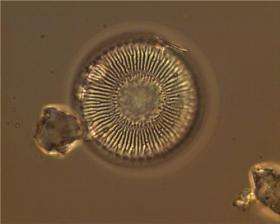
Cyclotella, a fossil silica algae.

A newly published dissertation by Linda Ampel from the Department of Physical Geography and Quaternary Geology at Stockholm University in Sweden examined how rapid climate changes during the most recent ice age affected ecosystems in an area in continental Europe.

Rapid and extensive changes have taken place on several occasions in the past. For example, the latest (lasting from about 115,000 to 11,500 years ago) is characterized by several rapid and dramatic climate swings. These swings recurred in cycles of roughly 1,500 years and were originally discovered through studies of ice cores from Greenland in the early 1990s. These cycles started with an extremely rapid rise in temperatures, over just a few years or decades, of as much as 8-16C over Greenland.

Linda Ampel studied how these rapid cycles in the climate affected in an area in continental Europe. The study was based on analyses of sediment cores from an overgrown lake named Les Echets in eastern France and focuses on a time interval between 40,000 and 16,000 ago.

The findings are based on analyses of fossil silica algae, diatoms. Various species of diatoms prefer different relating to physical and chemical parameters such as temperature, salinity, access to nutrients, light, water depth, or available types of places to grow. These parameters, in turn, are affected by climate. Different species of diatoms can therefore indicate how the water environment changed as a consequence of the climate in the past.

analyses of the environmental archive from Les Echets, together with further analyses of chemical and biological parameters such as content of organic material and pollen grains from trees and other plants preserved in the lake, show that the ecosystems in the lake and its surroundings underwent marked changes during the latest ice age as a consequence of these 1,500-year cycles. The adaptation of the ecosystems prompted by the recurring warm periods took place as quickly as within 50 to 200 years.

“These findings show that ecosystems have changed rapidly in reaction to climate changes in the past, which indicates that quick adaptations could also take place in the future as a consequence of global warming, for instance,” says Linda Ampel.

Provided by The Swedish Research Council


print this article email this article download pdf blog this article bookmark this article     Stumble it Digg this share on Facebook retweet share on Reddit add to delicious
Rate this story - not rated yet


March 9, 2009 all stories

Comments: 0

not rated yet
  • Stumble this up

  • Digg this

  • share this

  • hide
  • Related Stories

  • Small Organisms, Great Proxies
    created Oct 23, 2006 | popularity not rated yet | comments 0
  • Researchers link ice-age climate-change records to ocean salinity
    created Oct 04, 2006 | popularity not rated yet | comments 0
  • Ice cores map dynamics of sudden climate changes
    created Jun 19, 2008 | popularity not rated yet | comments 0
  • Ice core studies confirm accuracy of climate models
    created Sep 11, 2008 | popularity not rated yet | comments 0
  • Climate Change Alters Base of Tahoe Food Web
    created Sep 29, 2008 | popularity not rated yet | comments 0


  • hide
  • Relevant PhysicsForums posts

Other News

Jellyfish swarm northward in warming world (AP)

Jellyfish swarm northward in warming world

Biology / Ecology

created 4 hours ago | popularity 3.8 / 5 (4) | comments 0

(AP) -- A blood-orange blob the size of a small refrigerator emerged from the dark waters, its venomous tentacles trapped in a fishing net. Within minutes, hundreds more were being hauled up, a pulsating ...


Federal agencies not taking chances to keep carp from invading Great Lakes

Biology / Ecology

created 7 hours ago | popularity not rated yet | comments 0

A group of federal agencies criticized in the past for failing to move quickly to stop Asian carp from entering the Great Lakes announced Friday that they're taking every precaution to keep them out, even poisoning thousands ...


Salmon migration mystery explored on Idaho's Clearwater River

Salmon migration mystery explored on Idaho's Clearwater River

Biology / Ecology

created 11 hours ago | popularity not rated yet | comments 0

(PhysOrg.com) -- Temperature differences and slow-moving water at the confluence of the Clearwater and Snake rivers in Idaho might delay the migration of threatened juvenile salmon and allow them to grow larger ...


Ancient penguin DNA raises doubts about accuracy of genetic dating techniques

Ancient penguin DNA raises doubts about accuracy of genetic dating techniques

Biology / Evolution

created Nov 10, 2009 | popularity 4.7 / 5 (23) | comments 13

Penguins that died 44,000 years ago in Antarctica have provided extraordinary frozen DNA samples that challenge the accuracy of traditional genetic aging measurements, and suggest those approaches have been ...


Rasberry crazy ant

Rapacious Rasberry ants march north

Biology / Plants & Animals

created Nov 13, 2009 | popularity 4.3 / 5 (7) | comments 10

Poor Texas. First it was killer bees, then fire ants. Now, it's the Rasberry ants.