A water splitter with a double role
March 9, 2009 By Lucy Goodchild A water splitter with a double role

Enlarge

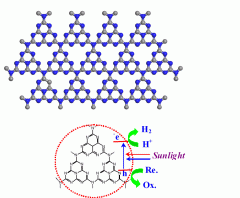
The carbon nitride ensures that hydrogen is formed when water is irradiated with sunlight. Image: Max Planck Institute of Colloids and Interfaces

(PhysOrg.com) -- There is a lot of hope invested in hydrogen, but it also presents some problems. It is energy-rich, clean and, as a constituent of water, of almost unlimited availability. However, so far it has been difficult to access it. Scientists at the Max Planck In-stitute of Colloids and Interfaces have now found a simple, low-cost way to produce hydrogen.

They extract this energy source from by irradiating it with sunlight and using a as an inexpensive photo catalyst. Up to now this reaction has required organometal compounds and inorganic semiconductors combined with expensive , such as platinum. (, January 2009)

is seen as the energy source of the future. There is around three times as much energy in a kilogramme of hydrogen as in a kilogramme of crude oil. In ad-dition, extracting energy from hydrogen in fuel cells, for example, creates no pol-lutants, only water. However, hydrogen is only present on the Earth in compounds such as water. Hydrogen must be in its pure form to create energy, and it must be produced with regenerative such as sunlight.

Scientists at the of and Interfaces have succeeded in taking a step in this direction with, surprisingly, one of the oldest polymers known to chemists. They used a carbon nitride, manufactured for the first time by Justus Liebig in 1834 and which he called "melon", to create hydrogen from water with the aid of sunlight. "The special thing about carbon nitride is that it is stable in water, even under extremely acidic or conditions. Apart from that, it is very easy and inexpensive to produce," says Xinchen Wang, whose research group carried out the experiments in collaboration with the University of Tokyo and Fuzhou University in China.

Carbon nitride uses sunlight to extract hydrogen from water. A substance that chemists call a sacrificial absorbs the oxygen from the water. The clever trick here is that the chemists in Potsdam did not need to use a precious metal like platinum. The traditional processes require precious metals, in addition to a semiconductor acting as an aerial for the sunlight, to catalyse the production of hydrogen. The carbon nitride does both jobs at the same time and furthermore acts as a particularly stable organic semiconductor that is much easier to produce than the inorganic materials normally used.

However, only four micromoles of hydrogen per hour bubbled up out of the re-searchers' reaction vessel. "Our yield is therefore not as high as that achieved with the established methods," says Xinchen Wang. "But we have shown that it is, in principle, possible to manufacture hydrogen with just a single organic substance as an additive." When the researchers added the normal quantities of platinum as a catalyst, the yield increased substantially - by a factor of seven. This means that there is not much more benefit compared to the existing methods, as they work with similar quantities of precious metals as catalysts. Wang and his colleagues are therefore trying to make the carbon nitride more efficient by increasing its active surface area.

"It would be ideal for technical applications if we could split water into hydrogen and elementary oxygen in one step," says Wang. Then chemists would not need a sacrificial reagent to absorb the oxygen. This means, however, that they would have to oxidise the oxygen, in the same way as plants can when they photosynthesise. The researchers' calculations have shown that this should also be possible with carbon nitride as the only additive. In experiments, though, they have needed an additional catalyst.

Wang's scientists are now working on a configuration to combine the production of hydrogen and oxygen. If they are successful, the process of water splitting will be perfect and hydrogen will be a step closer to fulfilling its role as an important source of energy.

More information: Xinchen Wang, Kazuhiko Maeda, Arne Thomas, Kazuhiro Takanabe, Gang Xin, Johan M. Carlsson, Kazunari Domen, Markus Antonietti, A metal-free, polymeric photo catalyst for hydrogen production from water under visible light, Nature Materials, 2009, 8, 76-80

Provided by Max Planck Institute of Colloids and Interfaces


print this article email this article download pdf blog this article bookmark this article     Stumble it Digg this share on Facebook retweet share on Reddit add to delicious
Rate this story - 4.5 /5 (10 votes)

Rank Filter

Move the slider to adjust rank threshold, so that you can hide some of the comments.


Display comments: newest first

  • Alizee - Mar 09, 2009
    • Rank: not rated yet
    ..more efficient by increasing its active surface area..

    Here's one way about it..

    http://natureasia...p?id=115
  • E_L_Earnhardt - Mar 09, 2009
    • Rank: 1 / 5 (1)
    Plants use free HEAT as a catalyst! Something GOOD
    should come from cosmic rays!
  • nevermark - Mar 10, 2009
    • Rank: 5 / 5 (1)
    Hydrogen is not seen as the energy SOURCE of the future. It is seen as an efficient means of storing and TRANSPORTING energy. These are two very different things.

    I think the author understands this but still managed to make this common mischaracterization.

    Sunlight is a source of energy. Fusion and fission are sources of energy. Wind, wave, and oil are sources of energy.

    Hydrogen is an energy medium. Its like a battery. It takes energy to get pure hydrogen as it must be separated from oxygen in its water state. It can then be stored or transported. We get the energy back by recombining it with oxygen. But the source of the energy has to be from somewhere else as vast quantities of pure hydrogen energy are not sitting around for us to bottle and burn.
  • AtlasGemini - Mar 12, 2009
    • Rank: not rated yet
    The storage of H2 will be the problem with using H2 as an energy medium. The pressures involved to get it to the energy density of gasoline would be very high and thus present some logistical difficulties. Probably much better to transport it as a metal hydride, or ammonia, or synthetically produced hydrocarbons (by "re-cycling" the effluent CO2 from coal-fired power plants).

March 9, 2009 all stories

Comments: 4

4.5 /5 (10 votes)
  • Stumble this up

  • Digg this

  • share this

  • hide
  • Related Stories

  • A Promising Catalyst for Solar-Based Hydrogen Energy Production
    created Dec 02, 2008 | popularity not rated yet | comments 0
  • Splitting Water with Sunlight
    created Sep 25, 2007 | popularity not rated yet | comments 0
  • Outlook bright for hydrogen biofuel cell
    created Oct 24, 2005 | popularity not rated yet | comments 0
  • Scientists learn from nature to split water
    created Aug 17, 2008 | popularity not rated yet | comments 0
  • Progress toward Artificial Photosynthesis?
    created Mar 09, 2007 | popularity not rated yet | comments 0


  • hide
  • Relevant PhysicsForums posts

Other News

Stars Fueled by Dark Matter Could Hold Secrets to the Universe

Stars Fueled by Dark Matter Could Hold Secrets to the Universe

Physics / General Physics

created Nov 03, 2009 | popularity 4.5 / 5 (50) | comments 40

(PhysOrg.com) -- The first stars in the universe may have been very different from the stars we see today, yet they may hold clues to understanding some of the mysterious features of the universe. These "dark ...


Second Law of Thermodynamics May Explain Economic Evolution

Second Law of Thermodynamics May Explain Economic Evolution

Physics / General Physics

created Nov 02, 2009 | popularity 4.3 / 5 (29) | comments 28

(PhysOrg.com) -- Terms such as the "invisible hand," laissez-faire policy, and free-market principles suggest that economic growth and decline in capitalist societies seem to be somehow self-regulated. Now, ...


High-performance plasmas may make reliable, efficient fusion power a reality

High-performance plasmas may make reliable, efficient fusion power a reality

Physics / Plasma Physics

created Nov 02, 2009 | popularity 4.7 / 5 (39) | comments 31

In the quest to produce nuclear fusion energy, researchers from the DIII-D National Fusion Facility have recently confirmed long-standing theoretical predictions that performance, efficiency and reliability ...


'Teapot effect' solved

Solving Teapot Effect

Physics / General Physics

created Nov 02, 2009 | popularity 4.9 / 5 (11) | comments 10

(PhysOrg.com) -- A team of scientists from France have worked out why teapots dribble at low flow rates, and how to stop them. The effect is called the "teapot effect", and solving it could finally put an ...


Laser accelerated protons to the highest energies so far

Researchers use trident laser to accelerate protons to record energies

Physics / General Physics

created Nov 02, 2009 | popularity 4.6 / 5 (5) | comments 10

An international team of physicists at Los Alamos National Laboratory has succeeded in using intense laser light to accelerate protons to energies never before achieved. Using this technique, scientists can ...