Regions of the brain can rewire themselves
March 9, 2009
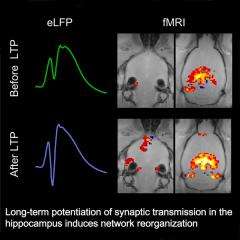
The long-term strengthening of stimulus transmission to the synapses (LTP) in the hippocampus results in the far-reaching reorganization of the neuronal network. The functional MRI (fMRI) images show which areas of the brain are well-supplied with blood and, therefore, active. Image: Santiago Canals/Max Planck Institute for Biological Cybernetics
(PhysOrg.com) -- Scientists at the Max Planck Institute for Biological Cybernetics in Tübingen have succeeded in demonstrating for the first time that the activities of large parts of the brain can be altered in the long term.
The breakthrough was achieved through the experimental stimulation of nerve cells in the hippocampus. Using a combination of functional magnetic resonance tomography, microstimulation and electrophysiology, the scientists were able to trace how large populations of nerve cells in the forebrain reorganize. This area of the brain is active when we remember something or orient ourselves spatially. The insights gained here represent the first experimental proof that large parts of the brain change when learning processes take place. (Current Biology, March 10, 2009)
Scientists refer to the characteristic whereby synapses, nerve cells or entire areas of the brain change depending on their use as neuronal plasticity. It is a fundamental mechanism for learning and memory processes. The explanation of this phenomenon in neuronal networks with shared synapses reaches as far back as the postulate of Hebbian learning proposed by psychologist Donald Olding Hebb in 1949: when a nerve cell A permanently and repeatedly stimulates another nerve cell B, the synapse is altered in such a way that the signal transmission becomes more efficient. The membrane potential in the recipient neuron increases as a result. This learning process, whose duration can range from a few minutes to an entire lifetime, was intensively researched in the hippocampus.
A large number of studies have since shown that the hippocampus plays an important role in memory capacity and spatial orientation in animals and humans. Like the cortex, the hippocampus consists of millions of nerve cells that are linked via synapses. The nerve cells communicate with each other through so-called "action potentials": electrical impulses that are sent from the transmitter cells to the recipient cells. If these action potentials become more frequent, faster or better coordinated, the signal transmission between the cells may be strengthened, resulting in a process called long-term potentiatation (LTP), whereby the transmission of the signal is strengthened permanently. The mechanism behind this process is seen as the basis of learning.
Although the effects of long-term potentiation within the hippocampus have long been known, up to now it was unclear how synaptic changes in this structure can influence the activities of entire neuronal networks outside the hippocampus, for example cortical networks. The scientists working with Nikos Logothetis, Director at the Max Planck Institute for Biological Cybernetics, have researched this phenomenon systematically for the first time. What is special about their study is the way in which it combines different methods: while the MRI scanner provides images of the blood flow in the brain and, therefore, an indirect measure of the activity of large neuronal networks, electrodes in the brain measure the action potentials directly, and therefore the strength of the nerve conduction. It emerged from the experiments that the reinforcement of the stimulation transmission generated in this way was maintained following experimental stimulation.
"We succeeded in demonstrating long-term reorganization in nerve networks based on altered activity in the synapses," explains Dr. Santiago Canals. The changes were reflected in better communication between the brain hemispheres and the strengthening of networks in the limbic system and cortex. While the cortex is responsible for, among other things, sensory perception and movement, the limbic system processes emotions and is partly responsible for the emergence of instinctive behavior.
More information: Santiago Canals, Michael Beyerlein, Hellmut Merkle & Nikos K. Logothetis, Functional MRI Evidence for LTP-Induced Neural Network, Current Biology (2009), doi:10.1016/j.cub.2009.01.037
Provided by Max-Planck-Institute for Biological Cybernetics
-
Brain on chip: Nerve tissue interfaced with a computer chip
Jun 02, 2006 |
not rated yet |
0
-
New research on octopuses sheds light on memory
Jun 17, 2008 |
not rated yet |
0
-
The building blocks of memory
Aug 20, 2007 |
not rated yet |
0
-
Learning During Sleep?
Dec 05, 2006 |
not rated yet |
0
-
It takes two to tango: Not only the receiving, but also the transmitting terminal of a nerve cell's synapse is higly ada
Nov 26, 2008 |
not rated yet |
0
-
Engineers build first sub-10-nm carbon nanotube transistor
Feb 01, 2012 |
4.9 / 5 (31) |
30
-
Something old, something new: Evolution and the structural divergence of duplicate genes
Jan 31, 2012 |
4.6 / 5 (7) |
1
-
The hidden nanoworld of ice crystals: Revealing the dynamic behavior of quasi-liquid layers
Jan 30, 2012 |
5 / 5 (3) |
1
-
Stock market network reveals investor clustering
Jan 27, 2012 |
3.9 / 5 (23) |
8
-
Of microchemistry and molecules: Electronic microfluidic device synthesizes biocompatible probes
Jan 26, 2012 |
5 / 5 (1) |
0
-
We the immaterial soul
6 hours ago
-
Is Everyday Technology Killing Us?
Feb 08, 2012
-
Exercise and weight loss
Feb 08, 2012
-
Why do we have head aches? Our brains can't feel anything.
Feb 07, 2012
-
"The end of diseases" by David Agus, interview from Daily Show with Jon Stewart
Feb 04, 2012
-
Oncolytic adenovirus
Feb 04, 2012
- More from Physics Forums - Medical Sciences
More news stories
Study finds that anti-diabetic medication can prevent the long-term effects of maternal obesity
In a study to be presented today at the Society for Maternal-Fetal Medicine's annual meeting, The Pregnancy Meeting, in Dallas, Texas, researchers will report findings that show that short therapy with the anti-diabetic medication ...
Feb 11, 2012 |
5 / 5 (1) |
1
FDA-approved drug rapidly clears amyloid from the brain, reverses Alzheimer's symptoms in mice
Neuroscientists at Case Western Reserve University School of Medicine have made a dramatic breakthrough in their efforts to find a cure for Alzheimer's disease. The researchers' findings, published in the journal Science, show t ...
Medicine & Health / Neuroscience
Feb 09, 2012 |
4.9 / 5 (53) |
21
|
Green tea found to reduce disability in the elderly
(Medical Xpress) -- A lot of research has been done over the past several years looking into the health benefits of green tea. As a result, scientists have found that regular consumption of the beverage leads ...
Teen school drop-outs three times as likely to be on benefits in later life
Teen school drop-outs are almost three times as likely to be on benefits in later life as their peers who complete their schooling, indicates research published online in the Journal of Epidemiology and Community Health.
Feb 06, 2012 |
not rated yet |
12
To perform with less effort, practice beyond perfection
Whether you are an athlete, a musician or a stroke patient learning to walk again, practice can make perfect, but more practice may make you more efficient, according to a surprising new University of Colorado Boulder study.
Medicine & Health / Neuroscience
Feb 09, 2012 |
4.4 / 5 (15) |
6
|
Google might launch Drive for cloud storage soon
(PhysOrg.com) -- Google's next big move, according to the Wall Street Journal, is a cloud storage service called Drive. Hardly first to the plate, Google is simply catching up to introducing its cloud reposi ...
Latin America mining boom clashes with conservation
Latin America is experiencing a mining boom as prices rise fuelled by a hike in global demand, but the region is also being hit by a wave of violent protests, strikes and rallies by environmentalists.
Walney offshore wind farm is world's biggest (for now)
(PhysOrg.com) -- The Walney wind farm on the Irish Sea--characterized by high tides, waves and windy weather--officially opened this week. The farm is treated in the press as a very big deal as the Walney ...
Love a click away in Indonesia's Twitter Republic
He was a geeky kid from Yogyakarta, she a glamorous city girl in Jakarta. In a country with one of the world's most vibrant social networking scenes they fell in love on Twitter.
Europeans protest controversial Internet pact
Tens of thousands of people marched in protests in more than a dozen European cities Saturday against a controversial anti-online piracy pact that critics say could curtail Internet freedom.
Navy to begin tests on electromagnetic railgun prototype launcher
The Office of Naval Research (ONR)'s Electromagnetic (EM) Railgun program will take an important step forward in the coming weeks when the first industry railgun prototype launcher is tested at a facility ...