Housing shortage alters reproductive behaviour in blue tits
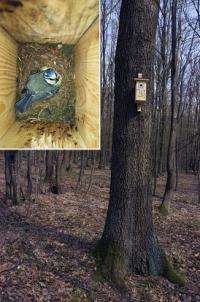
(PhysOrg.com) -- Increased competition for rare breeding sites causes female blue tits to invest more time in their current brood, to spend more time feeding their offspring and also to produce more male offspring in their clutches. These are the findings of a long-term study by behavioural ecologists Alain Jacot, Mihai Valcu and Bart Kempenaers from the Max Planck Institute for Ornithology in Seewiesen (Germany).
What happens when the demand for suitable nesting sites exceeds the availability? The law of demand and supply also applies in nature, and the consequences of enhanced competition for limited nesting sites can have far-reaching effects. Which individuals will prevail? And what happens to the unsuccessful competitors? Hole-nesting birds frequently face a difficult task in finding suitable accommodation: most of the coveted nesting cavities are located in old or dead trees and also, as result of modern forestry, increasingly few and far between.
Fortunately, many tit species readily accept artificial nest boxes. Researchers from the Max Planck Institute for Ornithology have taken advantage of this and investigated the impact of limited breeding opportunities by manipulating the number of nest boxes. The researchers identified 78 breeding pairs in a colour-banded blue tit population close to Vienna in Austria. There they split the study site into control areas and nest site-limited areas, in which the number of nest boxes was halved shortly before egg laying. The reduced number of nesting sites was expected to intensify competition among birds, with dominant individuals or pairs out-competing other birds.
Female blue tits quickly adapted to a reduction of nesting sites, showing surprisingly flexible reproductive strategies. Some of those losing out in the competition for nesting sites adopted a "parasitic" - or cuckoo-like - approach, by laying eggs in other females’ nests. This is only the second time such behaviour has been reported in blue tits. In contrast, successful females in nest-site limited areas invested relatively more in their reproduction compared to females breeding in control areas. While males did not change their feeding behaviour, females provisioned more food to their offspring compared to control females. The feeding rates of adult birds were measured during a 24-hour period by attaching a mini-transponder to a bird’s leg that sent a signal to a data-logger every time it passed the nest entrance. What is more, the limitation of nesting sites also affected the brood sex ratio: "Normally, we predict an even brood sex ratio", says Alain Jacot. "However, females breeding in nest-site limited plots produced male-biased broods in comparison to broods in control plots and also in comparison to broods from the same part of the study area from the previous six years."
The study by the Max Planck researchers shows that there is a direct link between the increased competitive situation for nesting sites and the reproductive strategies of female blue tits. "The enhanced investment of female blue tits can be explained by different mechanisms" explains Bart Kempenaers, director of the Max Planck Institute for Ornithology: "On the one hand, successful females might be of higher quality themselves and therefore able to invest more in a brood. On the other hand, the increased investment may reflect a flexible adaptation to an uncertain future with limited nesting sites. Also, it may be the case that these females invest more in their current brood because they were mated with a dominant and attractive mate. Distinguishing between these alternatives is not easy and comprehensive long-term studies are needed to provide more insight into the dynamics of these reproductive strategies."
More information: Alain Jacot, Mihai Valcu, Kees van Oers and Bart Kempenaers, Experimental nest site limitation affects reproductive strategies and parental investment in a hole-nesting passerine, Animal Behaviour 2009, online Publication, March 4
Provided by Max Planck Institute for Ornithology


