Capillary formation’s mechanical determinants: One growth factor can have many effects
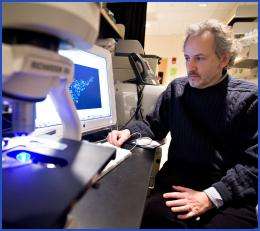
(PhysOrg.com) -- Harvard researchers have established a link between the growth of blood vessels and the mechanical stresses caused by the environment within which the vessels grow, a new understanding that researchers hope can lead to novel disease treatments based on manipulating blood flow to living tissues.
The work, conducted by a team of researchers led by Donald Ingber, director of Harvard's Wyss Institute for Biologically Inspired Engineering, is the first to decipher how blood vessel formation is guided by mechanical cues as well as by the chemical signals from growth factors illustrated in earlier research.
The findings, published in the Feb. 26 edition of the journal Nature, show that blood vessel formation is sensitive to the elasticity of the extracellular matrix within which the tissue grows. It also delineates the molecular signaling pathways that link mechanical forces to gene transcription.
Ingber, the Judah Folkman Professor of Vascular Biology at Harvard Medical School (HMS) and the School of Engineering and Applied Sciences, based at Children’s Hospital Boston, has for many years explored the characteristics and effects of the extracellular matrix on cell growth and function. His previous work has shown that tissue cells behave differently depending on the physical characteristics of the matrix to which they adhere, and on the physical forces transmitted to individual cells through it. Bones and cartilage respond to compression by altering their growth patterns, for example, while skin and muscle respond to the stretching pull of tension.
In this case, Ingber’s team created artificial extracellular matrices of varying stiffness and tested them, both in lab dishes and in animal experiments, in which the matrices were inserted under the animal’s skin.
“Here we showed that the stiffness of the matrix regulates angiogenesis: the growth, migration, and the network formation — tissue development in three dimensions,” Ingber said.
The work showed that blood vessel growth stopped if the matrix was too loose, slowed if it was too stiff, and that optimum capillary network formation occurred somewhere in between. Ingber said mechanical signaling goes hand-in-hand with chemical growth factors produced by the body, in this case vascular endothelial growth factors, or VEGF. In fact, Ingber said, growth factors are almost always present around cells, and it is the mechanical signals that prime a cell to respond to them or not.
“Mechanics modulates cell sensitivity to these other factors. Most people think you give a growth factor and you get growth,” Ingber said. “With the same growth factor, you can get growth, you can get differentiation, you can get apoptosis — cell suicide — or you can get migration, depending on the mechanical environment.”
The researchers were able to trace the entire signaling pathway, finding that mechanical stresses created by the varying elasticity of the artificial matrix influenced the production of a specific protein, called p190RhoGAP, which in turn controlled transport of transcription factors into the nucleus where they controlled the expression of a surface receptor for the angiogenic factor, VEGF.
“We mapped out the whole path that goes from mechanics to biochemistry to gene transcription to receptor expression that allows the cell to respond to the growth factors,” Ingber said.
Delineating the design principles that govern natural processes such as blood vessel formation is one of the missions of the Wyss Institute, said Ingber. The level of detail reached in the work provides design criteria that will help biologists and engineers fabricate artificial biomimetic materials that can selectively promote or inhibit capillary growth in ways that could have clinical applications, he said. When combined with existing knowledge about chemical growth factors, understanding the role of mechanical signaling in blood vessel formation can lead to new interventions.
These interventions can be useful both in cases where diseases, such as cancer, can be treated by choking off blood flow, and in cases, such as repairing injuries or amputations, where enhanced or restored blood flow is critical for tissue regeneration.
“The Wyss [Institute] seeks to understand the basic design principles that nature uses and leverage them to develop new approaches in materials and devices,” Ingber said. “In terms of design principles, this is really a major breakthrough as we have uncovered a fundamental link between mechanics and gene transcription. That is important for designing and engineering developmental controls, in this case the growth of capillary blood vessels for medical applications.”
Provided by Harvard University


