New Views of Martian Moon and Surface
March 9, 2009
New Views of Martian Moon and Surface

Enlarge

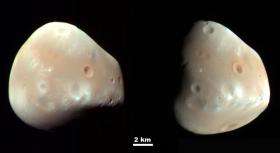
These color-enhanced views of Deimos, the smaller of the two moons of Mars, result from imaging on Feb. 21, 2009, by the High Resolution Imaging Science Experiment (HiRISE) camera on NASA's Mars Reconnaissance Orbiter. Image Credit: NASA/JPL-caltech/University of Arizona

(PhysOrg.com) -- New images from two observations of the Martian moon Deimos and more than 600 observations of Mars, acquired by the high-resolution camera (HiRISE) on NASA's Mars Reconnaissance Orbiter, became available for viewing Monday.

These color-enhanced views of , the smaller of the two moons of , result from imaging on Feb. 21, 2009, by the Science Experiment (HiRISE) camera on NASA's Mars Reconnaissance Orbiter.

Deimos has a smooth due to a blanket of fragmental rock or regolith, except for the most recent impact craters. It is a dark, reddish object, very similar to Mars' other moon, . For a comparison, see HiRISE images of Phobos taken March 23, 2008.

These Deimos images combine HiRISE exposures in near-infrared, red and blue-green wavelengths. In the enhanced color, subtle color variations are visible -- redder in the smoothest areas and less red near the fresh impact craters and over ridges of topographic highs (relative to Deimos' center of gravity). The color variations are probably caused by exposure of surface material to the space environment, which leads to darkening and reddening. Brighter and less-red surface materials have seen less exposure to space due to recent impacts or downslope movement of regolith.

Deimos is about 12 kilometers (7.5 miles) in diameter. Its orbital period is 1 day, 6 hours, 17.9 minutes.

These two images were acquired 5 hours and 35 minutes apart. The sun was to the upper left in the first (left) image, and to the right in the second image. The viewing geometry is similar in the two images, but surface features appear very different due to the change in illumination.

With an image scale of about 20 meters (66 feet) per pixel, features 60 meters (197 feet) or larger can be discerned.

These images are products from observations catalogued by the HiRISE team as ESP_012065_9000 and ESP_012068_9000. Other products from these observations are available at http://hirise.lpl. … u/deimos.php .

Provided by NASA

4.4 /5 (10 votes)  

Filter


Move the slider to adjust rank threshold, so that you can hide some of the comments.


Display comments: newest first

deatopmg
Mar 10, 2009

Rank: not rated yet
"The color variations are probably caused by exposure of surface material to the space environment, which leads to darkening and reddening"

What's the proposed mechanism?

....and they've got a bridge for sale too.

regolith? or pixel diddling here on earth? c'mon!

never a straight answer
Rank 4.4 /5 (10 votes)
Related Stories
Relevant PhysicsForums posts
  • Never ending outer space.....
    created12 hours ago
  • Neutron Star fragments?
    created14 hours ago
  • stationary or not?
    created18 hours ago
  • Scale of the Universe
    createdFeb 10, 2012
  • Titan's lack of impact craters
    createdFeb 09, 2012
  • Real pictures of black hole eating a star?
    createdFeb 08, 2012
  • More from Physics Forums - General Astronomy

More news stories

Latin America mining boom clashes with conservation

Latin America is experiencing a mining boom as prices rise fuelled by a hike in global demand, but the region is also being hit by a wave of violent protests, strikes and rallies by environmentalists.

Space & Earth / Environment

created 5 hours ago | popularity not rated yet | comments 0

Political leaders play key role in how worried Americans are by climate change: study

More than extreme weather events and the work of scientists, it is national political leaders who influence how much Americans worry about the threat of climate change, new research finds.

Space & Earth / Environment

created Feb 06, 2012 | popularity 5 / 5 (6) | comments 72

NASA budget will axe Mars deal with Europe: scientists

US President Barack Obama's budget proposal to be submitted next week for 2013 will cut NASA's budget by 20 percent and eliminate a major partnership with Europe on Mars exploration, scientists said Thursday.

Space & Earth / Space Exploration

created Feb 10, 2012 | popularity 5 / 5 (3) | comments 55

Humans may have helped the decline of African rainforests 3000 years ago

(PhysOrg.com) -- Large areas of rainforests in Central Africa mysteriously disappeared over three thousand years ago, to be replaced by savannas. The prevailing theory has been that the cause was a change ...

Space & Earth / Environment

created Feb 10, 2012 | popularity 4.1 / 5 (14) | comments 20 | with audio podcast report

High planetary tilt lowers odds for life?

Highly-tilted worlds would have extreme seasons, subjecting life to alternating periods of scorching and subzero temperatures. This could make the development of all but hardiest, simplest creatures a long ...

Space & Earth / Space Exploration

created Feb 06, 2012 | popularity 4.8 / 5 (12) | comments 14 | with audio podcast


Google might launch Drive for cloud storage soon

(PhysOrg.com) -- Google's next big move, according to the Wall Street Journal, is a cloud storage service called Drive. Hardly first to the plate, Google is simply catching up to introducing its cloud reposi ...

Love a click away in Indonesia's Twitter Republic

He was a geeky kid from Yogyakarta, she a glamorous city girl in Jakarta. In a country with one of the world's most vibrant social networking scenes they fell in love on Twitter.

Europeans protest controversial Internet pact

Tens of thousands of people marched in protests in more than a dozen European cities Saturday against a controversial anti-online piracy pact that critics say could curtail Internet freedom.

Walney offshore wind farm is world's biggest (for now)

(PhysOrg.com) -- The Walney wind farm on the Irish Sea--characterized by high tides, waves and windy weather--officially opened this week. The farm is treated in the press as a very big deal as the Walney ...

Navy to begin tests on electromagnetic railgun prototype launcher

The Office of Naval Research (ONR)'s Electromagnetic (EM) Railgun program will take an important step forward in the coming weeks when the first industry railgun prototype launcher is tested at a facility ...

Explained: Sigma

It's a question that arises with virtually every major new finding in science or medicine: What makes a result reliable enough to be taken seriously? The answer has to do with statistical significance -- but ...