Amazonian amphibian diversity traced to Andes
March 10, 2009
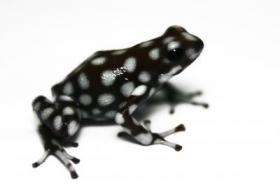
Dendrobates mysteriosus

Enlarge

Poison frog from the transition between the Andes and Amazonia in northeastern Peru. Credit: Juan Carlos Santos, the University of Texas at Austin

Colorful poison frogs in the Amazon owe their great diversity to ancestors that leapt into the region from the Andes Mountains several times during the last 10 million years, a new study from The University of Texas at Austin suggests.

This is the first study to show that the Andes have been a major source of diversity for the , one of the largest reservoirs of biological diversity on Earth. The finding runs counter to the idea that Amazonian diversity is the result of evolution only within the tropical forest itself.

"Basically, the Amazon basin is a 'melting pot' for South American frogs," says graduate student Juan Santos, lead author of the study. " there have come from multiple places of origin, notably the Andes Mountains, over many millions of years. We have shown that you cannot understand Amazonian biodiversity by looking only in the basin. Adjacent regions have played a major role."
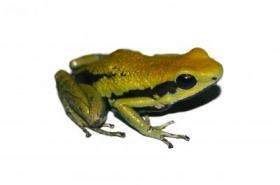
Ameerga bassleri
Enlarge

Poison frog from the transition between the Andes and Amazonia in northeastern Peru. Credit: Juan Carlos Santos, the University of Texas at Austin

Santos and Dr. David Cannatella, professor of integrative biology, published their findings this month in the journal PLoS Biology.

It has been assumed that much of the evolution of biodiversity in the Amazon basin occurred over the last one to two million years, a mere snapshot in time.

Santos and Cannatella peered about 45 million years into the past using novel biogeographical techniques to create a deep evolutionary history of poison frogs in space and time. Because of the lack of an extensive for the tropical forest, their work used to discover the frogs' evolutionary history.

The poison frogs, or dendrobatids, are diverse and widely distributed across the Neotropics, an area that includes Central and South America. The scientists created an , or phylogeny, using 223 of the 353 species of poison frogs known from throughout this region.

In analyzing the evolutionary relationships among the poison frogs, they discovered that Amazonian diversity is the result of at least 14 dispersals of ancestral frogs into the region beginning about 23 million years ago.

All living Amazonian poison frogs evolved from these ancestors, most of which (11 dispersals) came from the Andes Mountains.

The Amazon basin has changed dramatically over that long time. A large inland system of water has come and gone, the Andes Mountains started their uplift (about 15 million years ago) and the Amazon River was formed (about nine million years ago).

Most of the frog dispersals from the Andes occurred between one and seven million years ago, when the modern tropical rainforest of the Amazon River basin was forming.

"There was a repeated dispersal of frogs from the foothills of the Andes after the extensive inland wetlands retreated from the Amazon," says Santos.

These frogs then evolved into about 70 species found today in the Amazon basin.

The scientists also discovered that frogs have historically immigrated out of the Amazon basin to adjacent areas, and to and from other regions within the Neotropics.

Evolution and diversification of the poison frogs is ongoing, especially in the Amazon rainforest, the Chocó (a narrow region of tropical forest along the northwest Pacific Coast of South America) and in adjacent Central America.

Cannatella says many other tropical plants and animals in the Amazon may share this more complex geographical and temporal history with the poison frogs.

"The Amazon rainforest is not just gradually accumulating diversity over time," says Cannatella. "Ancestral frog species moved into and out of the area, and we can predict that other organisms restricted to these wet may show a similar pattern of dispersal, evolution and diversification."

Source: University of Texas at Austin


Rank 5 /5 (3 votes)
Related Stories
Relevant PhysicsForums posts
  • Factors affecting beet root cell membrane
    created18 hours ago
  • Stem cell question.
    createdFeb 10, 2012
  • Protease cleavage
    createdFeb 10, 2012
  • Pertubance in a model
    createdFeb 10, 2012
  • Cancer drugs and Alzheimer's, Oh my!
    createdFeb 09, 2012
  • Squishing cells
    createdFeb 09, 2012
  • More from Physics Forums - Biology

More news stories

A mitosis mystery solved: How chromosomes align perfectly in a dividing cell

Although the process of mitotic cell division has been studied intensely for more than 50 years, Whitehead Institute researchers have only now solved the mystery of how cells correctly align their chromosomes during symmetric ...

Biology / Cell & Microbiology

created 14 hours ago | popularity 4.5 / 5 (22) | comments 0 | with audio podcast

Researchers find extensive RNA editing in human transcriptome

In a new study published online in Nature Biotechnology, researchers from BGI, the world's largest genomics organization, reported the evidence of extensive RNA editing in a human cell line by analysis of RNA-seq data, demons ...

Biology / Biotechnology

created 14 hours ago | popularity 5 / 5 (4) | comments 0 | with audio podcast

The proteins ensuring genome protection

Researchers from the University of Geneva (UNIGE), Switzerland, have discovered the crucial role of two proteins in developing a cell 'anti-enzyme shield'. This protection system, which operates at the level of molecular ...

Biology / Cell & Microbiology

created 14 hours ago | popularity 5 / 5 (3) | comments 0 | with audio podcast

Entire genome of extinct human decoded from fossil

(PhysOrg.com) -- In 2010, Svante Pääbo and his colleagues presented a draft version of the genome from a small fragment of a human finger bone discovered in Denisova Cave in southern Siberia. The ...

Biology / Biotechnology

created Feb 07, 2012 | popularity 4.7 / 5 (60) | comments 51 | with audio podcast

Why are there so few fish in the Earth's oceans?

(PhysOrg.com) -- A Stony Brook University researcher has found that, contrary to popular belief, there are not plenty of fish in the sea.

Biology / Plants & Animals

created Feb 08, 2012 | popularity 4.3 / 5 (19) | comments 27 | with audio podcast


Japan's Fukushima reactor may be reheating: operator

Temperature readings at one of the crippled Fukushima nuclear reactors have risen above Japan's stringent new safety standard but there was no immediate danger, its operator said Sunday.

Scientists discover molecular secrets of 2,000-year-old Chinese herbal remedy

For roughly two thousand years, Chinese herbalists have treated Malaria using a root extract, commonly known as Chang Shan, from a type of hydrangea that grows in Tibet and Nepal. More recent studies suggest that halofuginone, ...

New method to examine batteries -- MRI from the inside

There is an ever-increasing need for advanced batteries for portable electronics, such as phones, cameras, and music players, but also to power electric vehicles and to facilitate the distribution and storage of energy derived ...

Google might launch Drive for cloud storage soon

(PhysOrg.com) -- Google's next big move, according to the Wall Street Journal, is a cloud storage service called Drive. Hardly first to the plate, Google is simply catching up to introducing its cloud reposi ...

Lab study raises questions over nano-particle impact

Tests involving chickens have raised questions about the impact on health from engineered nano-particles, the ultra-fine grains commonly used in drugs and processed foods, scientists said on Sunday.

Starve a virus, feed a cure? Findings show how some cells protect themselves against HIV

A protein that protects some of our immune cells from the most common and virulent form of HIV works by starving the virus of the molecular building blocks that it needs to replicate, according to research published online ...