Developing fruit fly embryo is capable of genetic corrections
March 10, 2009
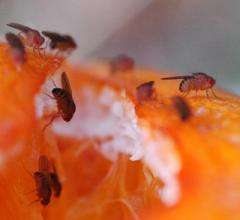
Fruit flies. Credit: Ted Morrow
Animals have an astonishing ability to develop reliably, in spite of variable conditions during embryogenesis. New research, published in parallel this week in PLoS Biology and PLoS Computational Biology, addresses how living things can develop into precise, adult forms when there is so much variation present during their development stages. A team led by John Reinitz at Stony Brook University, and funded by the National Institutes of Health, shows how fruit fly embryos can "forget" initial incorrect versions of their body plan and develop into recognizable adult flies.
"Our results show that groups of genes can act on one another to reduce variation and highlights the importance of genetic networks in generating robust development," said Dr. John Reinitz.
Canalization, a principle of developmental biology described more than 60 years ago by C.H. Waddington, is the property of embryonic development whereby genetic interactions can adjust biochemical reactions to bring about reliable developmental outcomes, despite variable conditions.
A great deal of progress has been made in understanding the buffering of genotypic and environmental variation, and individual mutations that reveal variation have been identified. However, the mechanisms by which genetic interactions produce canalization are not yet well understood, because this requires molecular data on multiple developmental determinants and models that correctly predict complex interactions.
"We make use of gene expression data at both high spatial and temporal resolution for the gap genes involved in the segmentation of the fruit fly Drosophila embryo," said Dr. Reinitz. "We also apply a mathematical model to show that cross regulation among the gap genes is responsible for canalization in this system." The model predicted specific interactions that cause canalization, and the prediction was validated in experiments.
"With canalization, if there is too much of one protein in the embryo, a network of genes could theoretically change the amount of that protein present, so that the outcome for the embryo was normal," said Dr. Reinitz. "Since this principle was suggested, a great deal of progress has been made in understanding the buffering of variation, but the specific mechanisms by which genetic interactions contribute to canalization have remained unclear - until now."
The authors started by measuring the concentrations of certain proteins in normal and mutant Drosophila embryos, at an early stage of development when the embryo looks like a hollow rugby ball. Each protein is synthesized from a gene, and each of the proteins measured has a regulatory role; they can turn their own gene - and others - on and off. The authors created a series of equations that could describe the diffusion of proteins and their action on their own gene and on other genes in the network. These equations show that a wide range of initial conditions (in terms of protein concentrations) lead to several possible final conditions. These final conditions, called fixed points, govern or describe the final state of the segmentation process for the fruit fly embryo. They do not allow for variability in the embryo, and they 'forget' the initial information. This mathematical property combined with their accuracy in describing the biological processes can be used towards the theoretical explanation for Waddington's canalization model.
"This study is an example of how biology is becoming a precise and quantitative field, like physics," says Reinitz.
More information:
Manu, Surkova S, Spirov AV, Gursky V V, Janssens H, et al. (2009) Canalization of gene expression in the Drosophila blastoderm by gap gene cross regulation. PLoS Biol 7(3): e1000049. doi:10.1371/journal.pbio.1000049
http://biology.plo … pbio.1000049
Manu, Surkova S, Spirov AV, Gursky VV, Janssens H, et al. (2009) Canalization of Gene Expression and Domain Shifts in the Drosophila Blastoderm by Dynamical Attractors. PLoS Comput Biol 5(3): e1000303. doi:10.1371/journal.pcbi.1000303
http://compbiol.pl … pcbi.1000303
Source: Public Library of Science
-
Suppressing cancer with a master control gene
Feb 23, 2009 |
not rated yet |
0
-
How do you know whether you are male or female?
Dec 27, 2007 |
not rated yet |
0
-
A novel explanation for a floral genetic mystery
Jan 16, 2009 |
not rated yet |
0
-
Gene regulators bind promiscuously, but often do nothing
Feb 12, 2008 |
not rated yet |
0
-
A First-Principles Model of Early Evolution
Jul 11, 2007 |
not rated yet |
0
-
Engineers build first sub-10-nm carbon nanotube transistor
Feb 01, 2012 |
4.9 / 5 (32) |
30
-
Something old, something new: Evolution and the structural divergence of duplicate genes
Jan 31, 2012 |
4.6 / 5 (7) |
1
-
The hidden nanoworld of ice crystals: Revealing the dynamic behavior of quasi-liquid layers
Jan 30, 2012 |
5 / 5 (4) |
1
-
Stock market network reveals investor clustering
Jan 27, 2012 |
3.9 / 5 (23) |
8
-
Of microchemistry and molecules: Electronic microfluidic device synthesizes biocompatible probes
Jan 26, 2012 |
5 / 5 (2) |
0
-
Factors affecting beet root cell membrane
5 hours ago
-
Stem cell question.
Feb 10, 2012
-
Protease cleavage
Feb 10, 2012
-
Pertubance in a model
Feb 10, 2012
-
Cancer drugs and Alzheimer's, Oh my!
Feb 09, 2012
-
Squishing cells
Feb 09, 2012
- More from Physics Forums - Biology
More news stories
A mitosis mystery solved: How chromosomes align perfectly in a dividing cell
Although the process of mitotic cell division has been studied intensely for more than 50 years, Whitehead Institute researchers have only now solved the mystery of how cells correctly align their chromosomes during symmetric ...
1 hour ago |
5 / 5 (2) |
0
|
The proteins ensuring genome protection
Researchers from the University of Geneva (UNIGE), Switzerland, have discovered the crucial role of two proteins in developing a cell 'anti-enzyme shield'. This protection system, which operates at the level of molecular ...
1 hour ago |
5 / 5 (2) |
0
|
Researchers find extensive RNA editing in human transcriptome
In a new study published online in Nature Biotechnology, researchers from BGI, the world's largest genomics organization, reported the evidence of extensive RNA editing in a human cell line by analysis of RNA-seq data, demons ...
1 hour ago |
5 / 5 (3) |
0
|
Entire genome of extinct human decoded from fossil
(PhysOrg.com) -- In 2010, Svante Pääbo and his colleagues presented a draft version of the genome from a small fragment of a human finger bone discovered in Denisova Cave in southern Siberia. The ...
Feb 07, 2012 |
4.7 / 5 (58) |
48
|
Why are there so few fish in the Earth's oceans?
(PhysOrg.com) -- A Stony Brook University researcher has found that, contrary to popular belief, there are not plenty of fish in the sea.
Feb 08, 2012 |
4.3 / 5 (17) |
27
|
Lab study raises questions over nano-particle impact
Tests involving chickens have raised questions about the impact on health from engineered nano-particles, the ultra-fine grains commonly used in drugs and processed foods, scientists said on Sunday.
Iran blocks email, restricts net access: reports
Iran has further restricted access to the Internet and blocked popular email services for the past few days, in a move a top lawmaker said could "cost the regime dearly," media reports said on Sunday.
Salvage workers begin pumping fuel from Italian shipwreck
Salvage workers Sunday began pumping fuel from the shipwrecked Italian cruise liner Costa Concordia, a day ahead of schedule, officials said.
Scientists discover molecular secrets of 2,000-year-old Chinese herbal remedy
For roughly two thousand years, Chinese herbalists have treated Malaria using a root extract, commonly known as Chang Shan, from a type of hydrangea that grows in Tibet and Nepal. More recent studies suggest that halofuginone, ...
New method to examine batteries -- MRI from the inside
There is an ever-increasing need for advanced batteries for portable electronics, such as phones, cameras, and music players, but also to power electric vehicles and to facilitate the distribution and storage of energy derived ...
Starve a virus, feed a cure? Findings show how some cells protect themselves against HIV
A protein that protects some of our immune cells from the most common and virulent form of HIV works by starving the virus of the molecular building blocks that it needs to replicate, according to research published online ...