Nanotech coating could lead to better brain implants to treat diseases
March 10, 2009
(PhysOrg.com) -- Biomedical and materials engineers at the University of Michigan have developed a nanotech coating for brain implants that helps the devices operate longer and could improve treatment for deafness, paralysis, blindness, epilepsy and Parkinson's disease.
Currently, brain implants can treat Parkinson's disease, depression and epilepsy. These and the next generation of the devices operate in one of two ways. Either they stimulate neurons with electrical impulses to override the brain's own signals, or they record what working neurons are transmitting to non-working parts of the brain and reroute that signal.
On-scalp and brain-surface electrodes are giving way to brain-penetrating microelectrodes that can communicate with individual neurons, offering hope for more precise control of signals.
In recent years, researchers at other institutions have demonstrated that these implanted microelectrodes can let a paralyzed person use thought to control a computer mouse and move a wheelchair. Michigan researchers' say their coating can most immediately improve this type of microelectrode.
Mohammad Reza Abidian, a post-doctoral researcher in the Department of Biomedical Engineering who is among the developers of the new coating, says the reliability of today's brain-penetrating microelectrodes often begins to decline after they're in place for only a few months.
"You want to be able to use these for at least a couple years," Abidian said. "Current technology doesn't allow this in most cases because of how the tissues of the brain respond to the implants. The goal is to increase their efficiency and their lifespans."
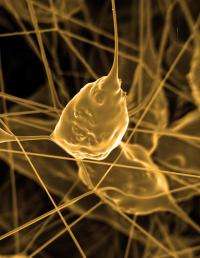
The new coating Abidian and his colleagues developed is made of three components that together allow electrodes to interface more smoothly with the brain. The coating is made of a special electrically-conductive nanoscale polymer called PEDOT; a natural, gel-like buffer called alginate hydrogel; and biodegradable nanofibers loaded with a controlled-release anti-inflammatory drug.
The PEDOT in the coating enables the electrodes to operate with less electrical resistance than current models, which means they can communicate more clearly with individual neurons.
The alginate hydrogel, partially derived from algae, gives the electrodes mechanical properties more similar to actual brain tissue than the current technology. That means coated neural electrodes would cause less tissue damage.
The biodegradable, drug-loaded nanofibers fight the "encapsulation" that occurs when the immune system tells the body to envelop foreign materials. Encapsulation is another reason these electrodes can stop functioning properly. The nanofibers fight this response well because they work with the alginate hydrogel to release the anti-inflammatory drugs in a controlled, sustained fashion as the nanofibers themselves break down.
"Penetrating microelectrodes provide a means to record from individual neurons, and in doing so, there is the potential to record extremely precise information about a movement or an intended movement. The open question in our field is what is the trade-off: How much invasiveness can be tolerated in exchange for more precision?" said Daryl Kipke, a professor in the Department of Biomedical Engineering and the director of the U-M Center for Neural Communication Technology.
In these experiments, the Michigan researchers applied their coating to microelectrodes provided by the U-M Center for Neural Communication Technology.
More information: A paper on this research, called "Multifunctional Nanobiomaterials for Neural Interfaces," is published in Advanced Functional Materials. It is the cover story on the February 24 issue.
Source: University of Michigan
-
Coatings to help medical implants connect with neurons
Aug 21, 2008 |
not rated yet |
0
-
Carbon Nanotube-Coated Electrodes Improve Brain Readouts
Aug 12, 2008 |
not rated yet |
0
-
Researchers engineer new polymers to change their stiffness, strength when exposed to liquids
Mar 06, 2008 |
not rated yet |
0
-
New 'smart' materials for the brain
Dec 21, 2008 |
not rated yet |
0
-
Researchers Use Nanowires to Develop Neural Probe That Will Limit Damage to Cells and Biological Tissue
Oct 14, 2008 |
not rated yet |
0
-
Engineers build first sub-10-nm carbon nanotube transistor
Feb 01, 2012 |
4.9 / 5 (30) |
30
-
Something old, something new: Evolution and the structural divergence of duplicate genes
Jan 31, 2012 |
4.6 / 5 (7) |
1
-
The hidden nanoworld of ice crystals: Revealing the dynamic behavior of quasi-liquid layers
Jan 30, 2012 |
5 / 5 (3) |
1
-
Stock market network reveals investor clustering
Jan 27, 2012 |
3.9 / 5 (23) |
8
-
Of microchemistry and molecules: Electronic microfluidic device synthesizes biocompatible probes
Jan 26, 2012 |
5 / 5 (1) |
0
-
Pertubance in a model
2 hours ago
-
Cancer drugs and Alzheimer's, Oh my!
10 hours ago
-
Squishing cells
11 hours ago
-
Any books/articles for evolutionary stable strategy models in humans?
22 hours ago
-
Science behind the bore feeling?
Feb 09, 2012
-
Homo Sapien vs. Chimpanzee - Divergence Timeline
Feb 09, 2012
- More from Physics Forums - Biology
More news stories
What lies beneath: Mapping hidden nanostructures
The ability to diagnose and predict the properties of materials is vital, particularly in the expanding field of nanotechnology. Electron and atom-probe microscopy can categorize atoms in thin sheets of material, ...
34 minutes ago |
not rated yet |
0
'Dark plasmons' transmit energy
Microscopic channels of gold nanoparticles have the ability to transmit electromagnetic energy that starts as light and propagates via "dark plasmons," according to researchers at Rice University.
17 hours ago |
5 / 5 (5) |
0
|
Nanotube therapy takes aim at breast cancer stem cells
Wake Forest Baptist Medical Center researchers have again proven that injecting multiwalled carbon nanotubes (MWCNTs) into tumors and heating them with a quick, 30-second laser treatment can kill them.
Nanotechnology / Bio & Medicine
22 hours ago |
5 / 5 (1) |
0
|
New kind of solar cell could capture significantly more energy than current cells
New solar cells could increase the maximum efficiency of solar panels by over 25%, according to scientists from the University of Cambridge.
Feb 08, 2012 |
4.5 / 5 (11) |
14
|
Nanoshell whispering galleries improve thin solar panels
Visitors to Statuary Hall in the U.S. Capitol Building may have experienced a curious acoustic feature that allows a person to whisper softly at one side of the cavernous, half-domed room and for another on ...
Nanotechnology / Nanomaterials
Feb 07, 2012 |
4.3 / 5 (6) |
6
|
The power of estrogen -- male snakes attract other males
A new study has shown that boosting the estrogen levels of male garter snakes causes them to secrete the same pheromones that females use to attract suitors, and turned the males into just about the sexiest ...
Experts reveal how plants don't get sunburn
(PhysOrg.com) -- Experts at the University of Glasgow have discovered how plants survive the harmful rays of the sun.
Team isolates nerve cells involved in storing long term memory and gene proteins associated with them
(Medical Xpress) -- A research team in Taiwan has succeeded in isolating two nerve cells in fruit fly brains that are believed to be the major players in allowing for the formation of long term memories. Furthermore, ...
Fool's gold may prove an unlikely alternative to overexploited catalytic materials
Catalytic materials, which lower the energy barriers for chemical reactions, are used in everything from the commercial production of chemicals to catalytic converters in car engines. However, with current catalytic materials ...
SLAC, Stanford team focuses on high-energy electrons to treat cancer
Accelerator physicists at SLAC and cancer specialists from Stanford are working on a new technology that could dramatically reduce the time needed for cancer radiation treatments. The team ran an initial experiment ...
News of plaque-clearing drug tops week of major advances against Alzheimer's disease
In the last eight days, scientists have delivered a powerful one-two punch in the fight to defeat Alzheimer's disease. At the same time, the White House and members of Congress are proposing increases in Alzheimer's research ...