Nanotubes find niche in electric switches
March 10, 2009 Nanotube Brushes

Enlarge

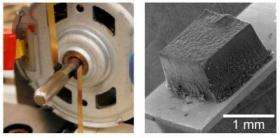
Pads of nanotube "forests" were tested as brush contacts. Credit: P. Ajayan/Rice University

New research from Rice University and the University of Oulu in Oulu, Finland, finds that carbon nanotubes could significantly improve the performance of electrical commutators that are common in electric motors and generators.

The research, which appeared online this month in the journal Advanced Materials, finds that "brush contact" pads made of carbon nanotubes had 10 times less resistance than did the carbon-copper composite brushes commonly used today. are an integral part of "commutators," or spinning used in many battery-powered electrical devices, such as cordless drills.

"The findings show that nanotubes have a great deal of practical relevance as brush contacts," said lead researcher Pulickel Ajayan, Rice's Benjamin M. and Mary Greenwood Anderson Professor in Mechanical Engineering and Materials Science. "The technology is widely used in industry, both in consumer gadgets as well as larger electrical machinery, so this could be a very interesting, near-term application for nanotubes." The combination of mechanical and of nanotubes makes this possible.

The carbon nanotubes used in the study are hollow tubes of pure carbon that are about 30 nanometers in diameter. By comparison, a human hair is about 100,000 nanometers in diameter. In addition to being small, nanotubes are also extremely lightweight and durable, and they are excellent conductors of heat and electricity.

Because of these properties, the researchers decided to test nanotubes as brush contacts. Brush contacts are conducting pads held against a spinning metal disc or rod by spring-loaded arms. Current is passed from the through the brush contacts to other parts of the device.

To test the feasibility of using brush contacts, the research team replaced the ordinary copper-carbon composite brushes of an electric motor with small blocks that contain millions of carbon nanotubes. Under an electron microscope, these millimeter-square blocks look like a tightly packed forest.

From Ajayan's previous work, the team knew that these nanotube forests react something like a "memory foam" pillow; they regain their shape very quickly after they are compressed.

"This elasticity is something that's not found in existing composites that are used for brush contacts, and that's the essence of why the nanotube brush contacts perform better: They keep much more of their surface area in contact with the spinning disc," said Robert Vajtai, faculty fellow at Rice. Vajtai worked on the study with Ajayan and a group of researchers in Finland led by University of Oulu Researcher Krisztian Kordas.

The team believes that the improved contact between the surface of the spinning disc and the brush accounts for the 90 percent reduction in lost energy.

Source: Rice University


print this article email this article download pdf blog this article bookmark this article     Stumble it Digg this share on Facebook retweet share on Reddit add to delicious
Rate this story - 1 /5 (1 vote)


March 10, 2009 all stories

Comments: 0

1 /5 (1 vote)
  • Stumble this up

  • Digg this

  • share this

  • hide
  • Related Stories

  • US struggles to pinpoint cyber attacks: Top official
    created Mar 10, 2009 | popularity not rated yet | comments 0
  • Scientists Create Multifunctional Brushes From Carbon Nanotubes
    created Jun 28, 2005 | popularity not rated yet | comments 0
  • Hewlett Packard to create 500 jobs in Ireland
    created Mar 10, 2009 | popularity not rated yet | comments 0
  • College best option for young people during times of high unemployment
    created Mar 10, 2009 | popularity not rated yet | comments 0
  • Can mental training games help prevent Alzheimer's?
    created Mar 10, 2009 | popularity not rated yet | comments 0


  • hide
  • Relevant PhysicsForums posts

  • Polymer Properties Question
    created 13 hours ago
  • Fatigue Properties of Chinese steel
    created Nov 04, 2009
  • Finding Hardness values
    created Nov 04, 2009
  • Fluid flow, pressure drop simulation in Comsol
    created Nov 04, 2009
  • More from Physics Forums - Materials & Chemical Engineering

Other News

Findings show nanomedicine promising for treating spinal cord injuries

Findings show nanomedicine promising for treating spinal cord injuries

Nanotechnology / Bio & Medicine

created 22 hours ago | popularity 4.5 / 5 (4) | comments 0

(PhysOrg.com) -- Researchers at Purdue University have discovered a new approach for repairing damaged nerve fibers in spinal cord injuries using nano-spheres that could be injected into the blood shortly ...


New Digital 'Electronics' Concept May Continue Moore's Law

New Digital 'Electronics' Concept May Continue Moore's Law

Nanotechnology / Nanophysics

created Nov 05, 2009 | popularity 4.6 / 5 (55) | comments 9

(PhysOrg.com) -- Computers of the future could be operating not on electrons, but on tiny waves traveling through an electron "fluid," if a new proposal is successful. The new circuit design, recently introduced ...


Nanoparticles for gene therapy improve

Nanoparticles for gene therapy improve

Nanotechnology / Bio & Medicine

created Nov 06, 2009 | popularity 5 / 5 (5) | comments 3

(PhysOrg.com) -- About five years ago, Professor Janet Sawicki at the Lankenau Institute in Pennsylvania read an article about nanoparticles developed by MIT's Robert Langer for gene therapy, the insertion ...


Breakthrough in industrial-scale nanotube processing

Breakthrough in industrial-scale nanotube processing

Nanotechnology / Nanomaterials

created Nov 02, 2009 | popularity 4.9 / 5 (20) | comments 3

(PhysOrg.com) -- Rice University scientists today unveiled a method for the industrial-scale processing of pure carbon-nanotube fibers that could lead to revolutionary advances in materials science, power ...


Nanoparticles may cause DNA damage across a cellular barrier

Nanoparticles may cause DNA damage across a cellular barrier

Nanotechnology / Bio & Medicine

created Nov 05, 2009 | popularity 4.3 / 5 (9) | comments 1

(PhysOrg.com) -- Scientists have shown in the laboratory that metal nanoparticles damaged the DNA in cells on the other side of a cellular barrier. The research, by the University of Bristol, is published ...