Seaweed and fireflies brew may guide stem cell treatment for peripheral artery disease
March 10, 2009 Seaweed and fireflies brew may guide stem cell treatment for peripheral artery disease

Enlarge

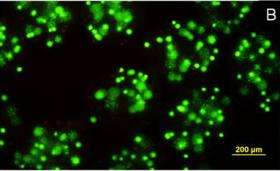
A microscopic view of stem cells inside X-ray visible bubbles, which protect the cells from rejection by the immune system.

An unlikely brew of seaweed and glow-in-the-dark biochemical agents may hold the key to the safe use of transplanted stem cells to treat patients with severe peripheral arterial disease (PAD), according to a team of veterinarians, basic scientists and interventional radiologists at Johns Hopkins.

In a preliminary "proof of concept" study in rabbits, Johns Hopkins scientists safely and successfully delivered therapeutic via intramuscular injections and then monitored the stem cells' viability once they reached their targets.

A report of the study by Johns Hopkins radiologists is scheduled for presentation at the Society of Interventional Radiology's 34th annual scientific meeting March 10.

Stem cells hold promise in treating PAD by reconstituting or increasing the number of blood vessels to replace or augment those choked off by plaque buildup. A chronic condition that can lead to amputations and even death, PAD is marked by vastly reduced circulation of blood in vessels feeding the legs and other "peripheral" body parts, and affects as many as 10 million Americans. Many cases can be treated with angioplasty or stents, similar to approaches used in coronary artery disease, but for some patients with extensive disease conventional treatment is not feasible, researchers say.

Among the technical hurdles to improving blood flow in such patients, according to Dara L. Kraitchman, V.M.D., Ph.D., associate professor of radiology at Johns Hopkins, is a means of telling doctors whether injected stem cells are staying alive and reaching the right targets to grow and develop into the needed new tissue.

This is critical, Kraitchman says, because the body's own immune defenses may recognize the potentially helpful donor stem cells as foreign invaders and try to destroy them, and also because traditional radioactive labeling agents, or tracers, which are normally used to track cells, can be toxic to stem cells.

To overcome rejection of the stem cells by the body's — in this case, rabbit immune systems — they first created a novel "capsule" derived from seaweed, which was used to surround and protect the rabbit stem cells from attack by the host's immune system. Within the seaweed capsule, they added X-ray contrast agents to allow the capsules to be seen on X-ray angiography. Next, they engineered the stem cells within the capsules to produce luciferase, the same bioluminescent chemical produced by fireflies, which is highly visible under bioluminescence imaging.

"Once we were able to trick the immune system into not attacking the cells, we had to know they arrived at their destination and were living," says Kraitchman. "We could use standard X-ray angiography of blood vessels to see the transplanted cells. When they lit up like fireflies at night, we knew they were still alive."

"Hopefully, this new technology will one day pave the way for treating humans," says Frank Wacker, M.D., director of vascular interventional radiology at Hopkins and visiting professor of radiology. "We look to the day when we will be able to perform targeted delivery of stem cell to treat PAD in patients who may be facing amputation or death."

Source: Johns Hopkins Medical Institutions


print this article email this article download pdf blog this article bookmark this article     Stumble it Digg this share on Facebook retweet share on Reddit add to delicious
Rate this story - 5 /5 (1 vote)


March 10, 2009 all stories

Comments: 0

5 /5 (1 vote)
  • Stumble this up

  • Digg this

  • share this

  • hide
  • Related Stories

  • Researchers identify new way the malaria parasite and red blood cells interact
    created Mar 10, 2009 | popularity not rated yet | comments 0
  • US struggles to pinpoint cyber attacks: Top official
    created Mar 10, 2009 | popularity not rated yet | comments 0
  • Small molecules block cancer gene
    created Mar 10, 2009 | popularity not rated yet | comments 0
  • Hewlett Packard to create 500 jobs in Ireland
    created Mar 10, 2009 | popularity not rated yet | comments 0
  • Can mental training games help prevent Alzheimer's?
    created Mar 10, 2009 | popularity not rated yet | comments 0


  • hide
  • Relevant PhysicsForums posts

  • Nanomaterials destroy cancer!
    created Nov 30, 2009
  • Nuclear Medicine
    created Nov 30, 2009
  • Silver nitrate, cold sore, stain
    created Nov 29, 2009
  • Chest x-ray???
    created Nov 27, 2009
  • More from Physics Forums - Medical Sciences

Other News

Discovery makes brain tumor cells more responsive to radiation

Medicine & Health / Cancer

created 19 minutes ago | popularity not rated yet | comments 0

Duke University Medical Center researchers have figured out how stem cells in the malignant brain cancer glioma may be better able to resist radiation therapy. And using a drug to block a particular signaling pathway in these ...


Why a short run is better than a long walk

Why a short run is better than a long walk

Medicine & Health / Research

created 2 hours ago | popularity 5 / 5 (1) | comments 1

(PhysOrg.com) -- Using the latest technology, researchers are uncovering evidence of exactly how major a role activity plays in the battle to keep obesity at bay. In new report published in the British Me ...


Experts: Man controlled robotic hand with thoughts (AP)

Scientists: Man controlled robotic hand with thoughts

Medicine & Health / Research

created 2 hours ago | popularity 5 / 5 (4) | comments 1

(AP) -- A group of European scientists said Wednesday they have successfully connected a robotic hand to an amputee, allowing him to feel sensations in the artificial limb and control it with his thoughts.


Alcohol companies target youths with magazine ads, new study shows

Medicine & Health / Health

created 1hour ago | popularity 1 / 5 (1) | comments 1

Alcoholic beverages popular among youths are more likely to be advertised in magazines with high youth readership than alcoholic drinks consumed mainly by adults, resulting in disproportionately high youth exposure to such ...


Young adults who exercise get higher IQ

Medicine & Health / Health

created 1hour ago | popularity not rated yet | comments 0

Young adults who are fit have a higher IQ and are more likely to go on to university, reveals a major new study carried out at the Sahlgrenska Academy and Sahlgrenska University Hospital.