A 3-D view of remote galaxies
March 10, 2009 A 3-D View of Remote Galaxies

Enlarge

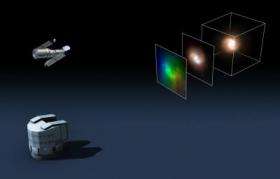
Combining the twin strengths of the NASA/ESA Hubble Space Telescope’s acute eye, and the capacity of ESO’s Very Large Telescope to probe the motions of gas in tiny objects. Astronomers have obtained exceptional 3D views of distant galaxies, seen when the Universe was half its current age. The VLT’s FLAMES/GIRAFFE spectrograph resolve the motions of the gas in these distant galaxies by measuring the velocity of the gas at various locations in these objects. This diagram illustrates this by showing a sketch of a remote galaxy (in the box), how Hubble sees it (middle panel) and the gas motion measured with the VLT (left panel). In the latter, parts which are red are moving away from us, while those that are blue are moving towards us. Credit: ESO

For decades, distant galaxies that emitted their light six billion years ago were no more than small specks of light on the sky. With the launch of the Hubble Space Telescope in the early 1990s, astronomers were able to scrutinise the structure of distant galaxies in some detail for the first time. Under the superb skies of Paranal, the VLT's FLAMES/GIRAFFE spectrograph — which obtains simultaneous spectra from small areas of extended objects — can now also resolve the motions of the gas in these distant galaxies.

"This unique combination of Hubble and the VLT allows us to model distant almost as nicely as we can close ones," says François Hammer, who led the team. "In effect, FLAMES/GIRAFFE now allows us to measure the velocity of the at various locations in these objects. This means that we can see how the gas is moving, which provides us with a three-dimensional view of galaxies halfway across the Universe."

The team has undertaken the Herculean task of reconstituting the history of about one hundred remote galaxies that have been observed with both Hubble and GIRAFFE on the VLT. The first results are coming in and have already provided useful insights for three galaxies.

In one galaxy, GIRAFFE revealed a region full of ionised gas, that is, hot gas composed of atoms that have been stripped of one or several . This is normally due to the presence of very hot, young stars. However, even after staring at the region for more than 11 days, Hubble did not detect any stars! "Clearly this unusual galaxy has some hidden secrets," says Mathieu Puech, lead author of one of the papers reporting this study. Comparisons with computer simulations suggest that the explanation lies in the collision of two very gas-rich spiral galaxies. The heat produced by the collision would ionise the gas, making it too hot for stars to form.

Another galaxy that the studied showed the opposite effect. There they discovered a bluish central region enshrouded in a reddish disc, almost completely hidden by dust. "The models indicate that gas and stars could be spiralling inwards rapidly," says Hammer. This might be the first example of a disc rebuilt after a major merger.

Finally, in a third galaxy, the astronomers identified a very unusual, extremely blue, elongated structure — a bar — composed of young, massive stars, rarely observed in nearby galaxies. Comparisons with computer simulations showed the astronomers that the properties of this object are well reproduced by a collision between two galaxies of unequal mass.

"The unique combination of Hubble and FLAMES/GIRAFFE at the VLT makes it possible to model distant galaxies in great detail, and reach a consensus on the crucial role of galaxy collisions for the formation of stars in a remote past," says Puech. "It is because we can now see how the gas is moving that we can trace back the mass and the orbits of the ancestral galaxies relatively accurately. Hubble and the VLT are real 'time machines' for probing the Universe's history", adds Sébastien Peirani, lead author of another paper reporting on this study.

The astronomers are now extending their analysis to the whole sample of galaxies observed. "The next step will then be to compare this with closer galaxies, and so, piece together a picture of the evolution of galaxies over the past six to eight billion years, that is, over half the age of the Universe," concludes Hammer.

The results reported here are either in print or to be printed in Astronomy and Astrophysics:

- Puech et al. 2009, A&A, 493, 899, A forming disk at z~0.6: Collapse of a gaseous disk or major merger remnant?

- Peirani et al. 2009, A giant bar induced by a merger event at z=0.4?

- Hammer et al. 2009, A forming, dust enshrouded disk at z=0.43: the first example of a late type disk rebuilt after a major merger?

Source: ESO (news : web)


print this article email this article download pdf blog this article bookmark this article     Stumble it Digg this share on Facebook retweet share on Reddit add to delicious
Rate this story - 4.6 /5 (17 votes)

Rank Filter

Move the slider to adjust rank threshold, so that you can hide some of the comments.


Display comments: newest first

  • dsanco - Mar 11, 2009
    • Rank: 3 / 5 (2)
    Why isn't the universe smaller when we look through these telescopes to the earliest ages at the edge?
  • deatopmg - Mar 11, 2009
    • Rank: 5 / 5 (1)
    Now they can look a Arp's objects in detail to confirm that there are multiple red shifts in the same objects. But they won't go there, because confirmation will disprove cosmologist's faith based belief system and turn the big bang theory into a big bust.
  • spice_guru - Mar 11, 2009
    • Rank: not rated yet
    @dsanco
    How would you measure a smaller universe?
    What we see at large red shifts are things that were much closer to us when they emitted the light we're observing now. We're seeing where they were X billions of years ago.
  • dsanco - Apr 23, 2009
    • Rank: not rated yet
    @dsanco
    How would you measure a smaller universe?
    What we see at large red shifts are things that were much closer to us when they emitted the light we're observing now. We're seeing where they were X billions of years ago.

    So essentially the only thing changing is the color. As objects get further away they simply get redder.

March 10, 2009 all stories

Comments: 4

4.6 /5 (17 votes)
  • Stumble this up

  • Digg this

  • share this

  • hide
  • Related Stories

  • US struggles to pinpoint cyber attacks: Top official
    created Mar 10, 2009 | popularity not rated yet | comments 0
  • Breath or urine analysis may detect cancer, diabetes
    created Mar 10, 2009 | popularity not rated yet | comments 0
  • Hewlett Packard to create 500 jobs in Ireland
    created Mar 10, 2009 | popularity not rated yet | comments 0
  • Can mental training games help prevent Alzheimer's?
    created Mar 10, 2009 | popularity not rated yet | comments 0
  • The changing roles of mothers and fathers
    created Mar 10, 2009 | popularity not rated yet | comments 0


  • hide
  • Relevant PhysicsForums posts

  • Black hole confusion
    created Nov 14, 2009
  • Moon tied to Earth
    created Nov 13, 2009
  • Water on the Moon!
    created Nov 13, 2009
  • Is it possible for a single super-massive black hole...
    created Nov 13, 2009
  • More from Physics Forums - General Astronomy

Other News

Geeky 'tweeters' to report on space shuttle launch (AP)

Geeky 'tweeters' to report on space shuttle launch

Space & Earth / Space Exploration

created 45 minutes ago | popularity not rated yet | comments 0

(AP) -- Fingers will be flying when space shuttle Atlantis blasts off Monday: About 100 of NASA's geekiest fans will be on hand, pecking away at iPhones, BlackBerrys, laptops and other Twittering gadgets.


MIT scientists pinpoint origin of dissolved arsenic in Bangladesh drinking water

Scientists pinpoint origin of dissolved arsenic in Bangladesh drinking water

Space & Earth / Environment

created 1hour ago | popularity 5 / 5 (2) | comments 0

Researchers in MIT's Department of Civil and Environmental Engineering believe they have pinpointed a pathway by which arsenic may be contaminating the drinking water in Bangladesh, a phenomenon that has puzzled ...


Warmer means windier on world's biggest lake

Space & Earth / Earth Sciences

created 1hour ago | popularity not rated yet | comments 0

Rising water temperatures are kicking up more powerful winds on Lake Superior, with consequences for currents, biological cycles, pollution and more on the world's largest lake and its smaller brethren.


Hawaii's famed white sandy beaches are shrinking (AP)

Hawaii's famed white sandy beaches are shrinking

Space & Earth / Environment

created 6 hours ago | popularity 5 / 5 (1) | comments 1

(AP) -- Jenn Boneza remembers when the white sandy beach near the boat ramp in her hometown was wide enough for people to build sand castles.


Wu Chang Gong temple in Taiwan was partially levelled by a powerful earthquake ten years ago

Taiwan to boost quake warning system

Space & Earth / Earth Sciences

created 7 hours ago | popularity not rated yet | comments 0

Taiwan plans to build its first undersea seismic station, designed to improve the island's early warning system and save valuable seconds when earthquakes strike, officials said.