Twin nanoparticle shown effective at targeting, killing breast cancer cells
March 10, 2009 Twin nanoparticle shown effective at targeting, killing breast cancer cells

Enlarge

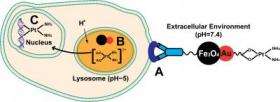
A unique, dumbbell-shaped twin nanoparticle created by Brown University chemists targets a class of breast cancer cells known as Her-2 tumor cells. Credit: Chenjie Xu, Shouheng Sun/Brown University

Breast cancer patients face many horrors, including those that arise when fighting the cancer itself. Medications given during chemotherapy can have wicked side effects, including vomiting, dizziness, anemia and hair loss. These side effects occur because medications released into the body target healthy cells as well as tumor cells.

The trick becomes how to deliver cancer-fighting drugs directly to the . Brown University chemists think they have an answer: They have created a twin nanoparticle that specifically targets the Her-2-positive tumor cell, a type of that affects up to 30 percent of breast cancer patients.

The combination nanoparticle binds to the Her-2 tumor cell and unloads the cancer-fighting drug cisplatin directly into the infected cell. The result: Greater success at killing the cancer while minimizing the anti-cancer drug's side effects.

"Like a missile, you don't want the anti-cancer drugs to explode everywhere," explained Shouheng Sun, a chemistry professor at Brown University and an author on the paper published online in The Journal of the American Chemical Society. "You want it to target the tumor cells and not the healthy ones."

The researchers created the twin nanoparticle by binding one gold (Au) nanoparticle with an iron-oxide (Fe3O4) nanoparticle. On one end, they attached a synthetic protein antibody to the iron-oxide nanoparticle. On the other end, they attached cisplatin to the gold nanoparticle. Visually, the whole contraption looks like an elongated dumbbell, but it may be better to think of it as a vehicle, equipped with a very good GPS system, that is ferrying a very important passenger.

In this case, the GPS comes from the iron-oxide nanoparticle, which homes in on a Her-2 breast-cancer cell like a guided missile. The attached antibody is critical, because it binds to the antigen, a protein located on the surface on the malignant cell. Put another way, the nanoparticle vehicle "docks" on the tumor cell when the antibody and the antigen become connected. Once docked, the vehicle unloads its "passenger," the cisplatin, into the malignant cell.

"It's like a magic bullet," said Chenjie Xu, a Brown graduate student and the lead author on the paper. Baodui Wang, a visiting scientist at Brown and now an associate professor at Lanzhou University in China, contributed to the paper.

In a neat twist, the Brown-led team used a pH-sensitive covalent bond to connect the gold nanoparticle with the cisplatin to ensure that the drug was not released into the body but remained attached to the nanoparticle until it was time for it to be released into the malignant cell.

In laboratory tests, the gold-iron oxide nanoparticle combination successfully targeted the cancer cells and released the anti-cancer drugs into the malignant cells, killing the cells in up to 80 percent of cases. "We made a Mercedes Benz now," Sun joked. "It's not a Honda Civic anymore."

The research builds on previous work in Sun's lab where researchers created peptide-coated iron-oxide nanoparticles that, in tests with mice, successfully located a brain tumor cell called U87MG.

The researchers will test the breast-cancer nanoparticle system in laboratory tests with animals. They also plan to create twin nanoparticles that can release the drug via remote-controlled magnetic heating.

Source: Brown University (news : web)


print this article email this article download pdf blog this article bookmark this article     Stumble it Digg this share on Facebook retweet share on Reddit add to delicious
Rate this story - 5 /5 (2 votes)

Rank Filter

Move the slider to adjust rank threshold, so that you can hide some of the comments.


Display comments: newest first

  • E_L_Earnhardt - Mar 11, 2009
    • Rank: not rated yet
    Good Work! The basic concept is still "killing", not "correcting" though! We are still of the old mindset of "going to war with a virus"! A "sea full of explosives" is a crude way to restore safe travel!

March 10, 2009 all stories

Comments: 1

5 /5 (2 votes)
  • Stumble this up

  • Digg this

  • share this

  • hide
  • Related Stories

  • Small molecules block cancer gene
    created Mar 10, 2009 | popularity not rated yet | comments 0
  • US struggles to pinpoint cyber attacks: Top official
    created Mar 10, 2009 | popularity not rated yet | comments 0
  • Researchers identify new way the malaria parasite and red blood cells interact
    created Mar 10, 2009 | popularity not rated yet | comments 0
  • Hewlett Packard to create 500 jobs in Ireland
    created Mar 10, 2009 | popularity not rated yet | comments 0
  • The changing roles of mothers and fathers
    created Mar 10, 2009 | popularity not rated yet | comments 0


  • hide
  • Relevant PhysicsForums posts

Other News

Findings show nanomedicine promising for treating spinal cord injuries

Findings show nanomedicine promising for treating spinal cord injuries

Nanotechnology / Bio & Medicine

created 16 hours ago | popularity 4.5 / 5 (4) | comments 0

(PhysOrg.com) -- Researchers at Purdue University have discovered a new approach for repairing damaged nerve fibers in spinal cord injuries using nano-spheres that could be injected into the blood shortly ...


New Digital 'Electronics' Concept May Continue Moore's Law

New Digital 'Electronics' Concept May Continue Moore's Law

Nanotechnology / Nanophysics

created Nov 05, 2009 | popularity 4.6 / 5 (55) | comments 9

(PhysOrg.com) -- Computers of the future could be operating not on electrons, but on tiny waves traveling through an electron "fluid," if a new proposal is successful. The new circuit design, recently introduced ...


Nanoparticles for gene therapy improve

Nanoparticles for gene therapy improve

Nanotechnology / Bio & Medicine

created Nov 06, 2009 | popularity 5 / 5 (4) | comments 3

(PhysOrg.com) -- About five years ago, Professor Janet Sawicki at the Lankenau Institute in Pennsylvania read an article about nanoparticles developed by MIT's Robert Langer for gene therapy, the insertion ...


Breakthrough in industrial-scale nanotube processing

Breakthrough in industrial-scale nanotube processing

Nanotechnology / Nanomaterials

created Nov 02, 2009 | popularity 4.9 / 5 (20) | comments 3

(PhysOrg.com) -- Rice University scientists today unveiled a method for the industrial-scale processing of pure carbon-nanotube fibers that could lead to revolutionary advances in materials science, power ...


Scientists witness nature's complexity unfold in self-assembling quasicrystals

Scientists witness nature's complexity unfold in self-assembling quasicrystals

Nanotechnology / Nanomaterials

created Oct 31, 2009 | popularity 4.9 / 5 (17) | comments 3

(PhysOrg.com) -- Just a few decades ago, scientists believed that all ordered matter consists of self-repeating building blocks -- atoms, ions or molecules. In this view, the ordinary solids of everyday life ...