Study of protein structures reveals key events in evolutionary history
March 10, 2009 Study of protein structures reveals key events in evolutionary history

Enlarge

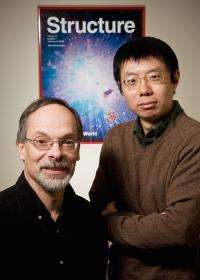
Gustavo Caetano-Anollés, a professor of bioinformatics in the department of crop sciences at Illinois, left, with postdoctoral researcher Minglei Wang, used protein structures to gain insight into evolutionary events. Photo by L. Brian Stauffer

A new study of proteins, the molecular machines that drive all life, also sheds light on the history of living organisms.

The study, in the journal Structure, reveals that after eons of , proteins suddenly experienced a "big bang" of innovation. The active regions of many proteins, called domains, combined with each other or split apart to produce a host of structures that had never been seen before. This explosion of new forms coincided with the rapidly increasing diversity of the three superkingdoms of life (; the microbes known as ; and eucarya, the group that includes animals, plants, and many other organisms).

Lead author Gustavo Caetano-Anollés, a professor of bioinformatics in the department of crop sciences at the University of Illinois and an affiliate of the Institute for Genomic Biology, has spent years studying structures - he calls them "architectures" - which he suggests offer a reliable record of evolutionary events.

All proteins contain domains that can be identified by their structural and functional similarities to one another. These domains are the gears and motors that allow the protein machinery to work. Every protein has one or more of them, and very different proteins can contain the same, or similar, domains.

By conducting a census of all the domains that appear in different groups of organisms and comparing the protein repertoires of hundreds of different groups, the researchers were able to construct a timeline of protein evolution that relates directly to the history of life.

"The history of the protein repertoire should match the history of the entire organism because the organism is made up of all those pieces," Caetano-Anollés said.

He and his co-author, postdoctoral researcher Minglei Wang, were interested in tracing how proteins make use of their domains, or groups of domains, to accomplish various tasks. These domains or clusters can be thought of as "modules" which fit together in various ways to achieve different ends.

Unlike the sequence of amino acids in a protein, which is highly susceptible to change, the protein modules found today in have endured because they perform critical tasks that are beneficial to the organisms that host them, Caetano-Anollés said.

"These modules are resistant to change, they are highly integrated and they are used in different contexts," he said.

By tracing the history of the modules, the researchers were able to build a rough timeline of protein evolution. It revealed that before the three superkingdoms began to emerge, most proteins contained only single domains that performed a lot of tasks.

"As time progressed, these domains started to combine with others and they became very specialized," Caetano-Anollés said. This eventually led to the big bang of protein architectures.

"Exactly at the time of the big bang," he said, many of the combined domains began to split apart, creating numerous single-domain modules again. But these new modules were much more efficient and specialized than their ancient predecessors had been.

"This makes a lot of sense," Caetano-Anollés said. "As you become more complex, you would want to fine-tune things, to do things in a more tailored way."

The protein modules of the three superkingdoms also began to diverge more dramatically from one another, with the eucarya (the group that includes plants and animals) hosting the greatest diversity of modules.

"This explosion of diversity allowed the eucarya to do things with their proteins that other organisms could not do," Caetano-Anollés said.

Source: University of Illinois at Urbana-Champaign (news : web)


print this article email this article download pdf blog this article bookmark this article     Stumble it Digg this share on Facebook retweet share on Reddit add to delicious
Rate this story - 4.8 /5 (12 votes)

Rank Filter

Move the slider to adjust rank threshold, so that you can hide some of the comments.


Display comments: newest first

  • E_L_Earnhardt - Mar 11, 2009
    • Rank: 1 / 5 (1)
    Highly inteligent! Marvelous work! Be very careful!
    There are those who would adopt your understanding
    to very harmful pursuits! Some understandings should remain guarded! Add secret "kill switches"
    known only to you!

March 10, 2009 all stories

Comments: 1

4.8 /5 (12 votes)
  • Stumble this up

  • Digg this

  • share this

  • hide
  • Related Stories

  • US struggles to pinpoint cyber attacks: Top official
    created Mar 10, 2009 | popularity not rated yet | comments 0
  • The changing roles of mothers and fathers
    created Mar 10, 2009 | popularity not rated yet | comments 0
  • Can mental training games help prevent Alzheimer's?
    created Mar 10, 2009 | popularity not rated yet | comments 0
  • Hewlett Packard to create 500 jobs in Ireland
    created Mar 10, 2009 | popularity not rated yet | comments 0


  • hide
  • Relevant PhysicsForums posts

  • The Modern Picture of Evolution
    created Dec 16, 2009
  • While you're dancing in the Flames... Juan Enriquez TED Video Feb 2009
    created Dec 15, 2009
  • Your opinion as to what homolgy is
    created Dec 15, 2009
  • I thought yall might think this was cool... A tool using Octopus
    created Dec 15, 2009
  • Why do we need polysaccharides?
    created Dec 14, 2009
  • Couple of questions on evolution
    created Dec 14, 2009
  • More from Physics Forums - Biology

Other News

Study shows loss of 15-42 percent of mammals in North America

Biology / Ecology

created 2 hours ago | popularity 5 / 5 (1) | comments 4

If the planet is headed for another mass extinction like the previous five, each of which wiped out more than 75 percent of all species on the planet, then North American mammals are one-fifth to one-half the way there, according ...


Christmas Tree

Scientists works to develop Christmas tree that doesn't shed needles

Biology / Biotechnology

created 1hour ago | popularity not rated yet | comments 0

After chasing the perfect Christmas tree for three decades, Gary Chastagner could be getting close.


New report underlines multiple benefits but also new challenges to biodiversity-rich sites

Biology / Ecology

created 3 hours ago | popularity 5 / 5 (1) | comments 0

An agreement in Copenhagen to fund reduced emissions from deforestation may generate multiple environmental and economic benefits if investments simultaneously target sites that are both carbon and biodiversity-rich.


Umbilical cord could be new source of plentiful stem cells, researchers say

Biology / Biotechnology

created 4 hours ago | popularity not rated yet | comments 0

Stem cells that could one day provide therapeutic options for muscle and bone disorders can be easily harvested from the tissue of the umbilical cord, just as the blood that goes through it provides precursor cells to treat ...


Invasion without a stir

Biology / Cell & Microbiology

created 4 hours ago | popularity not rated yet | comments 0

Bacteria of the genus Salmonella cause most food-borne illnesses. The bacteria attach to cells of the intestinal wall and induce their own ingestion by cells of the intestinal epithelium. Up till now, researchers assumed ...