China 'moon bear' agony persists, despite successes
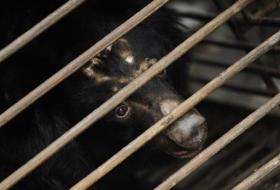
One by one, 13 sick and traumatised Asian black bears squeezed into tiny cages are pulled from a truck, a lifetime of agonising torture now over.
The bears, brought to a rescue centre in southwestern China, suffer festering wounds and associated illnesses from having their gall bladders tapped for bile that is used in some Chinese medicines.
Yet these animals are the lucky ones.
An estimated 7,000-10,000 moon bears, so-called for the pale crescent across their chests, still languish in bile farms across China.
They are victims of a brutal trade that, despite some successes by activists, persists in a country where respect for animal welfare is low and a sizable market for the bile remains.
"You look at these animals with absolute horror, wondering how they've ever survived this long," said Jill Robinson, a Briton who heads the Moon Bear Rescue Centre, carefully offering a new bear chunks of fruit on a wire hanger.
While the efficacy of bile is questionable, it remains popular in China and other Asian countries for treating fevers, liver disease and eye problems.
The methods for obtaining it have enraged animal welfare activists worldwide.
Bears are confined for life in cages barely big enough to hold them while the bile produced by their gall bladders is drained through catheters crudely inserted and kept permanently open.
The animals typically arrive at the centre with paw tips chopped off and teeth knocked out by their owners and suffer a range of problems linked to infection and prolonged confinement.
Robinson's Hong Kong-based Animals Asia Foundation (AAF) signed an agreement with Sichuan authorities in 1999 to rescue 500 bears in the province.
Animals Asia, which runs the rescue centre, pays bear owners what Robinson says is a "market rate" for the animals, though she won't reveal how much.
In turn, the farmers give up their bile-farming licenses. Under the agreement, confirmation of whether or not the farms have been shut down is left to Chinese authorities.
The 13 bears rescued last month bring the total at the centre to 260, past the half-way point of its goal -- although one had to be euthanised, a cause for celebration but also sobering reality.
"It's been a slower process than we would have hoped," Robinson admits.
Bile farming took off in the 1980s, officially encouraged as an alternative to hunting wild animals, but no laws govern it.
Bile demand and habitat loss have cut the bears to as few as 16,000 in the wild, according to the Worldwide Fund for Nature. They are now considered "vulnerable" by the International Union for Conservation of Nature.
While bile farming is legal in China, exports of the product and treatments made from it are banned under the Convention on International Trade in Endangered Species, to which China is a signatory.
Nevertheless, there is widely believed to be a large illegal export trade and pharmacies and departments stores throughout China openly sell bear bile products.
Activist campaigns have helped shut hundreds of farms in China, but the number of farmed bears is estimated by the government to have held firm.
Robinson says anecdotal evidence indicates increased captive breeding might be to blame. Chinese officials declined comment.
The government has previously stressed its promotion of what it says are less painful methods of extracting the bile, though Robinson says they are no better than the crude catheters of the past.
Grace Ge Gabriel, Asia director of the International Fund for Animal Welfare, said that even when shut down, owners often transfer their licenses, or simply operate illegally.
Her organisation has not taken any bears at its own rescue centre in southern Guangdong province for years, she said, calling it a "bottomless pit".
Instead, it is pushing for anti-cruelty legislation. China has a wildlife protection law widely viewed as inadequate, but no other animal protection laws, she said.
"That's the crux of the situation (in China). Animals are viewed only as a resource to be exploited," she said.
Yet Robinson is buoyed by what she calls a slowly growing animal welfare awareness in China, and the 10-hectare (25-acre) Sichuan centre continues to take in bears.
They shuffle around in varying states of disablement, including "Franzi," who spent about 25 years in a "crush cage," which allows owners to pin bears flat to facilitate bile extraction.
Her head is now too large for her body, a result of stunted bodily growth.
"She was a complete mess," Robinson said while hand-feeding Franzi raisins.
But the formerly anti-social Franzi has changed since the centre introduced her to Rupert, a brain-damaged bear who has become her "boyfriend" and has taught her how to play again, Robinson says.
(c) 2009 AFP


