Fermi telescope reveals best-ever view of the gamma-ray sky
March 11, 2009 Fermi telescope reveals best-ever view of the gamma-ray sky

Enlarge

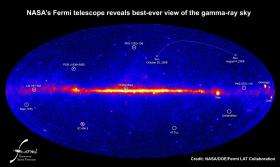
This view from NASA's Fermi Gamma-ray Space Telescope is the deepest and best-resolved portrait of the gamma-ray sky to date. The image shows how the sky appears at energies more than 150 million times greater than that of visible light. Among the signatures of bright pulsars and active galaxies is something familiar -- a faint path traced by the sun. Credit: NASA/DOE/Fermi LAT Collaboration

(PhysOrg.com) -- A new map combining nearly three months of data from NASA's Fermi Gamma-ray Space Telescope is giving astronomers an unprecedented look at the high-energy cosmos. To Fermi's eyes, the universe is ablaze with gamma rays from sources ranging from within the solar system to galaxies billions of light-years away.

"Fermi has given us a deeper and better-resolved view of the gamma-ray sky than any previous space mission," said Peter Michelson, the lead scientist for the spacecraft's Large Area Telescope (LAT) at Stanford University, Calif. "We're watching flares from in distant galaxies and seeing pulsars, high-mass binary systems, and even a globular cluster in our own."

A paper describing the 205 brightest sources the LAT sees has been submitted to The Supplement. "This is the mission's first major science product, and it's a big step toward producing our first source catalog later this year," said David Thompson, a Fermi deputy project scientist at NASA's in Greenbelt, Md.

The LAT scans the entire sky every three hours when operating in survey mode, which is occupying most of the telescope's observing time during Fermi's first year of operations. These snapshots let scientists monitor rapidly changing sources.

The all-sky image released today shows us how the cosmos would look if our eyes could detect radiation 150 million times more energetic than visible light. The view merges LAT observations spanning 87 days, from August 4 to October 30, 2008.

The map includes one object familiar to everyone: the sun. "Because the sun appears to move against the background sky, it produces a faint arc across the upper right of the map," Michelson explained. During the next few years, as solar activity increases, scientists expect the sun to produce growing numbers of high-energy flares. "No other instrument will be able to observe in the LAT's energy range," he said.

To better show individual sources, the new map was processed to suppress emissions from gas in the plane of our galaxy, the Milky Way. As a way of underscoring the variety of the objects the LAT is seeing, the Fermi team created a "top ten" list comprising five sources within the Milky Way and five beyond our galaxy.

The top sources within our galaxy include the sun; a star system known as LSI +61 303, which pairs a massive normal star with a superdense neutron star; PSR J1836+5925, which is one of many new pulsars, a type of spinning neutron star that emits gamma-ray beams; and the globular cluster 47 Tucanae, a sphere of ancient stars 15,000 light-years away.

Top extragalactic sources include NGC 1275, a galaxy that lies 225 million light-years away and is known for intense radio emissions; the dramatically flaring active galaxies 3C 454.3 and PKS 1502+106, both more than 6 billion light-years away; and PKS 0727-115, which is thought to be a type of active galaxy called a quasar.

The Fermi top ten also includes two sources -- one within the Milky Way plane and one beyond it -- that researchers have yet to identify. More than 30 of the brightest gamma-ray sources have no obvious counterparts at other wavelengths. "That's good news. It means we're seeing new objects," Michelson said. "It also means that we have lots of work to do."

Provided by NASA's Goddard Space Flight Center (news : web)


print this article email this article download pdf blog this article bookmark this article     Stumble it Digg this share on Facebook retweet share on Reddit add to delicious
Rate this story - 4.7 /5 (15 votes)


March 11, 2009 all stories

Comments: 0

4.7 /5 (15 votes)
  • Stumble this up

  • Digg this

  • share this

  • hide
  • Related Stories

  • US struggles to pinpoint cyber attacks: Top official
    created Mar 10, 2009 | popularity not rated yet | comments 0
  • A 3-D view of remote galaxies
    created Mar 10, 2009 | popularity not rated yet | comments 0
  • Review: Bookmark for public radio saves your place
    created Mar 11, 2009 | popularity not rated yet | comments 0
  • Report: Images from Mars lander show liquid water
    created Mar 11, 2009 | popularity not rated yet | comments 0
  • Software testing market resilient despite crisis: report
    created Mar 11, 2009 | popularity not rated yet | comments 0


  • hide
  • Relevant PhysicsForums posts

  • The shape of our solar system's orbits.
    created Nov 07, 2009
  • Above or Below the Line of Nodes
    created Nov 07, 2009
  • Supernova vs. Nova?
    created Nov 07, 2009
  • Supernova's Gamma Rays and Comets
    created Nov 06, 2009
  • More from Physics Forums - General Astronomy

Other News

Deep creep means milder, more frequent earthquakes along Southern California's San Jacinto fault

Deep creep means milder, more frequent earthquakes along Southern California's San Jacinto fault

Space & Earth / Earth Sciences

created 16 hours ago | popularity 4.5 / 5 (4) | comments 0

With an average of four mini-earthquakes per day, Southern California's San Jacinto fault constantly adjusts to make it a less likely candidate for a major earthquake than its quiet neighbor to the east, the ...


Success in 'space elevator' competition (AP)

Success in 'space elevator' competition (Update 3)

Space & Earth / Space Exploration

created Nov 05, 2009 | popularity 4.3 / 5 (33) | comments 50

(AP) -- A robot powered by a ground-based laser beam climbed a long cable dangling from a helicopter on Wednesday to qualify for prize money in a $2 million competition to test the potential reality of the ...


In a Galaxy Far, Far Away...

In a Galaxy Far, Far Away...

Space & Earth / Astronomy

created Nov 06, 2009 | popularity 4.8 / 5 (5) | comments 17

(PhysOrg.com) -- Astronomers have published the discovery of the farthest known object in the cosmos: a star that exploded when the universe was only 630 million years old -- only 4.6% of its current age. ...


'Dropouts' pinpoint earliest galaxies

'Dropouts' pinpoint earliest galaxies

Space & Earth / Astronomy

created Nov 06, 2009 | popularity 4.2 / 5 (10) | comments 13

Astronomers, conducting the broadest survey to date of galaxies from about 800 million years after the Big Bang, have found 22 early galaxies and confirmed the age of one by its characteristic hydrogen signature ...


Space hotel taking bookings for 2012 opening

Space hotel taking bookings for 2012 opening

Space & Earth / Space Exploration

created Nov 05, 2009 | popularity 4.4 / 5 (21) | comments 11

(PhysOrg.com) -- The first orbiting space hotel is on track to open for its first customers in 2012, but hurry, as bookings are filling fast.