NASA fuels Discovery for flight to space station
March 11, 2009 By MARCIA DUNN , AP Aerospace Writer
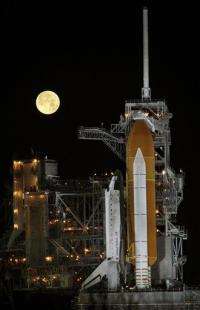
A full moon begins to set as the space shuttle Discovery sits on Kennedy Space Center's Launch Pad 39-A before sunrise Wednesday morning March 11, 2009 in Cape Canaveral, Fla. Discovery and her crew of seven astronauts is making final preparations for this evening's planned liftoff on a 14-day mission to the international space station. (AP Photo/Chris O'Meara)
(AP) -- NASA fueled space shuttle Discovery for a night flight to the international space station Wednesday, following a month's delay to make sure the ship's valves are just right.
Forecasters expected ideal weather and a rising full moon for the 9:20 p.m. launch.
At midday, the launch team began filling Discovery's giant tank with more than 500,000 gallons of fuel and the seven astronauts assigned to the flight underwent final medical checks.
Discovery is a month late in its mission to deliver a final set of solar wings to the space station. Liftoff originally was targeted for mid-February, but concern about the shuttle's hydrogen gas valves resulted in four delays.
Shuttle managers said they're convinced after extensive testing that the three valves aboard Discovery are safe and won't break like one did during the last shuttle launch in November. The valves are part of the main propulsion system.
The cargo on Discovery includes 31,000 pounds of framework that holds two folded-up solar wings and a radiator. The space station already has six electricity-producing wings; the two going up will be the last ones and elevate the orbiting outpost to full power.
Even though they're the last to fly, these solar wings are the oldest. They were used for testing and have been at Kennedy Space Center since 2002. As a result, engineers consider them "an old friend," said payload manager Robert Ashley.
"We're excited about the impending launch, but at the same time there will be a little sadness as this will mark the end of an era for the space station program," Ashley said.
This $300 million segment, in fact, is the last major American-made piece of the space station to be launched.
Once the astronauts install the framework and the 115-foot-long wings are unfurled, the space station will be more than 80 percent complete. Construction is scheduled to wrap up next year, coinciding with the retirement of NASA's space shuttles. A new rocketship is in the works, though, to ferry astronauts to the space station and eventually fly crews to the moon.
Two one-time schoolteachers are on Discovery's crew and will take part in the mission's four spacewalks. Joseph Acaba and Richard Arnold II were chosen as educator astronauts in 2004, following in the footsteps of Barbara Morgan, who rocketed into orbit in 2007. Morgan was the backup for Christa McAuliffe, who died aboard Challenger in 1986.
A Japanese astronaut, Koichi Wakata, also is going up on Discovery. He will become the first person from his country to live on the international space station, an achievement that has drawn more than 200 Japanese to NASA's launching site.
---
On the Net:
NASA: http://spaceflight.nasa.gov
©2009 The Associated Press. All rights reserved. This material may not be published, broadcast, rewritten or redistributed.
-
AT&T to put 8,000 natural-gas vehicles on road
Mar 11, 2009 |
not rated yet |
0
-
ISS Expedition 18 Crew Completes Spacewalk
Mar 10, 2009 |
not rated yet |
0
-
Report: Images from Mars lander show liquid water
Mar 11, 2009 |
not rated yet |
0
-
Hewlett Packard to create 500 jobs in Ireland
Mar 10, 2009 |
not rated yet |
0
-
US struggles to pinpoint cyber attacks: Top official
Mar 10, 2009 |
not rated yet |
0
-
Engineers build first sub-10-nm carbon nanotube transistor
Feb 01, 2012 |
4.9 / 5 (33) |
30
-
Something old, something new: Evolution and the structural divergence of duplicate genes
Jan 31, 2012 |
4.6 / 5 (7) |
1
-
The hidden nanoworld of ice crystals: Revealing the dynamic behavior of quasi-liquid layers
Jan 30, 2012 |
5 / 5 (4) |
1
-
Stock market network reveals investor clustering
Jan 27, 2012 |
3.9 / 5 (23) |
8
-
Of microchemistry and molecules: Electronic microfluidic device synthesizes biocompatible probes
Jan 26, 2012 |
5 / 5 (2) |
0
-
Never ending outer space.....
22 hours ago
-
Neutron Star fragments?
Feb 11, 2012
-
stationary or not?
Feb 11, 2012
-
Scale of the Universe
Feb 10, 2012
-
Titan's lack of impact craters
Feb 09, 2012
-
Real pictures of black hole eating a star?
Feb 08, 2012
- More from Physics Forums - General Astronomy
More news stories
Salvage workers begin pumping fuel from Italian shipwreck
Salvage workers Sunday began pumping fuel from the shipwrecked Italian cruise liner Costa Concordia, a day ahead of schedule, officials said.
7 hours ago |
5 / 5 (1) |
0
Latin America mining boom clashes with conservation
Latin America is experiencing a mining boom as prices rise fuelled by a hike in global demand, but the region is also being hit by a wave of violent protests, strikes and rallies by environmentalists.
15 hours ago |
5 / 5 (1) |
1
Political leaders play key role in how worried Americans are by climate change: study
More than extreme weather events and the work of scientists, it is national political leaders who influence how much Americans worry about the threat of climate change, new research finds.
Feb 06, 2012 |
5 / 5 (7) |
73
NASA budget will axe Mars deal with Europe: scientists
US President Barack Obama's budget proposal to be submitted next week for 2013 will cut NASA's budget by 20 percent and eliminate a major partnership with Europe on Mars exploration, scientists said Thursday.
Space & Earth / Space Exploration
Feb 10, 2012 |
5 / 5 (3) |
58
Humans may have helped the decline of African rainforests 3000 years ago
(PhysOrg.com) -- Large areas of rainforests in Central Africa mysteriously disappeared over three thousand years ago, to be replaced by savannas. The prevailing theory has been that the cause was a change ...
Scientists discover molecular secrets of 2,000-year-old Chinese herbal remedy
For roughly two thousand years, Chinese herbalists have treated Malaria using a root extract, commonly known as Chang Shan, from a type of hydrangea that grows in Tibet and Nepal. More recent studies suggest that halofuginone, ...
New method to examine batteries -- MRI from the inside
There is an ever-increasing need for advanced batteries for portable electronics, such as phones, cameras, and music players, but also to power electric vehicles and to facilitate the distribution and storage of energy derived ...
A mitosis mystery solved: How chromosomes align perfectly in a dividing cell
Although the process of mitotic cell division has been studied intensely for more than 50 years, Whitehead Institute researchers have only now solved the mystery of how cells correctly align their chromosomes during symmetric ...
Google might launch Drive for cloud storage soon
(PhysOrg.com) -- Google's next big move, according to the Wall Street Journal, is a cloud storage service called Drive. Hardly first to the plate, Google is simply catching up to introducing its cloud reposi ...
Lab study raises questions over nano-particle impact
Tests involving chickens have raised questions about the impact on health from engineered nano-particles, the ultra-fine grains commonly used in drugs and processed foods, scientists said on Sunday.
Overeating may double risk of memory loss
New research suggests that consuming between 2,100 and 6,000 calories per day may double the risk of memory loss, or mild cognitive impairment (MCI), among people age 70 and older. The study was released today and will be ...