Discovery liftoff postponed due to gas leak: NASA (Update)
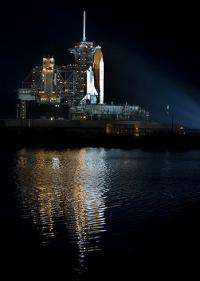
March 11, 2009 The US Space Shuttle Discovery

Enlarge

The US Space Shuttle Discovery sits on the launch pad March 11, 2009 at Kennedy Space Center in Florida. Discovery was postponed Wednesday just hours before liftoff after NASA engineers found a gas leak in the filling system for its external tank.

The launch of the US space shuttle Discovery was postponed Wednesday just hours before liftoff after NASA engineers found a gas leak in the filling system for its external tank.

NASA spokesman Allard Beutel said the shuttle's mission towards the International Space Station, with a Japanese astronaut among its seven crew, was delayed for at least 24 hours after the leak of highly flammable hydrogen gas was discovered.

"The launch was scrubbed at 02:37 pm (1837 GMT) for at least 24 hours ... so we won't launch tonight," Beutel said.

It was yet another frustrating delay for the Discovery and its crew which have already seen the launch put back four times from its original date of February 12.

NASA engineers discovered the leak soon after they began filling the Discovery's external tank at noon (1600 GMT), and the hitch came just hours before the planned 9:20 pm (0120 Thursday GMT) launch at the Kennedy Space Center in Cape Canaveral, Florida.

The leak was found to be coming from a valve regulating the hydrogen pressure which is located inside the tank towards the top, Bill Johnson, communications director, told AFP.

NASA officials were to meet around 5:00 pm (2100 GMT) Wednesday to decide on their next move.

The external tank, which was three quarters full with some two million liters of fuel (528,000 gallons), mostly composed of liquid hydrogen kept at minus 252 degrees Celsius and liquid oxygen, will be emptied again.

The shuttle's crew had arrived at the Kennedy Space Center late Sunday to prepare for their 14-day mission to deliver and install a fourth pair of solar panels to the International Space Station.

The panels are to supply power for onboard laboratories and more power for the station's crew, which will double from three to six in May.

Installing the panels, the final piece of a 100-billion-dollar project, is to take a two-astronaut team four space walks of more than six hours each to complete, NASA said.

The pairs of solar panels, containing 32,800 solar cells, are each 35 meters long once in place. And the final array, once in place, should boost power available to the ISS to 120 kilowatts from the current 90.

The launch has now been delayed five times, mainly due to problems with control valves, which channel hydrogen from the shuttle's three main engines.

Discovery has to be launched by March 16 in order not to hamper the launch of a Russian Soyuz mission to the ISS due to liftoff on March 26, carrying American businessman Charles Simonyi.

The Soyuz is due to arrive on March 28 at the orbiting space station, meaning Discovery must have already left as both craft cannot dock at the ISS at the same time.

NASA officials have said they would be prepared to shorten Discovery's mission and drop two of the four planned space walks if they are forced to launch much later than planned.

Discovery's astronauts include Koichi Wakata of the Japan Aerospace Exploration Agency, who is to become the first Japanese station crew member.

After Discovery finally docks at the ISS, Wakata is to stay aboard the station, while US astronaut Sandy Magnus -- who arrived at the ISS aboard the shuttle Endeavour in November 2008 -- will return home.

(c) 2009 AFP


print this article email this article download pdf blog this article bookmark this article     Stumble it Digg this share on Facebook retweet share on Reddit add to delicious
Rate this story - 4 /5 (1 vote)


March 11, 2009 all stories

Comments: 0

4 /5 (1 vote)
  • Stumble this up

  • Digg this

  • share this

  • hide
  • Related Stories

  • AT&T to put 8,000 natural-gas vehicles on road
    created Mar 11, 2009 | popularity not rated yet | comments 0
  • NASA fuels Discovery for flight to space station
    created Mar 11, 2009 | popularity not rated yet | comments 0
  • NASA still plans May shuttle launch
    created Mar 01, 2006 | popularity not rated yet | comments 0
  • NASA: Discovery launch on schedule
    created Apr 25, 2006 | popularity not rated yet | comments 0
  • NASA: progress studying shuttle tank foam
    created Oct 17, 2005 | popularity not rated yet | comments 0


  • hide
  • Relevant PhysicsForums posts

  • The shape of our solar system's orbits.
    created Nov 07, 2009
  • Above or Below the Line of Nodes
    created Nov 07, 2009
  • Supernova vs. Nova?
    created Nov 07, 2009
  • Supernova's Gamma Rays and Comets
    created Nov 06, 2009
  • More from Physics Forums - General Astronomy

Other News

Planetary Society plans new 'solar sail'

Space & Earth / Space Exploration

created 6 hours ago | popularity 4.5 / 5 (2) | comments 0

(AP) -- Four years after its first solar sail ended up in the ocean instead of orbit, The Planetary Society announced Monday that by the end of 2010 it will try again to launch a spacecraft that will be propelled by the ...


Antarctica glacier retreat creates new carbon dioxide store

Antarctica glacier retreat creates new carbon dioxide store

Space & Earth / Earth Sciences

created 16 hours ago | popularity 3.8 / 5 (5) | comments 0

Large blooms of tiny marine plants called phytoplankton are flourishing in areas of open water left exposed by the recent and rapid melting of ice shelves and glaciers around the Antarctic Peninsula. This ...


L-R: Chiwetel Ejiofor, Amanda Peet and John Cusack at the premiere of "2012"

NASA on crusade to debunk 2012 apocalypse myths

Space & Earth / Space Exploration

created 12 hours ago | popularity 4 / 5 (1) | comments 1

The world is not coming to an end on December 21, 2012, the US space agency insisted Monday in a rare campaign to dispel widespread rumors fueled by the Internet and a new Hollywood movie.


Australian scientists call for urgent 'global cooling' to save coral reefs

Space & Earth / Environment

created 7 hours ago | popularity 3 / 5 (2) | comments 0

(PhysOrg.com) -- Australian marine scientists have issued an urgent call for massive and rapid worldwide cuts in carbon emissions, deep enough to prevent atmospheric CO2 levels rising to 450 parts per million (ppm).


NASA satellites make a movie and get rainfall, wind info on Ida

NASA satellites make a movie and get rainfall, wind info on Ida (w/ Video)

Space & Earth / Earth Sciences

created 12 hours ago | popularity not rated yet | comments 0

NASA satellites are amazing examples of technology. The TRMM satellite peers into tropical cyclones and can tell how much rain is falling per hour and where. QuikScat uses microwave technology to measure Ida's ...