GOCE gravity satellite moves to launch pad
March 11, 2009 GOCE gravity satellite moves to launch pad

Enlarge

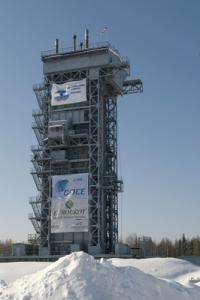
The tower supporting the launcher that will carry GOCE into orbit on Monday 16 March 2009. The picture, taken on 11 March, shows the wintery conditions at the launch site. Credits: ESA - S. Corvaja, 2009

(PhysOrg.com) -- With liftoff just five days away, ESA's GOCE spacecraft - encased in the protective half-shells of the launcher fairing - has been transported from the cleanroom and installed in the launch tower at the Plesetsk Cosmodrome in northern Russia.

The so-called Upper Composite, which comprises the and steady-state Ocean Explorer () joined to the Breeze-KM of the Rockot launcher and sealed within the fairing, was protected by a thermal cover and transported by rail from the cleanroom to the pad 5 km away. The weather conditions in Plesetsk are very cold at the moment - the ground covered in snow and temperatures well below freezing. However, these conditions do not hamper operations.

The next step was to hoist the Upper Composite to the seventh floor of the service tower where it has been joined to the rest of the Rockot launcher. Operations will continue over the coming days in readiness for on Monday 16 March at 15:21 CET (14:21 GMT, 17:21 local time).

GOCE has been undergoing preparations for launch since it was taken out of storage around three weeks ago. These launch campaign activities included a series of mechanical and electrical tests, mating to the and finally encapsulation in the launcher fairing.

GOCE is ESA's first Earth Explorer mission and will map global variations in the with extreme detail and accuracy. This will result in a unique model of the geoid, which is the surface of equal defined by the gravity field.

This model of the gravity field is crucial for deriving accurate measurements of ocean circulation and sea-level change, both of which are affected by climate change. GOCE-derived data are also much needed to understand more about processes occurring inside Earth and for use in practical applications such as surveying and levelling.

Provided by ESA


print this article email this article download pdf blog this article bookmark this article     Stumble it Digg this share on Facebook retweet share on Reddit add to delicious
Rate this story - 5 /5 (3 votes)


March 11, 2009 all stories

Comments: 0

5 /5 (3 votes)
  • Stumble this up

  • Digg this

  • share this

  • hide
  • Related Stories

  • Last-ever look at ESA's gravity satellite GOCE
    created Sep 04, 2008 | popularity not rated yet | comments 0
  • GOCE prepares for shipment to Russia
    created Jul 24, 2008 | popularity not rated yet | comments 0
  • September launch for ESA's gravity mission GOCE
    created May 27, 2008 | popularity not rated yet | comments 0
  • Launch of GOCE Satellite delayed
    created Sep 08, 2008 | popularity not rated yet | comments 0
  • GOCE team gearing up for new launch date
    created Oct 02, 2008 | popularity not rated yet | comments 0


  • hide
  • Relevant PhysicsForums posts

  • The shape of our solar system's orbits.
    created Nov 07, 2009
  • Above or Below the Line of Nodes
    created Nov 07, 2009
  • Supernova vs. Nova?
    created Nov 07, 2009
  • Supernova's Gamma Rays and Comets
    created Nov 06, 2009
  • More from Physics Forums - General Astronomy

Other News

NASA satellites make a movie and get rainfall, wind info on Ida

NASA satellites make a movie and get rainfall, wind info on Ida (w/ Video)

Space & Earth / Earth Sciences

created 54 minutes ago | popularity not rated yet | comments 0

NASA satellites are amazing examples of technology. The TRMM satellite peers into tropical cyclones and can tell how much rain is falling per hour and where. QuikScat uses microwave technology to measure Ida's ...


L-R: Chiwetel Ejiofor, Amanda Peet and John Cusack at the premiere of "2012"

NASA on crusade to debunk 2012 apocalypse myths

Space & Earth / Space Exploration

created 43 minutes ago | popularity not rated yet | comments 0

The world is not coming to an end on December 21, 2012, the US space agency insisted Monday in a rare campaign to dispel widespread rumors fueled by the Internet and a new Hollywood movie.


NASA's GOES Project offers real-time hurricane alley movies

NASA's GOES Project offers real-time hurricane alley movies

Space & Earth / Earth Sciences

created 34 minutes ago | popularity not rated yet | comments 0

People love to get the big picture of hurricane alleys, and thanks to the GOES Project at NASA's Goddard Space Flight Center in Greenbelt, Md., they can now get real-time satellite animations of the eastern ...


Antarctica glacier retreat creates new carbon dioxide store

Antarctica glacier retreat creates new carbon dioxide store

Space & Earth / Earth Sciences

created 5 hours ago | popularity 5 / 5 (2) | comments 0

Large blooms of tiny marine plants called phytoplankton are flourishing in areas of open water left exposed by the recent and rapid melting of ice shelves and glaciers around the Antarctic Peninsula. This ...


NASA's TRMM Satellite sees most of Ida's heaviest rain stayed off coasts

NASA's TRMM Satellite sees most of Ida's heaviest rain stayed off coasts

Space & Earth / Earth Sciences

created 1hour ago | popularity not rated yet | comments 0

NASA and the Japanese Space Agency's Tropical Rainfall Measuring Mission (TRMM) satellite flew over Ida and captured her rainfall when she passed by Nicaragua, Honduras and Belize this weekend. TRMM data revealed ...