Deep-sea fish stocks threatened
(PhysOrg.com) -- Commercial fishing in the north-east Atlantic could be harming deep-sea fish populations a kilometre below the deepest reach of fishing trawlers, according to a 25-year study published on Wednesday.
Scientists have long known that commercial fishing affects deep-water fish numbers, but its effects appear to be felt twice as deep as previously thought.
Dr David Bailey of the University of Glasgow, who led the study - published in the journal Proceedings of the Royal Society B - said:
"Commercial fishing may have wider effects than anyone previously thought, affecting fish which we assumed were safely beyond the range of fishing boats. We were extremely surprised by this result and believe that it has important implications for how we manage the oceans."
Populations of north-east Atlantic commercial deep-water fish such as black scabbardfish, orange roughy and roundnose grenadier have dwindled since deep-water fishing started in the area in the late 1980s, but it wasn't until 2003 that catch quotas were recommended.
Researchers started mapping the distribution of deep-water fish on the slopes off the west coast of Ireland in 1977 in an effort to understand more about the fish that live there and their biology. They used Natural Environment Research Council-owned ships RRS Discovery and RRS Challenger to continue recording species over an 11-year period until 1989 - before any fishery was established in the region. They then mapped the slopes again from 1997 until 2002 using the same ships and the same fishing methods to get a consistent data set.
As part of a European Union-led project to study species in deep-sea environments - HERMES, the researchers then compared the abundance of fish in the two different periods.
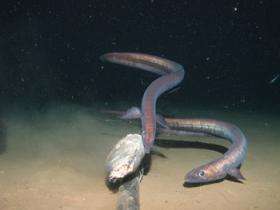
They unexpectedly found that deep-sea fish numbers down to 2500 metres - a kilometre below the deepest reach of fishing trawlers - were lower in the later 1997 to 2002 period. Not only this, but target species and non-target species were both affected and in much deeper parts of the ocean. Numbers of one species of eel has dropped by half. Most deep-water trawlers harvest down to 1600 metres.
"This study is unique in that we have over 10 years of scientific data from before 1990 when the commercial fishery took off so we can accurately detect the decline," said Professor Monty Priede of the University of Aberdeen's Oceanlab.
"The deep-seas fishery targets relatively few species, such as roundnose grenadier and orange roughy and unwanted species are discarded. These can make up around 50 per cent of the catch and because of the extreme change in pressure and temperature when they're brought to the surface, none of these will survive. This explains why the study has shown a decrease in abundance of target and non-target species.
"Each deep-water species has a defined depth range and very often the juveniles live at depths shallower than the adults. Removal of fish by commercial trawling down to 1600 metres is likely to affect populations in deeper waters," said Dr John Gordon of the Scottish Association for Marine Science and a member of the study team.
Fishery managers must now take into account adverse ecosystem effects, not just the abundance of the fish stocks being targeted and trawling may need to be restricted more than it is now.
There are plans for Marine Protected Areas in the north-east Atlantic, which are being considered by the OSPAR Convention. But this might not be enough.
"Marine Protected Areas need to be much bigger than the existing coral-protecting MPAs. They are not very effective for mobile fish species unless the fishing effort itself is reduced," said Professor Priede.
"MPAs might not be as effective as we'd hoped since we can detect the depletion of fish up to over 50 miles outside the fishing zone," added Dr Bailey.
"The general consensus is that deep-water fisheries are unsustainable and most if not all should be closed," said Dr Gordon.
The study, funded by the Natural Environment Research Council, European Commission and the Marine Conservation Biology Institute, involved researchers from the University of Glasgow, the British Antarctic Survey, the Scottish Association for Marine Science, Highland Statistics and the University of Aberdeen's Oceanlab.
Provided by University of Aberdeen


