Dracula minnow has teeth, almost
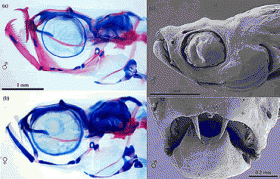
A new species of tiny fish with jaw structures that look like huge teeth has been identified, Natural History Museum scientists report in the Proceedings of the Royal Society journal today.
Named Danionella dracula, this new minnow is part of the group called Cypriniformes (carp-like fishes), one of the largest orders of fishes and a close relative of the zebrafish. It has evolved many unique and unusual characteristics. Its most obvious, and surprising, are its huge ‘teeth’.
None of the 3700 species in the Cypriniform group has any teeth in their jaws. In fact, they lost their jaw teeth about 50 million years ago in the Upper Eocene period. Danionella dracula, however, evolved its own tooth-like structures.
‘This fish is one of the most extraordinary vertebrates discovered in the last few decades,’ says Dr Ralf Britz, Museum fish expert (ichthyologist).
‘The males have something that, on first inspection, looks like a series of large impressive teeth. We therefore named the species Danionella dracula.’
This unusual species is 17mm long with a transparent body. Dr Britz discovered it during one of his collecting trips. It lives in a stream in northern Myanmar.
Not normal teeth
The ‘teeth’ of D. dracula aren’t the same as normal teeth.
Britz explains, ‘The males have spectacular jaw modifications that resemble true teeth and protrude through the skin. They represent, however, processes grown from the jaw bones rather than re-evolved jaw teeth.'
More surprises
The adult D. dracula has a larval-like skeleton and over 40 bones missing compared to the zebrafish.
It is also sexually dimorphic, meaning the males differ from the females.
‘In addition to the tooth-like processes which are almost absent in females,’ Dr Britz explains, ‘males have much larger pelvic fins and their anus and genital opening are shifted forward between these fins.’
Studying the specimens
Dr Britz worked with Museum colleague, Dr Lukas Rüber, and Kevin Conway from Saint Louis University, USA, to study D. dracula and make this remarkable fish scientifically known.
Staining the skeleton
To study the anatomy, Dr Britz cleared and stained the fish specimens. The tissue was digested with an enzyme and bone and cartilage were stained red and blue, respectively. This resulted in nicely coloured, completely transparent specimens.
DNA study
The team also performed a DNA study to determine how much time D. dracula had to evolve its unusual tooth-like structures and concluded that it had 30 million years to gain its spectacular jaws.
Miniature species
The D. dracula species is miniature. Miniaturisation is an evolutionary process that leads to dwarfed sexually mature organisms.
A famous miniature fish is the Paedocypris progenetica species, which was announced as the world’s smallest vertebrate in January 2006.
There is more than one way to become miniature and the team discovered how this happened in D. dracula. It was due to a process called developmental truncation.
Developmental truncation
Developmental truncation is an evolutionary process by which the last stages of the development of an ancestor have been cut off in the descendant.
In the case of D. dracula this means that its anatomy resembles that of a 7mm larva of the zebrafish, but, unlike the larva, it is sexually mature.
Over time, these changes in developmental events can have a major effect and lead to the evolution of new body characteristics and new species.
Developmental truncation thus results in an adult that with the exception of its mature gonads looks like an early developmental stage or larval form.
Dr Britz concludes, ‘Danionella dracula represents a remarkable example of the evolution of morphological novelties through changes in developmental timing.’
As well as revealing more about how diversity evolves this research may help us to understand how lost structures re-evolve.
More information: www.nhm.ac.uk
Source: The Natural History Museum


